Australia's economic complexity ranks lower than Uganda and Armenia, and that's a problem
Nations that score higher on economic complexity typically prove more resilient to shocks. Improving Australia's woeful global ranking is a top priority for the Centre for Policy Development.



Australia has lagged behind its global peers on measures of economic complexity for years. Centre for Policy Development (CPD) chief executive Andrew Hudson wants to see the issue front and centre of the political debate in the upcoming election campaign, in a bid to protect and improve the economy for current and future generations.
Economic complexity is a way of measuring and ranking diversity of economic activity in different countries. It has real world outcomes — nations that score higher on this measure typically proving more resilient to shocks. This ability to withstand economic headwinds is becoming more critical, with central bank officials warning the world is in a new era of challenges ranging from climate change to cybersecurity.
Yet on the latest available data, Australia ranks 93rd out of 133 countries on complexity.
“It’s one of the more shocking statistics,” Hudson tells Capital Brief.
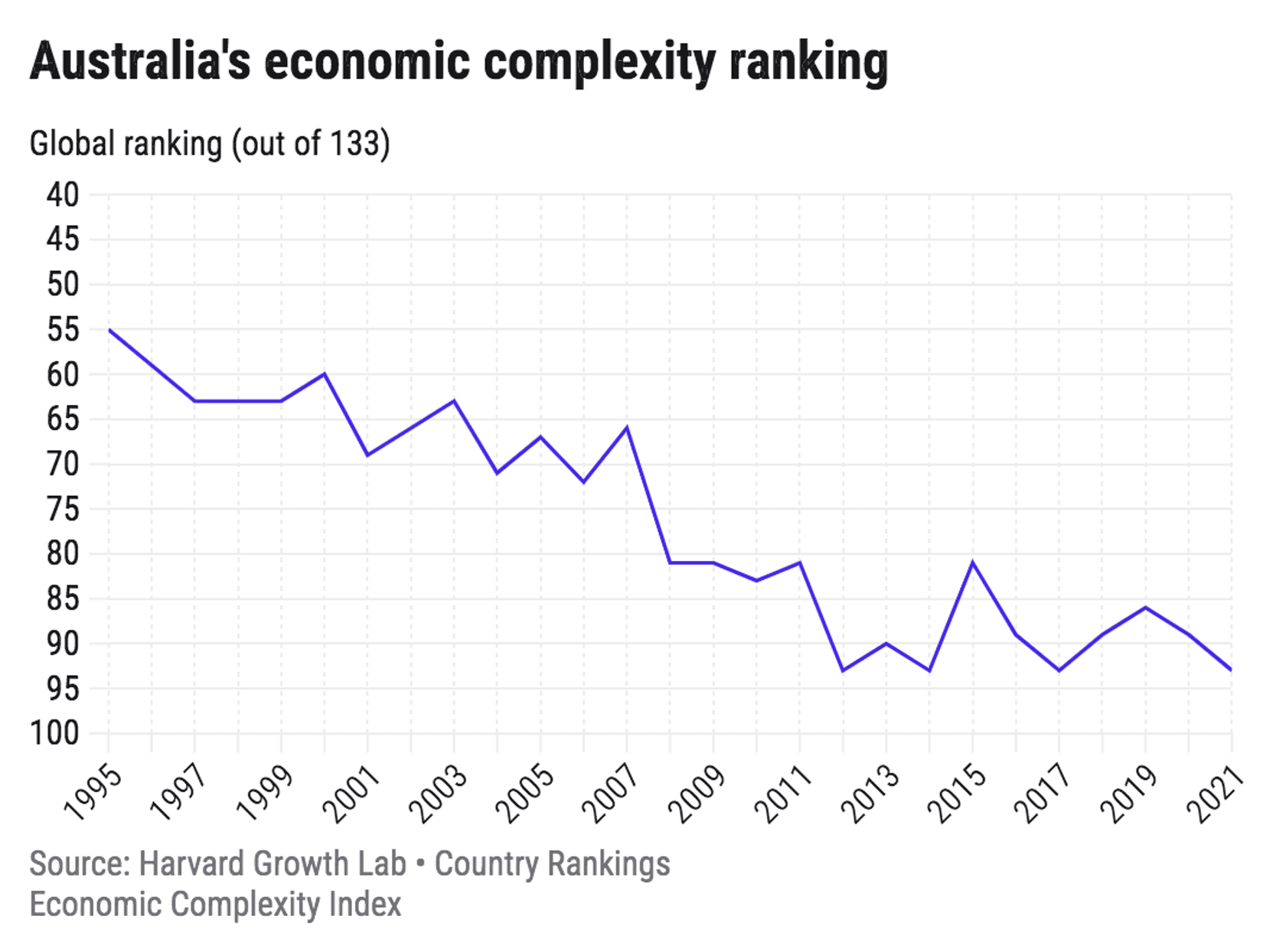
Policymakers are well aware of the trend. Economic complexity is one of the measures included in the Australian Bureau of Statistics’ Measuring What Matters dashboard, an initiative introduced by the Albanese government and supported by Hudson's think tank. It cites the latest Harvard Growth Lab data from 2021, which shows Australia is just ahead of Pakistan, Namibia and Algeria for complexity but is surpassed by Uganda, Armenia and Honduras.