Canada deputy PM resigns amid Trump rift
Plus: Softbank pledges $157b investment in US tech at Trump’s Mar-a-Lago; Labor’s MYEFO to unveil “unavoidable” extra spending; Honeywell considers aerospace unit split.


Good morning. Here's what happened overnight and what you need to know today.

1.
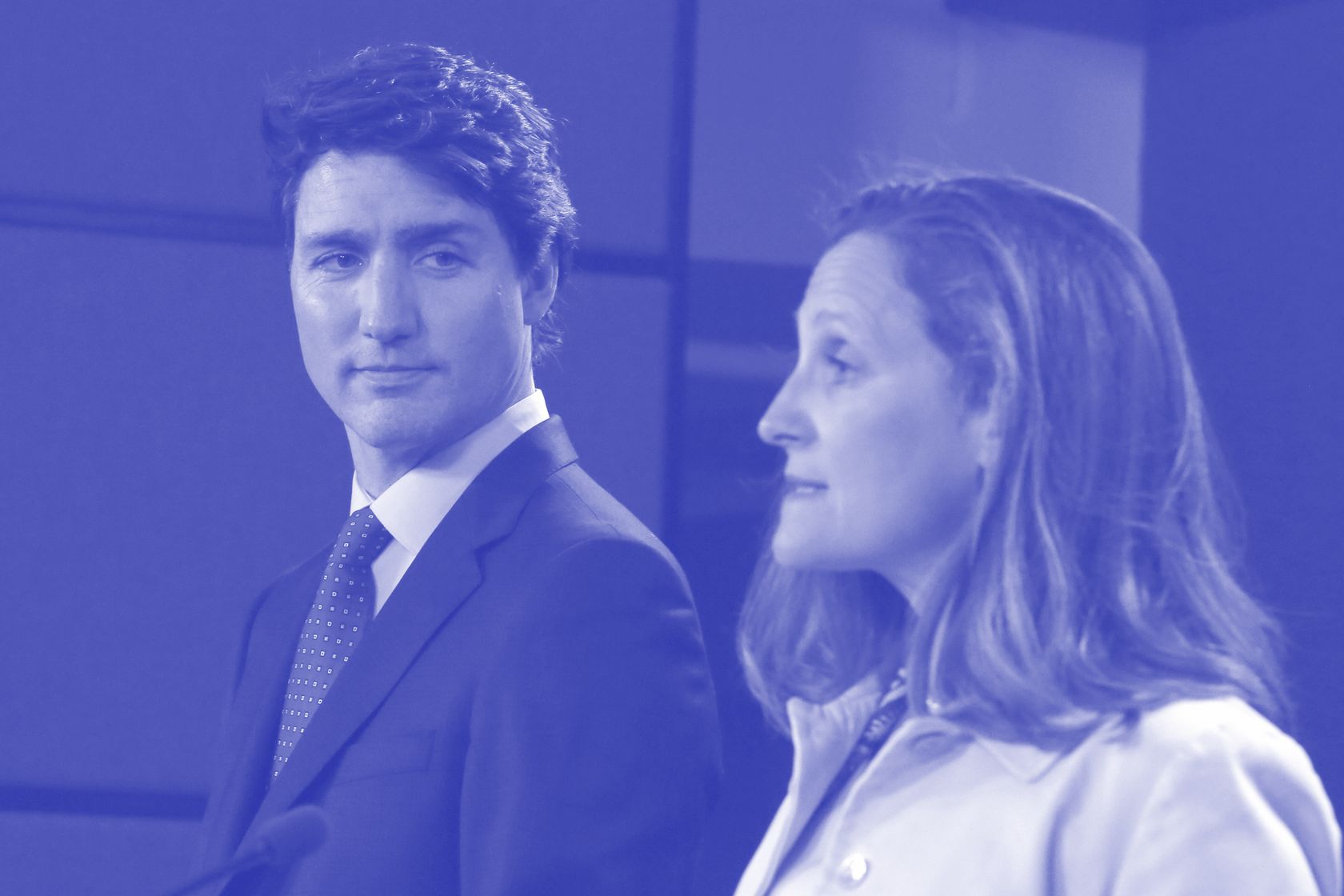
Trump ripples: Canada’s Finance Minister and Deputy Prime Minister Chrystia Freeland abruptly resigned Monday (early Tuesday morning AEDT) after clashing with Prime Minister Justin Trudeau over economic policy and US President-elect Donald Trump’s 25% tariff threat. It leaves Trudeau without one of his closest allies ahead of an election next year. In a resignation letter posted on social media hours before she was due to deliver a fiscal update likely showing a larger deficit, Freeland revealed Trudeau asked her on Friday to step aside as finance minister, offering her another cabinet role. “I have concluded that the only honest and viable path is for me to resign,” she wrote. Freeland called Trump’s aggressive economic nationalism “a grave challenge” and issued a thinly veiled criticism of Trudeau’s recent spending plans, including a sales-tax holiday and C$250 ($276) cheques, as “costly political gimmicks” Canada cannot afford. (Capital Brief)(Freeland's post)(Reuters)(Bloomberg)
2.
Softbank redux: SoftBank CEO Masayoshi Son announced a USD100 billion ($156.89 billion) investment in the US over the next four years at an event at President-elect Donald Trump’s Mar-a-Lago estate. The plan aims to create 100,000 jobs and will focus on investments in artificial intelligence, data centres and chip manufacturing. Trump called the pledge a "monumental demonstration of confidence in America’s future," while Son said his confidence in the US economy had “tremendously increased” following Trump’s election. At the announcement Trump asked Son to consider doubling the investment to USD200 billion, to which Son said laughing he would “try to make it happen.” SoftBank has roughly USD30 billion of cash on hand, the WSJ noted, and it is unclear how it intends to fund the commitment. It could come from its Vision Fund or its chip design company, Arm Holdings. The pledge is Son’s second after a USD50 billion commitment in 2016. (Capital Brief)(CNBC)(WSJ)(FT)(The Hill)
3.
Budget update: The Albanese government’s Mid-Year Economic and Fiscal Outlook (MYEFO) will unveil $14.6 billion in savings and reprioritisations, alongside $16.3 billion in additional payments and $8.8 billion in "unavoidable" spending to maintain programs and services. Key savings include $5.2 billion from aged care reforms, $1.6 billion redirected Defence funding and $7.8 billion in Commonwealth reprioritisations. Payment variations stem from higher costs for pensions ($3.6 billion), childcare subsidies ($3.1 billion), school enrolments ($2.6 billion) and Medicare and PBS funding ($2.3 billion). Spending pressures were compounded by an $8.5 billion drop in company tax receipts due to weaker mining exports. Economist Chris Richardson dismissed claims the extra outlays couldn’t be avoided, saying government’s “absolutely have a choice” to increase their expenditure. “I have no problem with the government identifying and funding their priorities,” he told The Australian. “But if you’re spending more or cutting taxes, you need to offset those decisions elsewhere.” Finance Minister Katy Gallagher said the measures were necessary to protect essential services. (Capital Brief)(AFR)(The Australian)
4.
Honey core: US industrial conglomerate Honeywell is considering separating its aerospace business, which accounts for 40% of its revenue, following activist investor Elliott Investment Management’s USD5 billion ($7.88 billion) stake investment and calls for a breakup. Last month Elliott explained its largest investment in a single stock was a conviction call as it believed the split could increase Honeywell's share price by 75%. In a statement, Honeywell said its board has made “significant progress” in reviewing strategic options, "including the potential separation of its Aerospace business," and will provide an update with its Q4 earnings in January. Vimal Kapur, who was appointed CEO last year and so far has led a deal-making spree including strategic acquisitions and non-core divestments, said the company was exploring “significant transformational alternatives.” The aerospace division is Honeywell’s largest by revenue, counting Boeing and Airbus as clients, and could be valued between USD90 billion and USD120 billion, according to analysts cited by Bloomberg. (Capital Brief)(Honeywell)(Elliott)(Reuters)(WSJ)
5.
Service surge: US services activity expanded at its fastest pace since October 2021, with the S&P Global flash services index climbing to 58.5 in December from 56.1. The data contrasts with a further deterioration in manufacturing, with the manufacturing index at its lowest since May 2020. Input costs for manufacturers surged due to tariff concerns, while service provider costs grew at the slowest pace in four years. New business growth for services hit its strongest since March 2022, and the outlook for services improved to a two-year high. In manufacturing, factory backlogs shrank at the quickest pace since early 2020. The data was collected from 5 to 13 December. (Bloomberg)(Reuters)
6.
Revolut riches: Revolut staff and early investors have sold nearly USD1 billion ($1.57 billion) in stock since August, The Financial Times reported, leveraging its USD45 billion valuation following its UK banking licence approval. The secondary share sales, initially for current employees only, were extended to include early backers and former staff, the paper added. Institutional investors, such as Abu Dhabi sovereign investor Mubadala and Goldman Sachs’ private bank clients, participated in the sales. Founder Nik Storonsky reportedly netted USD200-300 million in the first round, while early venture capital investors sold USD500 million worth of stock in the second round, the FT added. Revolut took a 2% transaction fee from some sellers to cover costs, but did not profit from the process, the paper reported. Revolut did not comment on the report. (FT)
7.
Tech safety: Britain’s online safety regime has come into force, requiring platforms like Facebook, YouTube and TikTok to tackle illegal activity and improve user safety. Media regulator Ofcom’s new codes of practice target child sexual abuse, promoting suicide and other harms, with platforms given until 16 March to assess risks and implement measures like moderation, reporting tools and automated detection systems. Failing to comply could lead to fines of up to £18 million ($35.85 million) or 10% of global turnover. Technology Secretary Peter Kyle described the codes as a “material step change” and endorsed Ofcom’s powers to fine platforms or block access if they fail to comply. Ofcom CEO Melanie Dawes said the "safety spotlight" is now on tech firms, with further requirements to follow next year. (Reuters)
8.
Snap countdown: German Chancellor Olaf Scholz lost a parliamentary confidence vote, setting Germany on course for snap elections on 23 February. The Bundestag vote saw 394 votes against Scholz, 207 in favour and 116 abstentions, far short of the 367 majority Scholz needed to win. The vote followed the collapse of Scholz’s three-party coalition last month, triggered by disputes over budget issues and the liberal FDP’s departure. President Frank-Walter Steinmeier, who must dissolve parliament, is expected to confirm the election date but will consult with parliamentary groups first. Polls place Scholz’s SPD behind the conservative CDU and far-right AfD. The widely anticipated defeat comes amid a darkening economic outlook, the threat of a trade war with the US and political tensions elsewhere in Europe over Ukraine and immigration. (FT)(DW)
