Global rally ends as Trump confirms 104% China tariff
Plus: Albanese edges debate win in policy clash; Musk calls Trump adviser Navarro “moron” over tariffs; Top VC pair Blackbird and Airtree back $2.5m student startup fund.

Good morning. Here's what happened overnight and what you need to know today.

1.
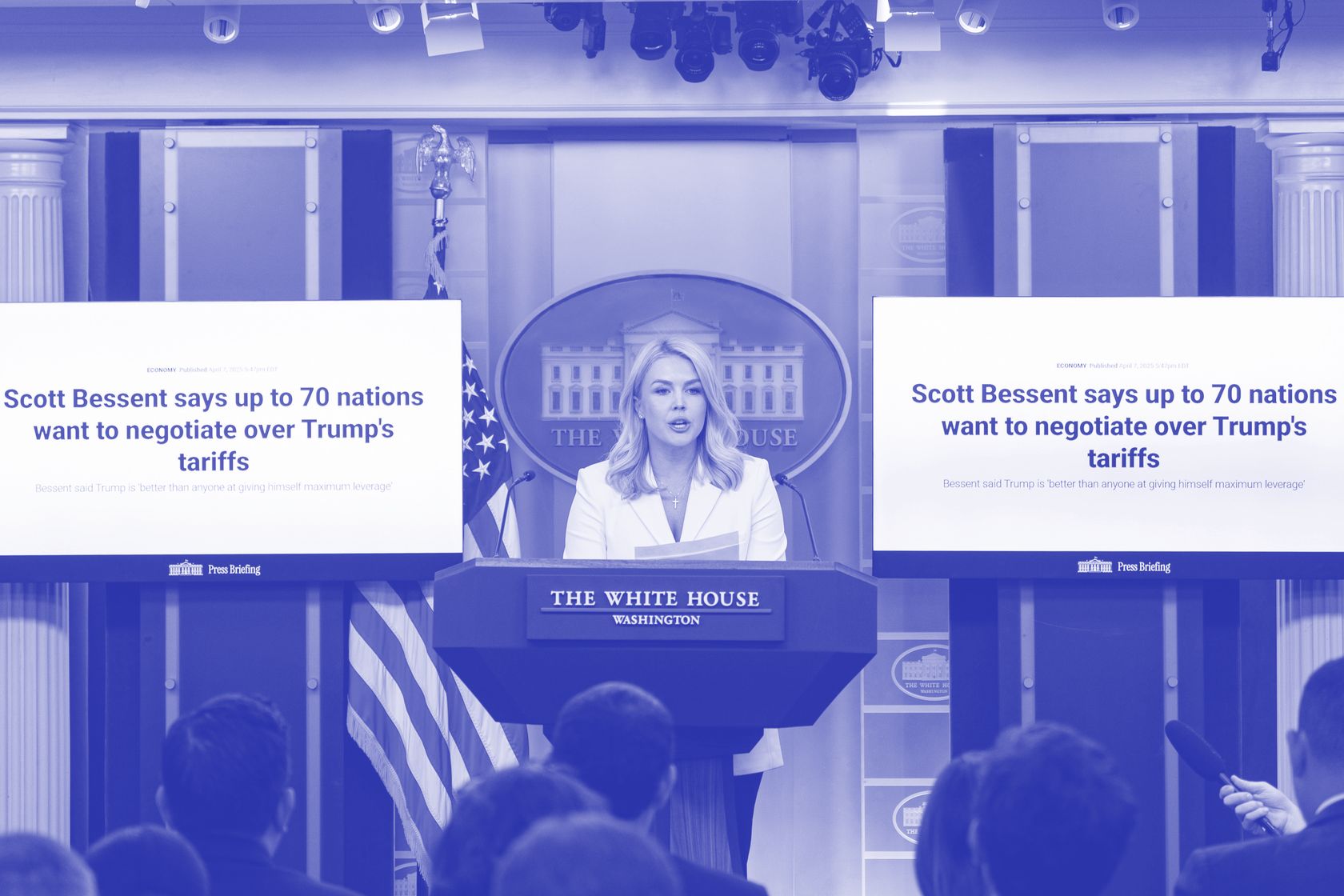
Markets manoeuvre: Global stock markets briefly rebounded Tuesday after three days of heavy selling, but US stocks reversed sharply as hopes for tariff relief faded. The Dow rose as much as 3.84% to 39,426.60 before falling 2.02% in late trade. The S&P 500 and Nasdaq, both up over 4% earlier, were down 2.82% and 3.35%, respectively. Volatility followed confirmation from White House press secretary Karoline Leavitt that President Trump’s 104% tariffs on Chinese imports would take effect at midnight (2am AEDT), alongside duties of up to 50% on goods from 80-plus countries. Nearly 70 nations have contacted the US to negotiate, but China vowed to “fight to the end” and devalued the yuan, pulling a reference rate below a key threshold. Earlier, Japan’s Nikkei closed 6% higher, and the STOXX 600 gained 3.69%. At a Senate Finance Committee, Senator Mark Warner, a Democrat from Virginia, called tariffs on Australia “insulting”, but US trade chief Jamieson Greer defended them. (Capital Brief)(Bloomberg)(WSJ)(Reuters)
2.
Best of four: Sky News’ straw poll called the first debate of the election campaign in PM Anthony Albanese’s favour, as the two hopefuls duked it out on a policy highlights reel from their respective campaigns. Healthcare, education and Future Made in Australia were the PM’s cue cards, while Peter Dutton hammered the cost of living and Labor’s ‘broken commitment’ to cut energy bills by $275. Dutton’s focus hit home a little after the fact, as the Coalition released its economic modelling on Tuesday night that it claims will see a 3% cut in household electricity prices. Under the Coalition’s gas-reservation plan, east coast LNG producers will be required to boost their domestic supply, forcing down wholesale gas prices. Queensland’s LNP government also shared its five-year plan to prioritise support for coal plants, investing in new gas power and selected hydro projects, after launching a review into the state’s greenhouse gas reduction targets. (Capital Brief)
3.
Tariff triangle: Elon Musk called Donald Trump’s top trade adviser Peter Navarro a “moron” and “dumber than a sack of bricks”, in the most public display yet of apparent strain between the US president and the world’s richest man. Navarro, a long-time Trump ally who served four months in jail for contempt of Congress, remains central to Trump’s trade policy. The clash came as Tesla stock dropped more than 40% this year, with Musk estimated to have lost USD31 billion since Trump’s tariff announcement. It followed Navarro’s claim that Musk is “not a car manufacturer” but a “car assembler” who uses “cheap foreign parts”. Musk dismissed the attack as “demonstrably false” and mocked Navarro for citing “Ron Vara” — a fictional economist whose name is an anagram of his own, quoted in his books and used to promote tariffs in Washington after Trump’s election. The White House downplayed the feud, saying, “boys will be boys.” (Capital Brief)(Elon Musk)(Bloomberg)(NYT)
4.
Campus capital: The founders of Blackbird and Airtree — Australia’s two largest venture capital firms — are backing a $2.5 million fund exclusively for students, started by Mitchell Hughes and Jerry X’Lingson while still at university in 2023. NextGen Ventures plans to write $70,000 cheques for 30 student-led startups, aiming to fill what X’Lingson called a long-standing “capital gap” for young founders. The fund is modelled on the US Dorm Room Fund, which made USD20,000 investments in student startups that later raised USD6 billion, including Shield AI and AnySphere. NextGen has raised $1.5 million so far, or 60% of its target, and has already invested in Fluency, which automates training for new employees using tools like Excel and Confluence. Airtree said the $70,000 cheque “isn’t about scaling a company, it’s about sparking one”. NextGen also runs a scout network across six universities. (Capital Brief)
5.
Bidstorm brew: More than 10 bids have been made for StrongRoom AI, with administrator Todd Gammel of HLB Mann Judd telling Capital Brief they are hopeful a deal could be finalised next week. The medtech startup collapsed into voluntary administration at the end of March, weeks after announcing it had raised $17 million at a valuation near $70 million. About 10 days later, lead investor EVP called the police, alleging StrongRoom understated debts by over $4 million and was losing $800,000 a month despite claiming profitability. EVP has since been granted a Federal Court asset freeze order against StrongRoom, co-founders Max Mito and Christopher Durre and 10 others. Around 20 to 23 staff were cut on Monday, with entitlements for former employees frozen. A creditors’ report will be issued in early May, ahead of a second meeting on 13 May. The sale process has been complicated by legal action from EVP and a receivership appointment by lender Paddington Street Finance. (Capital Brief)
6.
Friend or foe: Beijing has told Shein it must stop its plans to shift production out of China, in attempts to stem an exodus of manufacturers as trade tensions between the US and China spiral. The Chinese Ministry of Commerce reportedly told companies to halt diversification of their supply chains away from China ahead of Trump’s tariff announcements last week. Tensions have escalated between the countries, as China’s 34% retaliatory tariffs on US goods roiled markets on Monday, worsened by Trump’s call to add an additional 50% tariff on Chinese goods later in the day. China threatened that it would “fight to the end” after Trump’s latest barb. During a call with European Commission President Ursula Von der Leyen on Tuesday, Chinese Premier Li Qiang said China has ample policy tools to “fully offset” any negative external impacts, and called for strengthened communication between China and the EU. (Capital Brief)(Bloomberg)
7.
Crypto history: Ripple is acquiring prime-brokerage Hidden Road for USD1.25 billion ($2.06 billion), in one of the largest M&A deals the crypto industry has witnessed to date. With the deal, Ripple will become the first crypto firm to own and operate a global, multi-asset prime broker. Hidden Road will migrate its post-trade activity across the CRP Ledger, and will leverage the Ripple USD (RLUSD) stablecoin as collateral across its prime brokerage products. Ripple said that the partnership will optimise costs and liquidity in its cross-border payments solution, Ripple Payments, and provide custody service to Hidden Road customers. Ripple participated in Hidden Road’s Series B and is a customer of its platform. Ripple is on a high after the Securities and Exchange Commission (SEC) abandoned its case against the firm last month. The SEC had sued Ripple in 2020, claiming that the company was selling unregistered securities when it sold XRP tokens. (Ripple)(Bloomberg)
8.
Getting messy: Administrators operating the Whyalla steelworks are struggling to wrest control of the port from its previous owner, Sanjeev Gupta’s GFG Alliance, and have dragged the matter before the Federal Court. An affidavit filed by Michael Korda reads that the dispute must be resolved urgently in order for a sales process at the steelworks to begin, as the steelworks is bleeding money at a rate of $1 million every day. KordaMentha served a GFG subsidiary with a notice of termination of its lease over the port facilities in March, which was rejected, and the administrators are now pushing for the court to void the lease. Korda warned that failure to take control of the port could lead to a permanent site shutdown. Administrators were given $100 million in immediate funding in February, with another $384 million allocated to fund the project during the administration. The funding is being split between the Commonwealth and state governments. (ABC)(AFR)(The Australian)(Capital Brief)
