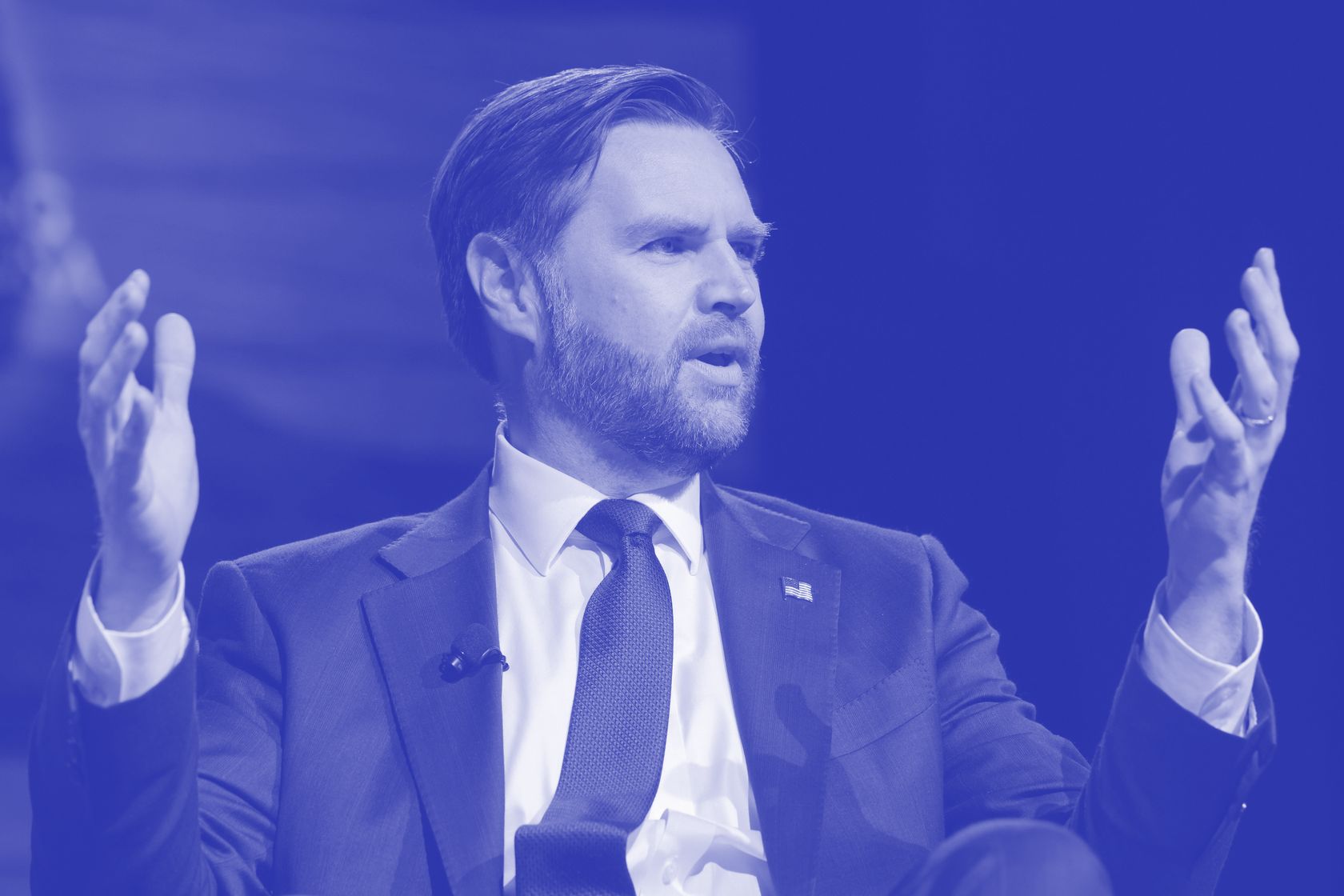
JD Vance’s Iran peace trip halted
Plus: Oil surges, Wall St falls as Iran talks stall; Trump Fed chair nominee Warsh vows independence, wants ‘regime change’; Revolut targets USD200b IPO valuation: FT.
Good morning. Here’s what happened overnight and what you need to know today.
1.
On hold: US Vice President JD Vance’s trip to Pakistan for a second round of peace talks with Iran was put on hold after US officials said Tehran failed to respond to American negotiating positions. With the ceasefire set to expire Wednesday night Washington time (Thursday AEST), Iran’s Foreign Ministry said via state TV that it had not decided whether to send a delegation, blaming “contradictory messages, inconsistent behaviour and unacceptable actions by the American side.” Trump told CNBC the US military was “raring to go" if no deal was struck and said he did not want to extend the truce. Meanwhile, the US military boarded a sanctioned tanker, the M/T Tifani, in the Indian Ocean. That was the first such boarding outside the Middle East since the war began and part of what officials are calling “Economic Fury”. Trump separately confirmed the US was considering a currency swap with war-battered Gulf ally the UAE. He also said he would like to see a buyer emerge for struggling Spirit Airlines, which filed for bankruptcy for the second time in under a year as jet fuel prices surge on the back of the Iran war. In the same interview, Trump said it was “possible” the White House and Anthropic could reach a deal to use the AI company’s technology in the Defence Department. “We had some very good talks with them, and I think they’re shaping up,” Trump said. “They’re very smart, and I think they can be of great use.“(NYT)(WSJ)(Bloomberg)(CNBC)
2.
War torn: A rebound of oil prices drove stocks lower on Wall Street after the New York Times reported Vice President JD Vance’s trip to Pakistan for peace talks with Iran had been put on hold, sending the S&P 500, the Dow Jones and the Nasdaq 100 all lower. Brent crude surged nearly 5% topping USD99 a barrel, bond yields rose and the dollar strengthened. US retail sales jumped 1.7% in March, the largest rise in a year, as the Iran war boosted gasoline prices and drove a record surge in receipts at service stations. Apple shares fell 2.5% after announcing hardware chief John Ternus will replace CEO Tim Cook in September. On the corporate front, Bloomberg reported citing unnamed sources that Deutsche Telekom is considering a full combination with T-Mobile US, which would rank as the largest-ever public M&A deal. Elsewhere, Spirit Airlines shares surged as much as 178% after Trump said he would like to see a buyer emerge for the struggling carrier and suggested the federal government could help given thousands of jobs were at stake. (Bloomberg)(Reuters)
3.
Yield man: Donald Trump’s nominee to lead the US Federal Reserve, Kevin Warsh, told the Senate Banking Committee that the US president has never asked him to commit to cutting interest rates. That came hours after Trump told CNBC he would be "disappointed” if Warsh didn’t cut immediately upon taking the job and suggested Warsh may have to have an office next to his at the White House because the Fed’s headquarters renovation would not be finished in time. During the two-hour hearing, Warsh, 56, called for “regime change” at the Fed and a new inflation framework, and said he would be an “independent actor” if confirmed. Senators pressed him on financial disclosures showing assets of up to USD209 million ($406 million), which if confirmed, would make him the wealthiest person ever to lead the central bank. Warsh said he would divest most holdings if confirmed. Under questioning from Democratic senator Elizabeth Warren, Warsh also declined to say whether Trump lost the 2020 election. Republican Senator Thom Tillis complimented Warsh but stood by his position to block the nomination until the DOJ drops its criminal probe into current chair Jay Powell, which a federal judge has ruled is a thinly disguised effort to pressure Powell into lowering rates or resigning. (Capital Brief)(SBC)(CNBC)(NYT)(WSJ)
4.
Float goals: London-based fintech Revolut is targeting a stock market valuation of up to USD200 billion ($280 billion), the Financial Times reported, in a listing that would trigger an Elon Musk-style reward for founder Nik Storonsky and make him one of the world’s richest people. Revolut has told financial media it will not seek a listing before 2028, while executives have discussed a target valuation of between USD150 billion and USD200 billion internally and with some of its backers, the FT reported citing unnamed sources. A person close to the company said that no formal valuation target had been set. Under a long-standing agreement, Storonsky’s stake in the business will increase by several percentage points if Revolut clinches a USD150 billion valuation. He said in December that his incentive package would entitle him to hold about 40% of the company if it reached a USD200 billion valuation, which would value his stake at about USD80 billion. Before any IPO, Revolut is preparing a secondary share sale in the second half of this year expected to value the company at more than USD100 billion, the paper said. That’s up from USD75 billion in its November funding round. Revolut received a full UK banking licence last month after a four-year wait and also applied for a US licence. Last year, pre-tax profits rose 57% to GBP1.7 billion, driven by a 67% surge in premium subscriber revenue. (FT)
5.
Data cover: The Department of Home Affairs is set to release a consultation paper this week proposing sweeping new security rules that would tighten the existing national Hosting Certification Framework for data centres that host Australian government information, including mandatory security clearances for company directors and new foreign ownership tests, The Australian Financial Review reported. The moves could slow billion-dollar capital raises needed to win the AI infrastructure arms race, according to industry voices cited by the paper. The proposed changes would require board members and executives with strategic decision-making authority to pass a security clearance or undertake a fit and proper person test, and that data centres and core infrastructure be majority-owned and controlled by a low-risk entity. The rules apply only to infrastructure that house and run systems used by government departments that require security clearance, not those used solely by AI giants to build and run large language models, the paper said. Impacted operators include AirTrunk, CDC Data Centres, NextDC, Equinix, Macquarie Technology and Digital Realty, as well as Amazon Web Services, Google and Microsoft. (AFR)
6.
Spectrum spat: ASX-listed telcos Telstra and TPG Telecom urged the government to proceed with a competitive process for satellite spectrum licences despite a warning from Elon Musk’s SpaceX that it will withhold satellite mobile services from Australia if it isn’t granted priority access to crucial wireless airspace. The mobile network operators argue that a competitive process for spectrum licences would drive costs down, rather than entrenching Starlink’s dominant position for providing satellite-based connectivity. ACMA is considering auctioning off the spectrum licences to use the 2GHz mobile frequency that Starlink would require to deliver full satellite to mobile services. A Telstra spokesperson told Capital Brief that if mobile network operators held the satellite spectrum licences, it would make it easier for them to “change satellite partners over time”. SpaceX’s vice president of satellite policy, David Goldman, warned that Australia risked missing out on Starlink’s next generation services if it couldn’t guarantee access to its preferred frequency. (Capital Brief)
7.
Bad vibe (coding): HubSpot chief executive Yamini Rangan told Capital Brief that the selloff gripping her sector rests on a category error: confusing what software companies make with what they sell. “I think it is a dire perspective that just because coding got easier, the value that SaaS companies deliver has just disappeared,” Rangan said. Listed on the NYSE with a current market capitalisation of USD12.1 billion ($16.9 billion), HubSpot has been one of the many victims of the SaaSpocalypse, its share price down 40% since January 2026. Rangan draws a hard distinction between what AI can generate and where AI can deliver business outcomes and believes business growth requires contextual data that reinforces the need for SaaS companies. Rangan’s scepticism also extends to the other end of the AI trade, data centres. “There’s a lot of building, and I would say overbuilding, that is happening in terms of the data centre capacity,” Rangan said in her keynote at HubSpot’s Grow conference. (Capital Brief)
8.
Compliance Hero: Employment services platform Employment Hero released a fully managed software model, HeroForce, designed to automate complex regulatory requirements for Australian businesses. The AI-powered co-employment model positions itself as the legal employer for businesses, managing payroll, compliance and HR administration, while firms maintain operational control of their workplace. HeroForce has been designed to fully operate within Australia’s regulatory framework, as well as in New Zealand, the UK and Canada. The software can interpret modern awards, develop rosters, automate payroll calculations and monitor compliance obligations across thousands of employees. Earlier this year Seek Growth Fund revealed that it would offload its remaining stake in Employment Hero after the companies’ relationship deteriorated into a Federal Court battle, with Employment Hero alleging anti-competitive conduct after Seek terminated a critical API agreement. (Capital Brief)