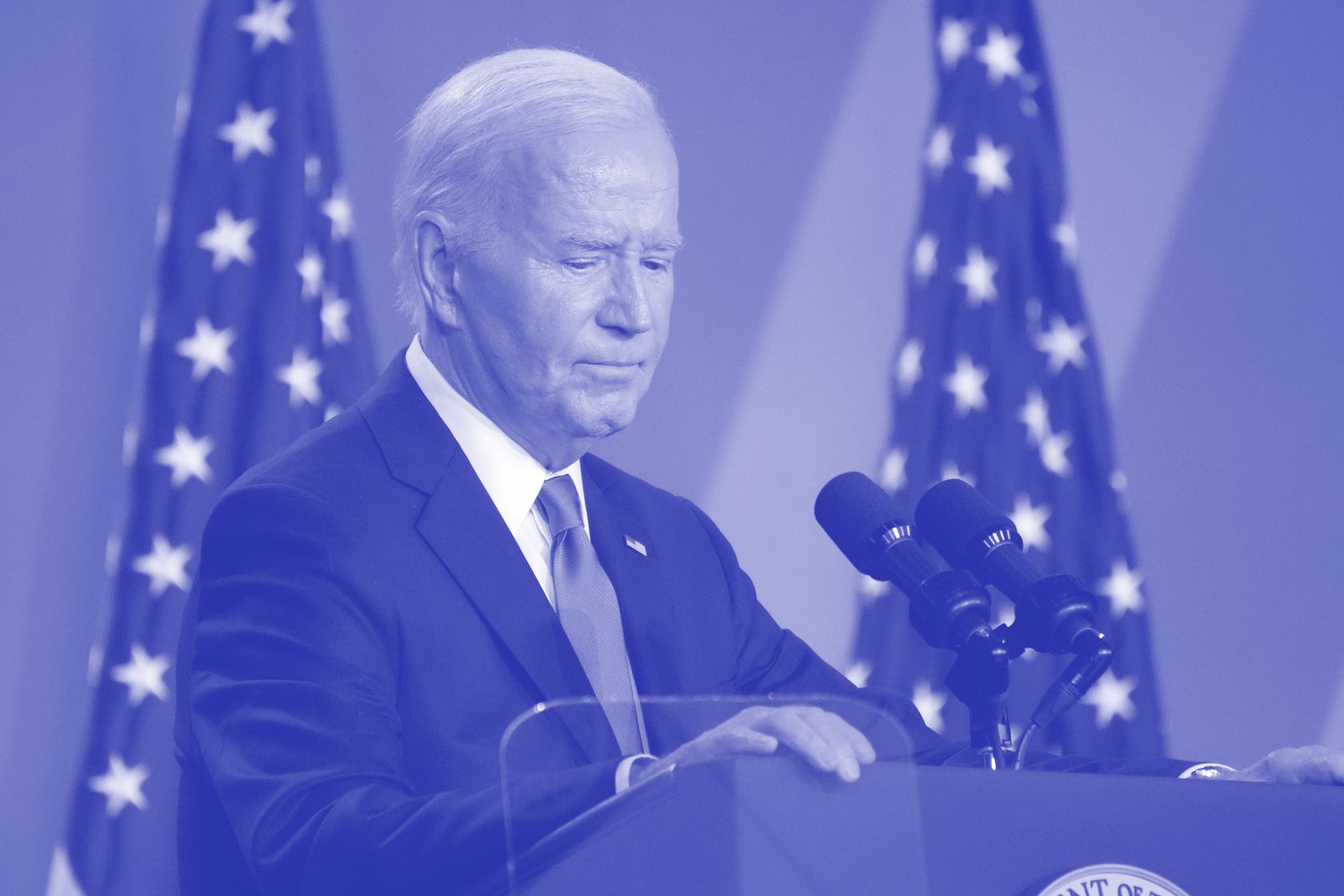
Joe Biden pulls out of US presidential race, endorses Kamala Harris
Plus: Donald Trump reacts to Biden’s exit; China unveils long-term financial-fix blueprint; Israel-Houthi violence intensifies.
Good morning. Here's what happened overnight and what you need to know today.
1.
Biden out: President Joe Biden, 81, ended his re-election bid on Sunday, yielding to relentless pressure from his closest allies amid serious doubts about his age and health affecting his chances against former President Donald Trump. Announcing the unprecedented move on X, Biden endorsed Vice President Kamala Harris to succeed him and committed to serve as president until January 2025. "It has been the greatest honor of my life to serve as your President. And while it has been my intention to seek reelection, I believe it is in the best interest of my party and the country for me to stand down and to focus solely on fulfilling my duties as President for the remainder of my term," Biden wrote, only days before he was due to be officially nominated at the Democratic National Convention. His withdrawal clears the path for Harris to potentially run for president and make history as the first Black woman to do so. It remains unclear, however, if other senior Democrats will contest the nomination or if the party will open the field for other candidates. Over 30 Democratic lawmakers had publicly urged Biden to step aside after a troubling debate performance against Trump on 27 June raised concerns about his mental acuity. Despite holding firm for three weeks after the debate, Biden yielded to a torrent of polls showing him trailing Trump and voter preference for a younger candidate. (Capital Brief)(New York Times)(Reuters)
2.
Trump roars: Donald Trump seized on Biden’s announcement, saying he was never fit for the presidency and using the moment to fundraise on social media. "He [Biden] only attained the position of President by lies, Fake News, and not leaving his Basement," The Republican presidential nominee wrote on his social media site. "All those around him, including his Doctor and the Media, knew that he wasn't capable of being President, and he wasn't." After a brief call for national unity immediately after an assassination attack against him last week, Trump has resumed his characteristic inflammatory rhetoric. Over the weekend, Trump said he received a “beautiful” note from Chinese President Xi Jinping after he was shot in the ear during the attack. Trump brought up the note at his first rally since the attack, held in Grand Rapids, Michigan on Saturday, which was also the first alongside his new running mate JD Vance. At the rally, he mocked President Biden’s intelligence calling him “stupid”, compared former Democratic House Speaker Nancy Pelosi to a dog and repeated provocative but false claims on immigration, the economy and election fraud. Rebutting accusations he is a threat to democracy and distancing himself from Project 2025 - a set of major conservative policy proposals in preparation for a Trump administration - he also declared: “Last week, I took a bullet for democracy.” (Reuters)(Axios)

3.
Beijing’s fix: President Xi Jinping flagged plans to address the debt crisis facing China’s local governments on Sunday following the Communist Party’s Central Committee meeting last week, Bloomberg reported citing a resolution published by Xinhua News Agency. The long-term strategy, described as “vague” by academics, involves redistributing more revenue to regional authorities by gradually increasing their share of consumption tax and giving city governments more autonomy to regulate property markets. Other measures flagged include a gradual increase to the retirement age and reforms to private sector access to finance. At the four-day conclave that ended 18 July, national security took a “more prominent” position, Xi said. The resolution also signalled a potential expansion to Beijing’s surveillance architecture, Bloomberg reported, as it vowed to “explore and establish a national unified population management mechanism.” (Bloomberg)(Capital Brief)
4.
Israel Houthi attacks: Violence between Israel and Yemen’s Iran-aligned Houthi movement escalated over the weekend after a Houthi drone struck Tel Aviv on Friday, killing one and injuring four. In retaliation, an airstrike on Saturday targeted what Israel said were Houthi military targets near the Hodeidah port, resulting in six civilian deaths and 80 injuries, Reuters reported citing medical sources in Yemen. On Sunday, Israel intercepted a missile fired from Yemen at the Red Sea city of Eilat. Prior to interception by the Arrow 3 missile defence system, air raid sirens sent residents seeking shelter. The conflict, an extension from the broader Gaza war, has seen the Houthis and Hezbollah, another Iran-backed group, attack Israeli and Western targets in support of Palestinians and the Islamist militant group Hamas that controls Gaza. Iran condemned the Israeli attacks, warning of escalating tensions and the potential spread of war in the region. The incidents came as Israeli Prime Minister Benjamin Netanyahu prepared to travel to Washington this week to meet with President Biden and address Congress. (Reuters).
5.
Risky business: A confidential assessment by the US Office of the Comptroller of the Currency (OCC) found half of the major banks it oversees have inadequate management of operational risks, including cyber threats and employee errors, Bloomberg reported. Eleven of the 22 large banks the OCC supervises had “insufficient” or “weak” management of operational risk, and one-third scored 3 or less in a 5-point scale for overall management, Bloomberg said citing sources familiar with the matter. Operational risk encompasses a wide range of potential threats beyond market and credit risks and is a critical area of focus for regulators. The evaluations add to regulators’ concerns about risk management following last year’s bank failures. (Bloomberg)
6.
Tech chaos: The unprecedented global IT meltdown caused by a faulty update from security vendor CrowdStrike continued to disrupt US airports on Sunday, with over 1,100 flights cancelled across major US cities, Bloomberg reported. Repairs are expected to take days or weeks, as affected businesses manually remove the problematic update. The Friday outage broke 8.5 million Windows PCs and servers, delaying hospital procedures, shutting banking networks, ATMs and grounding planes across the world, especially in the US, Australia, India and Canada. New York, Atlanta, Newark and San Francisco were experiencing the most flight cancellations in the US on Sunday. CrowdStrike has apologised and assured customers their systems remain secure despite the incident, but the outage has also raised concerns about potential phishing scams exploiting the chaos. (The Financial Times)(Bloomberg)
7.
Deadly quotas: More than 100 people have died in violent protests in Bangladesh, sparked by job quota reforms. On Sunday, the top court overturned a ruling that reserved 30% of government jobs for war veterans and their families, The Guardian reported. The new ruling limits quotas to 5% for descendants of freedom fighters and 2% for ethnic minorities or those with disabilities, leaving the rest open to merit-based competition. The reintroduced quotas had led to widespread student protests, which initially were peaceful but turned violent as clashes with pro-government groups and police intensified. Thousands were injured, and the government imposed a curfew, restricted communications, and arrested opposition and student leaders. Protests continue, with demonstrators demanding justice for the deceased and calling for Prime Minister Sheikh Hasina’s resignation and political reforms. (The Guardian)
8.
Porsche stake: German battery maker Varta is exploring two restructuring options that could involve luxury carmaker Porsche acquiring a stake in the company. Reuters reported Varta said it is considering a deal with new investors, including Porsche and existing Austrian majority shareholder Michael Tojner, or one involving financial creditors. Varta decided to notify courts under Germany's corporate restructuring law of its plans in order to avoid losses that could deplete its share capital. In a statement to Reuters, Porsche confirmed the negotiations to acquire a majority stake in Varta's V4Drive business, contingent on Varta achieving a “sound financial basis,” it said. Varta aims to resolve the restructuring scenario swiftly, potentially resulting in the reduction of its share capital to zero and a delisting of its shares. This plan may also involve substantial debt reductions and deferrals, with the possibility of proceeding without investor approval if courts agree. (Reuters)