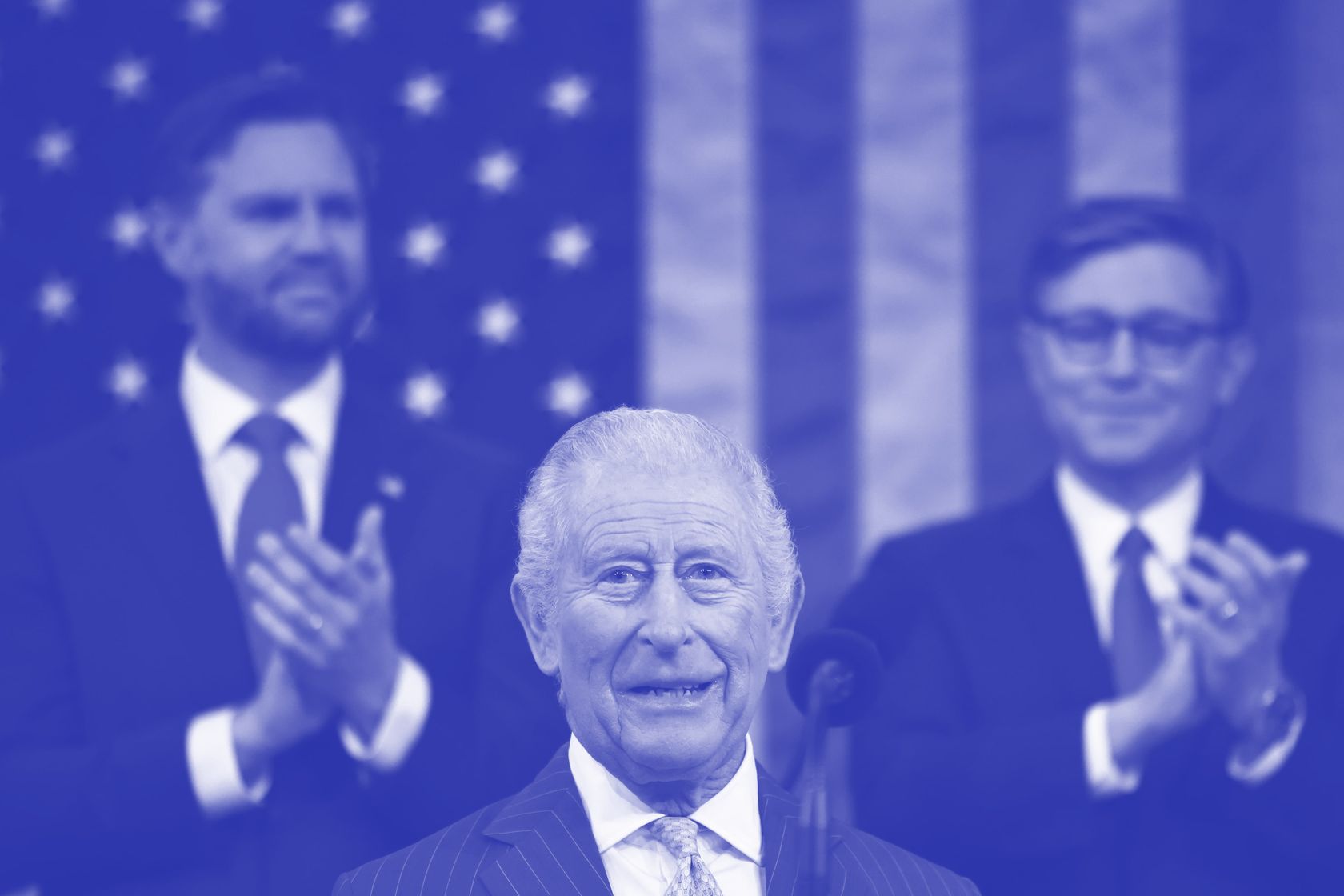
King Charles tells US Congress ‘actions matter’, backs NATO
Plus: UAE to leave OPEC citing need for policy independence; Tech stocks hit by OpenAI growth and funding fears; Musk claims OpenAI leaders “stole a charity” in court.
Good morning. Here’s what happened overnight and what you need to know today.
1.
Words weigh: King Charles used a rare address to the US Congress to urge the US and the UK to “ignore the clarion calls to become ever more inward-looking”, as tensions over the war in Iran test the alliance. He framed the alliance in moral terms, telling lawmakers that while “America’s words carry weight and meaning”, “the actions of this great nation matter even more”, as he urged it to uphold shared values with partners in Europe and the Commonwealth, including Australia. The speech to mark 250 years since US independence is only the second time a British monarch has addressed Congress. The King also described the US-UK partnership as “one of the most consequential alliances in human history” and said it “cannot rest on past achievements”. He said “we meet in times of great uncertainty” with conflicts “from Europe to the Middle East” and stressed defence cooperation, noting NATO “answered the call together” after the September 11 attacks. He also called for “unyielding resolve” in defence of Ukraine. He made the remarks after meeting President Donald Trump at the White House, who he described as “a fantastic person”. (AP)(NYT)(Reuters)
2.
Cartel blow: The United Arab Emirates said it will leave OPEC after nearly 60 years, dealing a significant blow to the oil cartel. The UAE is one of the group’s largest producers. It said it planned to exit this Friday, 1 May, giving less than a week’s notice. Emirati officials have long complained that OPEC’s production quotas limited their ability to export more oil, The New York Times noted. Energy Minister Suhail Al Mazrouei said the move was a “policy-driven” decision following a review of energy strategy, and said the UAE wanted to be “unconstrained by any groups”. The decision follows years of tension with OPEC leader Saudi Arabia over output policy and comes as the Iran war disrupts oil markets and the Strait of Hormuz. The UAE’s departure is expected to weaken OPEC’s influence over global supply and could lead to greater market volatility over time, according to analysts. (Capital Brief)(WSJ)(Reuters)(Bloomberg)(NYT)(FT)(WAM)(UAE Energy Minister)
3.
Growth fears: Tech stocks slid as a Wall Street Journal report that OpenAI had missed its own revenue and user growth targets rattled investors across the AI sector. Oracle and Nvidia shares closed 4.1% and 1.6% lower respectively in New York. CoreWeave fell 5.8% and Arm Holdings was down 8%. SoftBank, with a double-digit stake in OpenAI fell 9.9% in Tokyo. The Nasdaq composite fell 0.9%. The Journal reported that CFO Sarah Friar told other company leaders she was worried OpenAI might not be able to pay for future computing contracts if revenue didn’t grow fast enough. According to the report, board directors had also more closely examined the company’s data-centre deals in recent months and questioned Altman’s efforts to secure even more computing power despite the business slowdown. The Journal said OpenAI fell short of its revenue targets, missing both its annual goal and subsequent monthly benchmarks as competition from Google’s Gemini and Anthropic eroded its market share. The company also missed its internal target of reaching one billion weekly active ChatGPT users by the end of last year. In a statement to media, OpenAI called the report “prime clickbait” and said its businesses were “firing on all cylinders.” Altman and Friar also rejected the reports’ suggestions that they were divided over computing spending, telling CNBC in a joint statement it was “ridiculous” and that they were “totally aligned on buying as much compute as we can.”. (Capital Brief)(WSJ)(CNBC)(Bloomberg)
4.
Charity case: A trial between Elon Musk and OpenAI began in Oakland, California, with Musk’s lawyer telling jurors the company “stole a charity” when it converted from a nonprofit into a for-profit entity. Musk claims he was misled into donating tens of millions of dollars believing OpenAI would remain a nonprofit and alleges fellow co-founders Sam Altman and Greg Brockman abandoned its founding mission to benefit humanity. He is seeking USD150 billion ($209 billion) in damages from OpenAI and Microsoft and wants the company to revert to a nonprofit structure. “The defendants in the case stole a charity, and we’re asking you to hold them accountable,” Steven Molo, from Musk’s legal team, told jurors. OpenAI’s lawyer William Savitt said the case stemmed from Musk being upset he “didn’t get his way at OpenAI” “We are here because Musk didn’t get his way at OpenAI,” he said. “My clients had the nerve to go on and succeed without him. Mr Musk did not like that.” He noted the original nonprofit still oversees the for-profit company. Musk and Altman both appeared in court. The trial is expected to run for about four weeks, with Musk, Altman and Microsoft chief executive Satya Nadella among those slated to testify. (NYT)(Reuters)(FT)(Bloomberg)(WSJ)
5.
Long haul: Shell CEO Wael Sawan warned oil and liquefied natural gas shortages could last “for at least the coming months, if not the next year-plus”, as Brent crude rose to about USD111 amid disruption linked to the Strait of Hormuz blockade. “We are talking about roughly 900 million barrels that haven’t been produced in the last couple of months and that’s been replaced essentially by stock drawdown,” Sawan told Bloomberg. “We’re now starting to reach some relatively low levels. We’re talking about demand curtailment in certain areas. We’re talking about fuel switching.” Meanwhile, dozens of nations called for the Strait of Hormuz to be reopened in a joint statement led by Bahrain, while German Chancellor Friedrich Merz said the US was being “humiliated” by Iran and lacked a strategy for ending the conflict, before Donald Trump hit back saying Merz “doesn’t know what he’s talking about”. (WSJ)(The Guardian)(Bloomberg)
6.
Budget alignment: In an exclusive interview with Capital Brief ahead of the budget later this month, Federal Industry Minister Tim Ayres warned workforce shortages in areas like construction and engineering risk holding back the government’s Future Made in Australia agenda, and called on industry to lift its effort to attract young Australians into apprenticeships. Ayres attacked the Coalition and One Nation’s calls for large reductions in migration as “divorced from reality”, stating that the Future Made in Australia program was successfully creating jobs and supporting the growth of new minerals processing and manufacturing industries. The comments come ahead of a speech Anthony Albanese will deliver in Perth today where he will shift his narrative about next month’s 2026–27 budget from being about productivity to a focus on economic resilience. The Prime Minister will announce $45 million in funding to fast-track new energy, housing and resources projects by combining federal and state approvals, streamlining the approvals procedure into a “single-touch” process. (Capital Brief)
7.
SunCable moonshot: Singapore Energy Market Authority (EMA) CEO Kok Keong Puah described Mike Cannon-Brookes’ $30 billion SunCable electricity export project as “very ambitious” ahead of a confidential meeting with owner Grok Ventures for an update on development. Puah told Capital Brief that based on what has been submitted, the project is “actually possible” despite technical and feasibility challenges. Puah met with Grok Ventures on Friday. SunCable proposes building a 4,300km long subsea transmission cable to supply Singapore with 1.7GW of electricity from wind and solar farms to be built in the Northern Territory. SunCable is one of 11 electricity export projects across the region that have been granted conditional approval and while six projects have “received a conditional licence”, reaching stage two of a three-part process, SunCable is still at the initial conditional approval stage. Puah cited the key challenge of the distance between Australia and Singapore, putting SunCable at a disadvantage to regional options, but added that Singapore may be willing to pay a premium for the geographic diversification offered by the project. (Capital Brief)
8.
Big-guns Prins: Apple added veteran satellite policy consultant, Hendrik Prins, to its lobbying ranks as its satellite mobile service provider Amazon Leo faces a controversial licensing regime being considered by telco regulator ACMA. Cemdia-Aust’s Prins was added to Apple’s lobbyist register on 14 April, a week before Elon Musk’s SpaceX warned that its low-earth orbit satellite arm Starlink could withhold mobile services from Australia if it is not given preferential access to radio frequencies designated for satellite-based mobile services. While Apple does not directly deploy or operate satellites, it has signed a long-term agreement with Starlink’s direct rival Amazon Leo to provide satellite-based mobile services. Prins was put on the lobby register on behalf of Apple Inc. on the day the $5.5 trillion company’s long-term partnership with Amazon Leo was announced, with Leo planning to begin delivering satellite-based voice call services from 2028. (Capital Brief)
9.
Everything at Stake: The sale of Eucalyptus is being celebrated as an Australian success story. It should also be read as a warning about the weakness of our public markets. It is a success story, but when one of our best growth companies ultimately ends up in the hands of an NYSE-listed company rather than on the ASX, we are not just losing a listing, but also the long-term upside of Australian innovation, writes Matt Leibowitz, founder and CEO of Stake. This is hardly an isolated case. Over the past decade, billions of dollars in market value have migrated offshore. The number of ASX IPOs has fallen from 96 in 2016 to just 35 in 2025. If we want to re-energise Australian businesses and workers, and keep the businesses of the future — perhaps even our next unicorns — growing onshore, we need to reshape our market structure by focusing on connectivity, exchanges and liquidity. (Capital Brief)