Trump blasts Israel, says Iran deal still ahead
Plus: Meet the woman teaching Claude morals; SpaceX shares keep rising as bankers weigh fee-free greenshoe; Inside the collapse that blindsided an industry.


Good morning. Here’s what happened overnight and what you need to know today.
1.
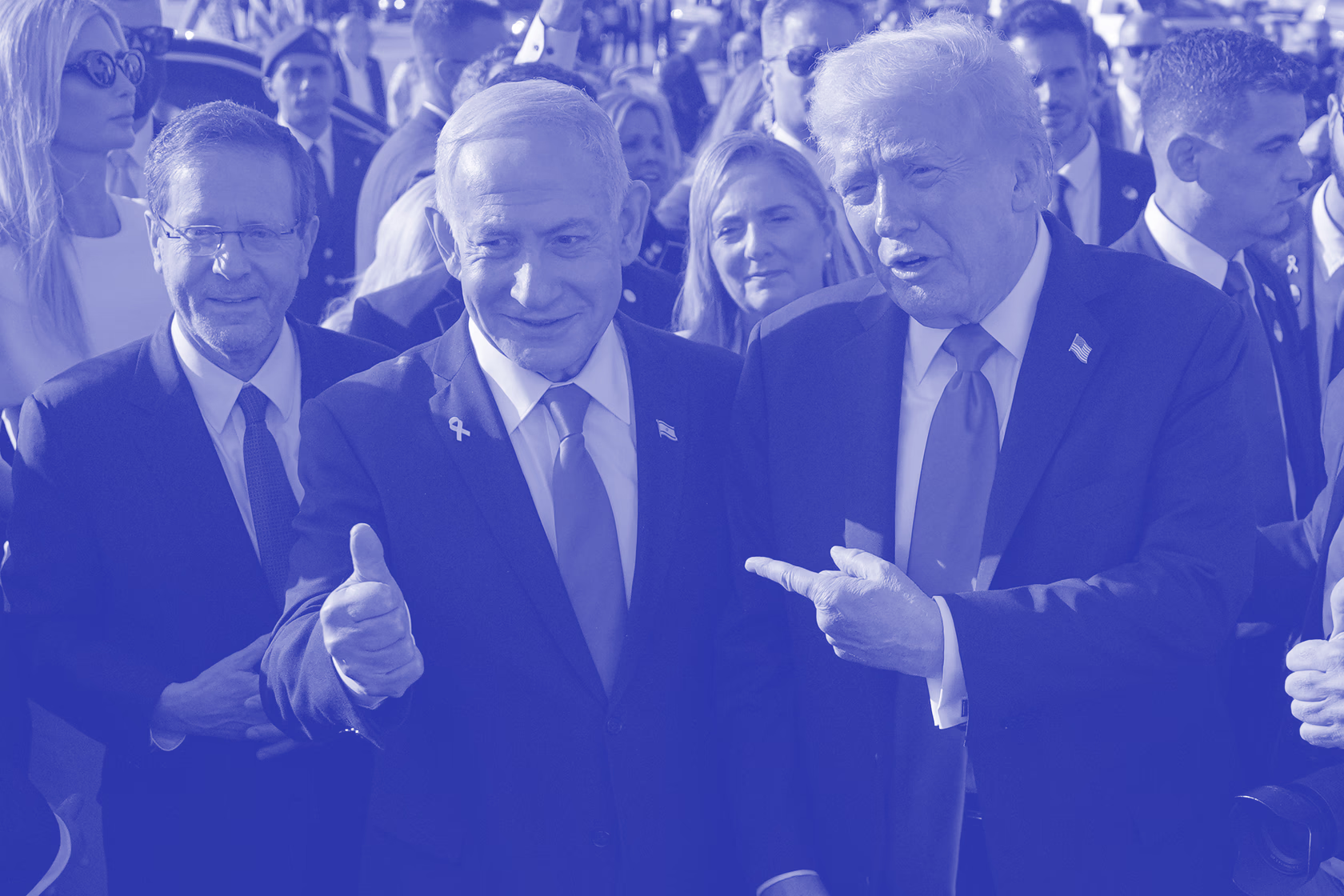
Strait talk: Donald Trump rebuked Israel over a strike on Beirut’s southern suburbs, but said he still expected to sign a framework deal with Iran in the coming hours. The US president posted that the attack "should not have happened” and urged Israel and Hezbollah to “stand down,” saying the strike Israel was responding to “was very small and meaningless” and that no more Israeli attacks should occur anywhere in Lebanon. The Israeli military said it hit what it called a Hezbollah command centre after the Iranian-backed group fired drones at northern Israel, the WSJ reported, with Lebanese health authorities saying three people were killed and 16 injured. Trump also told Axios he was “so pissed off" at Prime Minister Benjamin Netanyahu and said the Israeli leader has “no judgement.” Meanwhile, Iran’s lead negotiator Mohammad Bagher Ghalibaf condemned the strike and suggested it undermined US credibility, while senior Iranian officials warned Tehran would retaliate. Trump and mediator Pakistan had said the preliminary deal would be signed Sunday, Trump’s 80th birthday, though Iran cast doubt on the timing. A senior Iranian official told Reuters the draft would release USD25 billion in frozen Iranian assets and waive oil sanctions in return for reopening the Strait of Hormuz. (Reuters)(WSJ)(NYT)
2.
Mind the machine: In her first Australian interview, Amanda Askell, Anthropic’s resident philosopher and in-house ethicist — and the person responsible for Claude’s personality, ethical behaviour and character — told Capital Brief that in the AI era, what looks like hype or fear-mongering has more often than not turned out to be prescient. Speaking just before Anthropic suspended access to its new Fable 5 and Mythos 5 models after the US government issued a directive on national security grounds, she said the safety challenge around AI compounds as capability grows: “if you manage to jailbreak a less capable model, it just doesn’t have the same consequences as managing to jailbreak a model like Mythos.” She said cybersecurity sits at the sharpest edge of the problem, because offence and defence look very similar and a model often can’t tell the difference between legitimate and malicious intent. The directive followed a sweeping policy essay this week in which Anthropic founder Dario Amodei named Claude Mythos Preview as the moment AI’s risks stopped being theoretical, calling for an FAA-style regime of mandatory third-party safety testing before deployment. With Claude now writing more than 80% of the code merged into Anthropic’s own codebase, Askell sat down with Capital Brief’s Bronwen Clune on safety, identity and whether the ceiling on AI capability is closer than we think. (Capital Brief)
3.
Rocket day: SpaceX shares kept climbing 3.7% in after-hours trading, extending a 19% first-day gain that cemented the largest IPO in history and made Elon Musk the world’s first trillionaire. The space-and-AI company squeezed its bankers to razor-thin fees then got them to work the greenshoe for free. That option to sell a further 15% of stock could lift the raise to as much as USD86 billion if exercised within 30 days. Goldman Sachs and Morgan Stanley have not said whether they will exercise the option. But Musk claims he only agreed to it on the condition that his bankers wore green shoes on the day. Beneath the USD2.1 trillion valuation headline, the smooth debut had some friction. Robinhood buckled under traffic as retail traders piled in, handing Citadel Securities its biggest-ever retail order activity for an IPO auction. A group called Stop Funding Billionaires rallied outside JPMorgan under a banner reading “Elon is stealing your 401k,” while an inflatable Musk in Times Square attacked his Grok chatbot over illicit images. (Reuters)(WSJ)(Bloomberg)(FT)
4.
Deep dive: One day after the Albanese government handed down sweeping curbs to long-existing housing tax concessions, Dashdot founder Glenn ‘Goose’ McGrath told clients "the plan still works ... and we’re still here.” Two weeks later, the buyers agency, one of Australia’s largest, collapsed into voluntary liquidation. A creditors’ report filed with ASIC shows Dashdot collapsed owing $16.57 million, with hundreds of customers cumulatively owed $10.6 million in prepaid fees. The liquidator said Dashdot Pty Ltd held just $749 in the bank against around 700 creditors. The report also shows venture debt provider Mighty Partners is owed $1.5 million and 43 staff are owed more than $1.1 million in entitlements. McGrath, who told Capital Brief he has lived overseas since 2022, built the business on his own story of conquering homelessness and drug addiction, self-publishing a book titled Limitless. Capital Brief’s Jack Derwin spoke to more than a dozen former clients and staff, McGrath and the liquidator to trace how it all unravelled. (Capital Brief)
5.
Tax revolt: Business groups will tell a senate inquiry the government’s capital gains tax changes will lower productivity and make Australia less competitive. In a joint statement issued ahead of the inquiry, the Australian Chamber of Commerce and Industry, AI Group, the Business Council and the Council of Small Business Organisations Australia said the changes were being rushed through and would discourage investment. Under the changes, the 50% capital gains tax discount would be replaced with a rate tied to inflation and a 30% minimum, while negative gearing would be limited to new houses only from July 2027. The groups said the changes must be rejected, with the statement warning Australia cannot afford policies that make it a less attractive investment destination. Labor wants the changes to pass by 2 July, when parliament rises for the winter break, though that is not guaranteed. The government says the measures will help an additional 75,000 Australians buy their first home over the next decade. (AAP)(Joint statement)
6.
Shadow play: UK armed forces boarded a sanctioned Russian shadow fleet oil tanker in the English Channel in the early hours of Sunday local time, in the first operation of its kind. Royal Marine Commandos, joined by National Crime Agency officers and supported by the RAF, intercepted and boarded the vessel, named Smyrtos, in a six-hour operation, the BBC reported. The Ministry of Defence said the tanker would be held and monitored off the south coast of England while investigations continue. The freight data company Kpler said the vessel was loaded with 700,000 barrels of crude from Ust-Luga, one of Russia’s Baltic ports. Prime Minister Keir Starmer said the operation delivered “yet another blow to Russia.” Russia, which had no immediate response, has previously described similar interceptions as “bordering on international piracy.” (BBC)(FT)(UK ministry of defence)
7.
Border lines: Swiss voters rejected a proposal to cap the country’s population at 10 million, in a referendum that had threatened to jeopardise Switzerland’s free movement agreement with the European Union. Nearly 55% of voters rejected the initiative against 45% in favour, with turnout around 60%, the BBC reported. The proposal came from the right-wing Swiss People’s Party, which has the most seats in parliament and has long campaigned on an anti-immigration platform. The party argued that capping the population would ease pressure on transport, housing and the environment. Opponents said it would cost Switzerland much-needed workers in sectors such as healthcare, tourism and hospitality. The vote was opposed by the government, Swiss businesses and all the other major parties, the BBC reported. Switzerland’s population has grown from 7.3 million in 2002 to 9.1 million, of whom about 27% are not Swiss citizens. European Commission President Ursula von der Leyen said “the Swiss people have spoken,” the BBC reported. (BBC)(AP)
