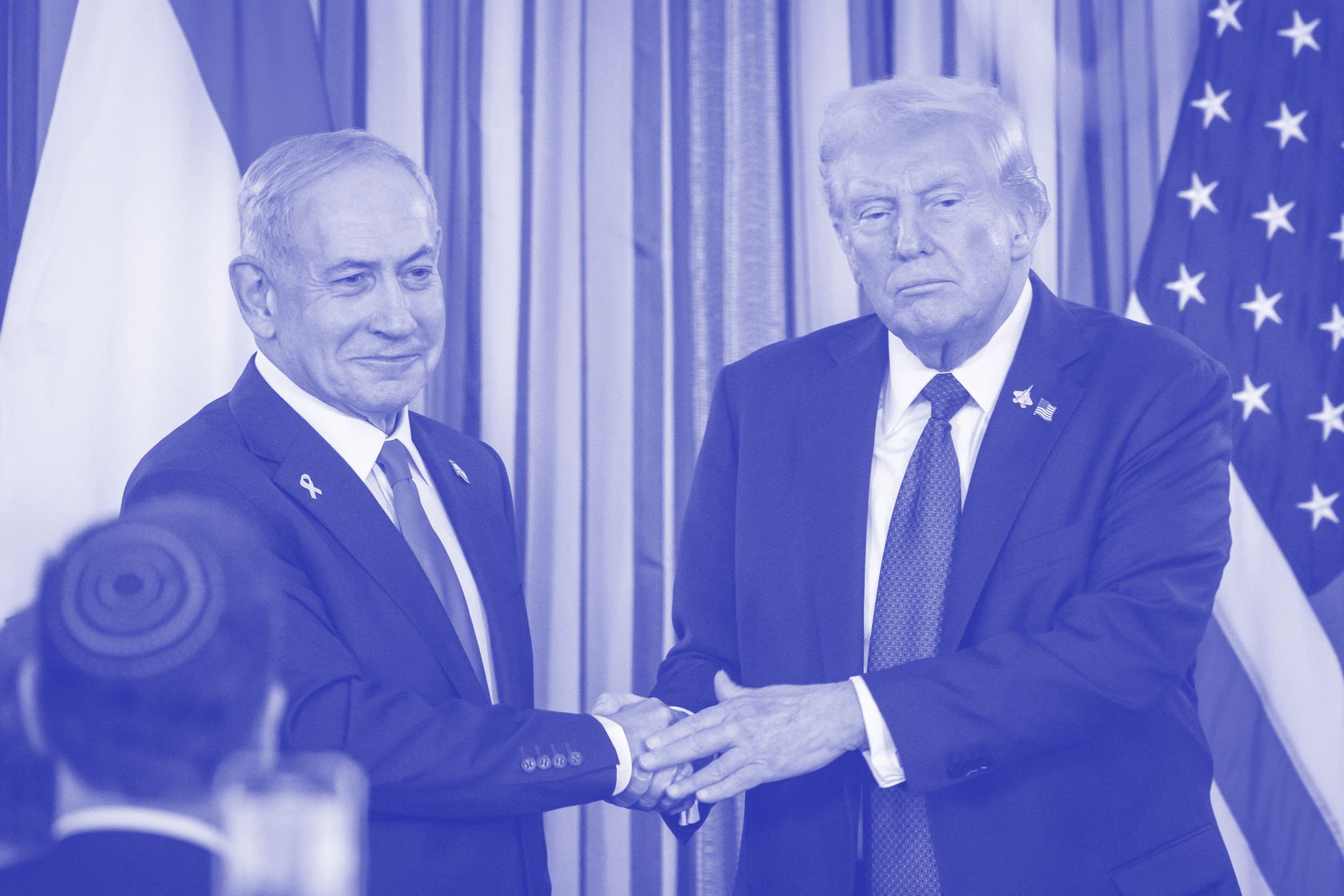
Trump, Netanyahu unveil Gaza peace plan with ultimatum
Plus: ASIC warns super funds, auditors over unlisted asset valuations; Wall Street rally stalls as US shutdown threat grows; EA to go private in record USD55b buyout.

Good morning. Here's what happened overnight and what you need to know today.

1.
Deal or Else: Donald Trump and Benjamin Netanyahu jointly announced they had agreed to a plan to end the war in Gaza, as the White House released the full 20-point proposal. Hamas has the option of accepting the deal, or, as Trump warned, face full US backing for further Israeli military action. The plan calls for an immediate end to hostilities if accepted by both sides, the return of all hostages within 72 hours, and the release of Palestinian prisoners. According to media reports citing a White House email, Hamas, which said it was not consulted and has not yet received the plan, would be required to disarm and relinquish control of Gaza. Governance would shift to a technocratic Palestinian committee overseen by a “Board of Peace” chaired by Trump and involving leaders including Tony Blair. The proposal includes aid resumption, reconstruction, and an economic development plan. “I support your plan to end the war in Gaza, which achieves our war aims. It will bring back to Israel all our hostages,” Netanyahu said. “This can be done the easy way, or it can be done the hard way, but it will be done,” he said. (Capital Brief)(NYT)(AP)(Bloomberg)
2.
Watchdog warning: The Australian Securities and Investments Commission (ASIC) put superannuation funds and auditors on notice with regard to valuation practices for unlisted assets, including private credit. The watchdog will release the findings of its review into financial reporting and audit of super funds today. In its report, ASIC was particularly concerned with the valuation processes of registrable superannuation entity (RSE) assets held through unlisted managed funds, including private credit. It said super trustees and auditors need to be doing more so that valuations of assets are reliable and give members confidence in their investments. ASIC also noted that it was difficult to compare investments between RSEs as they each took different approaches when categorising unlisted investments, often with limited disclosure about their approach. The regulator flagged concerns that sponsorship and advertising expenses were not separately disclosed from other expenses in some RSE financial reports as RSEs “took a narrow, quantitative approach to materiality”. (Capital Brief)
3.
Looming shutdown: A rally in US stocks lost steam as concerns about a looming government shutdown weighed on markets and threatened to delay the release of key economic data, including Friday’s jobs report. The S&P 500 rose 0.26% and the Nasdaq 100 gained 0.48%, while Treasury yields declined and gold hit another record. Investors are worried that the shutdown could cloud the Federal Reserve’s view ahead of its late October meeting. As the deadline approaches, congressional leaders arrived at the White House Monday afternoon for a meeting with President Trump, but both sides have shown little willingness to shift from entrenched positions. Without a funding deal by Tuesday night, many government offices will close, nonessential federal employees will be furloughed or fired, and data collection by the Bureau of Labor Statistics will be suspended. Trump has said he expects a shutdown and has rejected Democrats’ push to extend Affordable Care Act tax credits, which are set to expire at the end of the year. The White House has instructed agencies to prepare layoff plans. (Reuters)(Bloomberg)(WSJ)(AP)
4.
Game over: Video game maker Electronic Arts (EA) agreed to be taken private by a consortium including private equity player Silver Lake, Saudi Arabia’s Public Investment Fund (PIF) and Affinity Partners. EA shareholders will receive USD210 ($320) per share in cash, representing a premium of 25% as of the company's closing share price on 25 September, valuing EA at USD55 billion. The consortium will acquire 100% of EA, with PIF rolling over its existing 9.9% stake in the company. EA said that the transaction represents the largest all-cash sponsor take-private investment in history. The transaction will be funded by a combination of cash and the PIF roll over, constituting a USD36 billion equity investment, and USD20 billion of debt financing by JPMorgan. Jared Kushner, Affinity Partners CEO and son-in-law of Trump, said: “As someone who grew up playing [EA] games - and now enjoys them with his kids - I couldn't be more excited about what's ahead.” (Capital Brief)(EA)(Reuters)
5.
Beautiful coal: The Trump administration will open 13.1 million acres of federal land for leasing to coal miners and inject USD625 million ($951.5 million) into the sector to revive the industry. The Department of the Interior (DOI) said that the expanded leasing will triple the benchmarks set by Trump’s One Big Beautiful Bill Act and deliver on the President’s directive to restore American energy dominance. The DOI said it would reduce the royalty rate paid for coal and would streamline approvals for projects in Wyoming, Tennessee and other states. The USD625 million in funding from the Department of Energy will go to recommissioning or modernising coal plants or funding new projects. US Environmental Protection Agency chief Lee Zeldin said: “We will do more deregulation at the EPA than entire federal governments have done across all federal agencies, across entire presidencies.” Meanwhile, BP approved its USD5 billion Tiber-Guadalupe project off the US Gulf coast. (US DOI)(Bloomberg)(Reuters)(Capital Brief)
6.
Regime frontrunning: Competition lawyers are rushing to lodge exemptions to Australia’s merger clearance rules on behalf of clients eager to be cleared before the competition regulator’s new merger control regime begins next year. The Australian Competition and Consumer Commission will not formally adopt the new rules until 1 January, but it has advised companies doing deals — including those with no competition issues — to apply for exemptions under the current informal merger review process by 30 September to avoid being guinea pigs under the new regime. That guidance has triggered a surge in demand for so-called Section 189 letters, which exempt companies acquiring assets or businesses from undergoing an ACCC clearance and give parties 12 months to complete their transaction. Clayton Utz partner Michael Corrigan told Capital Brief that he had never drafted so many s189 letters, as dealmaking clients sought to avoid the new merger controls, which capture all deals worth more than $250 million. (Capital Brief)
7.
Desperate plea: The nation’s major creative groups are preparing to make a plea for Labor to rule out copyright law reform for the benefit of AI platforms, warning changes would pose a major threat to future licensing deals. The issue is expected to dominate a Senate committee on Labor’s national culture policy today, after a Productivity Commission report last month suggested Australia relax copyright laws to aid the rise of AI platforms. Australian Recording Industry Association chief executive Annabelle Herd told Capital Brief music publishers and the broader creative sector have grown increasingly unsettled by the government’s reluctance to rule out adopting the recommendation. Herd said she gets the sense the government has yet to make up its mind on the issue, and that the uncertainty “is stopping more licensing discussions and more licensing deals from happening.” (Capital Brief)
8.
AI Updates: OpenAI introduced a feature allowing users to make purchases through ChatGPT, in partnership with Etsy and Shopify. US-based ChatGPT Plus, Pro and free users will be able to buy directly from US Etsy sellers, with over a million Shopify merchants. Merchants will pay a fee to OpenAI on completed purchases, while users won’t be charged commission. The Instant Checkout feature currently supports single-item purchases, with plans to expand, OpenAI said. Meanwhile, Anthropic released Claude Sonnet 4.5, a model that can code autonomously for up to 30 hours, compared to seven hours for its predecessor. The company said the model is better at following instructions and taking actions on a user’s computer, and performs particularly well in cybersecurity and financial services. Elsewhere, DeepSeek updated an experimental AI model, calling it a step toward next-generation artificial intelligence. It introduces a new method to improve efficiency when processing long text and is now supported by Huawei chips. DeepSeek also halved prices on its software tools. (OpenAI)(Anthropic)(Bloomberg)(Reuters)(SCMP)
