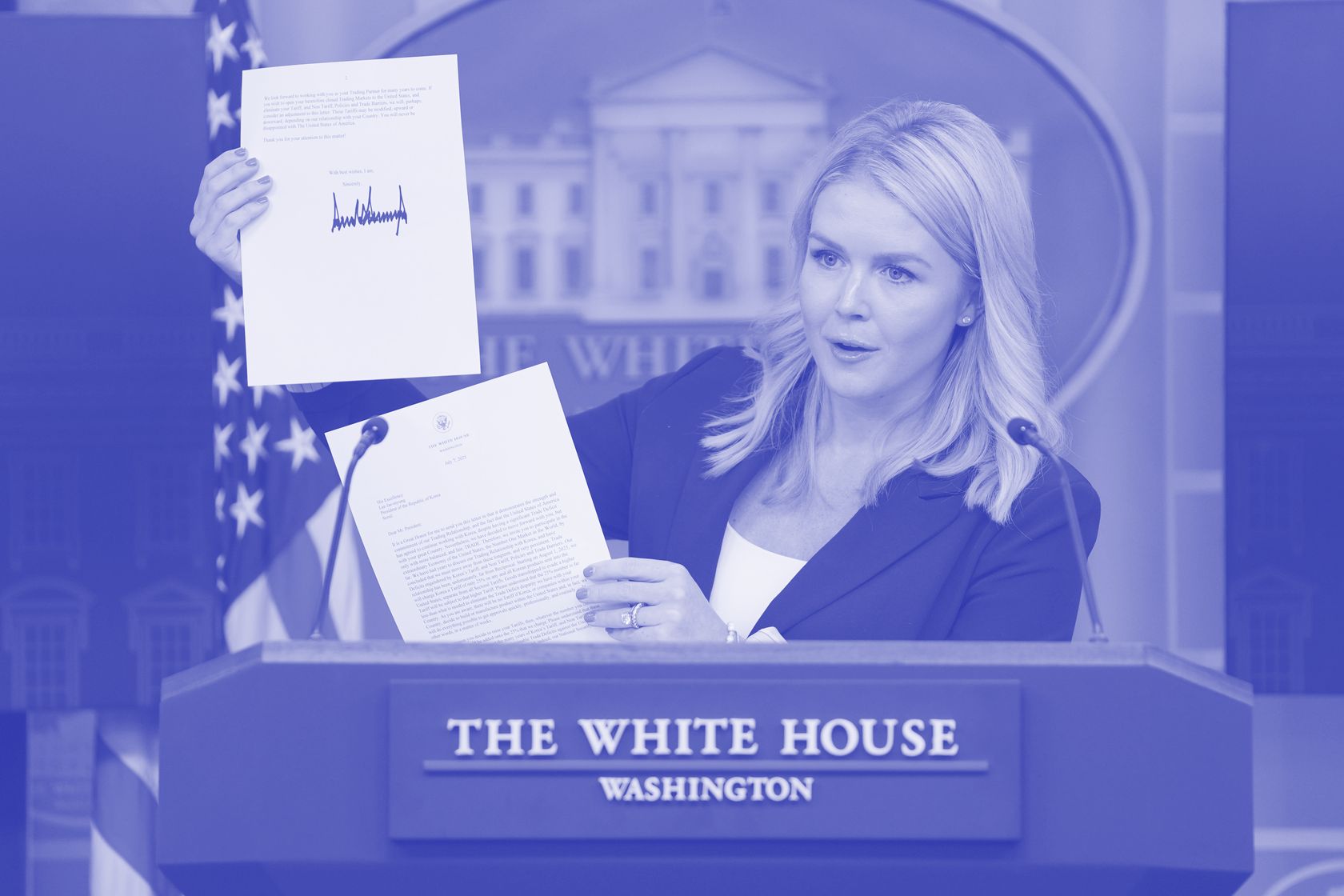
Trump posts batch of 25-40% tariff letters to trading partners
Plus: Australia’s top judge says AI poses ‘existential threat’ to justice system; Markets fall after Trump unveils broad tariffs; Productivity Commission finds tariff upside for Australia.
Good morning. Here's what happened overnight and what you need to know today.
Get Standup in your inbox Signed up to Standup
1.
Tariff missive: US President Donald Trump posted on social media a round of tariff letters notifying trading partners of the rates they’ll face from 1 August. In letters posted to Truth Social, he first announced 25% tariffs on all imports from Japan and South Korea. The letters cited “significant Trade Deficit[s]” and said the tariffs are “separate from all Sectoral Tariffs.” He warned any retaliatory tariffs would be matched, transhipped goods would be penalised and said the rates could be adjusted “upward or downward, depending on our relationship.” Trump then posted the letters to Malaysia (25%), Kazakhstan (25%), South Africa (30%), Laos (40%) and Myanmar (40%). Stocks fell on the news, with Toyota, Honda, SK Telecom and US indexes down. The White House said Trump would today sign an order formally delaying the 9 July deadline to 1 August. Yesterday, Trump also threatened an additional 10% tariff on countries aligned with BRICS policies. (Capital Brief)(Donald Trump posts)(Bloomberg)(Reuters)
2.
Courtroom code: Australia’s chief justice, Stephen Gageler, declared artificial intelligence an “existential threat” to the justice system, forcing courts to reconsider the role of a judge. In an exclusive interview with Capital Brief — his first with an Australian outlet since taking over from Susan Kiefel as chief justice in November 2023 — Gageler said the rapid development of programs such as ChatGPT “calls into question the adversarial system”. “If you're a plaintiff and you have an AI system formulating your arguments, and there's a defendant who has an AI system formulating the defendant's arguments, is a judge going to have another AI system judging between these two computer generated arguments? “Or do you have one AI system? I mean, really, it's that big an issue.” He revealed the court would conduct a “modest” AI trial later this year, but only after it had established guardrails for every step of the experiment. (Capital Brief)
3.
Tariff tremor: Stocks fell from all-time highs and the dollar climbed after Trump began unveiling his tariff plans, setting levies of 25% to 40% on nations including Japan, South Korea, Malaysia, Kazakhstan, South Africa, Laos and Myanmar, starting 1 August. Trump also warned of an extra 10% tariff on any country aligning with “the Anti-American policies of BRICS.” The Nasdaq fell 0.92%, the S&P 500 closed 0.79% lower and the Dow down 0.94%. Tesla dropped 6.79% after Elon Musk announced he’s formed a new political party, with investors disappointed the car manufacturer boss’ political activity has become a major liability for the company. Emerging-market currencies sank and longer-dated Treasuries led bond losses, with yields on the 30-year bond seven basis points higher. (Bloomberg)(WSJ)
4.
Tariff boost?: The Productivity Commission reached the surprising conclusion that Australia may actually benefit from the Trump administration's planned tariffs on exports to the world's largest economy. It's also not convinced the federal government has solved one of the major complaints about its flagship Future Made in Australia (FMIA) plan raised over a year ago by chair Danielle Wood. Alex Robson, deputy chair of the Productivity Commission, told Capital Brief on Monday that it “remains to be seen” whether the federal government would include appropriate off-ramps when providing significant funding to projects under the FMIA plan. The Trade and Assistance Review, released on Monday evening, notes that industry policy, if poorly managed, can be costly, act as trade protectionism and reduce productivity. It also recognises the benefits, such as addressing market failures in critical areas. (Capital Brief)
5.
Data hack: Qantas said that a potential cybercriminal made contact with the airline almost one week after personal data from up to 6 million customer records was stolen from the airline. In a statement released Monday evening, Qantas explained that the Australian Federal Police have been engaged to assess the legitimacy of the contact. Qantas did not confirm the nature of the contact or whether the group asked for a ransom. The airline added that there is no evidence that any personal data stolen from Qantas has been released, “but with the support of specialist cyber security experts, we continue to actively monitor.” Hackers had used AI voice technology to persuade a call centre operative to provide access to Qantas data that had been held by Salesforce as a third-party software provider. In June Google warned about a group of hackers tricking employees using voice phishing tools to gain access to Salesforce data. (Capital Brief)(Qantas)(Google)
6.
Struck gold: Unions won a landmark ruling against BHP after the Fair Work Commission (FWC) approved Australia’s first ‘same job, same pay’ application. The ruling is expected to see average pay rises of $30,000 annually for over 2,200 mineworkers, amounting to a cost of around $66 million each year for BHP. The matter was considered to be a test case for Labor’s industrial relations laws which allow the FWC to order companies to pay labour-hire workers the same wage as directly employed employees if they are performing the same job. The Mining and Energy Union said the decision confirms that “BHP’s labour hire model was used to unfairly undercut wages and it must end.” Minerals Council of Australia chief executive Tania Constable told the AFR the decision confirms “almost any service contractor could be captured by the legislation unless they can litigate their way out.” (MEU)(FWC decision)(Capital Brief)
7.
AI-cquisition: CoreWeave said it will buy bitcoin miner Core Scientific in an all-stock transaction valued at approximately USD9 billion ($13.85 billion), as AI infrastructure companies move to secure energy and data centre capacity to meet surging demand. The offer values Core Scientific at USD20.40 per share, about a 66% premium to its closing price before reports of deal talks surfaced in late June. Core Scientific shareholders will receive 0.1235 share of CoreWeave stock for each share they own. The deal, expected to close in the fourth quarter, will eliminate more than USD10 billion of cumulative future lease overhead and give CoreWeave full control of Core Scientific’s 1.3 GW of power capacity, the company said. CoreWeave had offered USD5.75 per share in 2024, which Core Scientific rejected. Core Scientific filed for bankruptcy in late 2022 and emerged in early 2024. (CoreWeave)(WSJ)
8.
Mushroom murderer: A Supreme Court jury found Erin Patterson guilty on three counts of murder and one count of attempted murder after a highly publicised nine-week trial in Victoria. Patterson was accused of murdering her estranged husband’s parents and aunt by serving them beef Wellington laced with death cap mushrooms in 2023. While Patterson pleaded not guilty, jurors unanimously rejected her defence that the presence of the deadly mushrooms in her meal was nothing more than a tragic accident. Evidence released by the court after the verdict was delivered included photos of the tainted meal after it was brought into the hospital for assessment, as well as images of a food dehydrator used to prepare mushrooms that Patterson had disposed of in a panic after the victims died. Patterson faces life in prison for the crimes, with a date for the sentencing hearing yet to be set. (ABC)(Bloomberg)(BBC)(NYT)