Trump reviews Iran war proposal as King Charles lands in US
Plus: Wall St holds near records ahead of Mag Seven, Fed decision; OpenAI, Microsoft end exclusive partnership; China blocks Meta’s Manus takeover despite integration underway.

Good morning. Here’s what happened overnight and what you need to know today.
1.
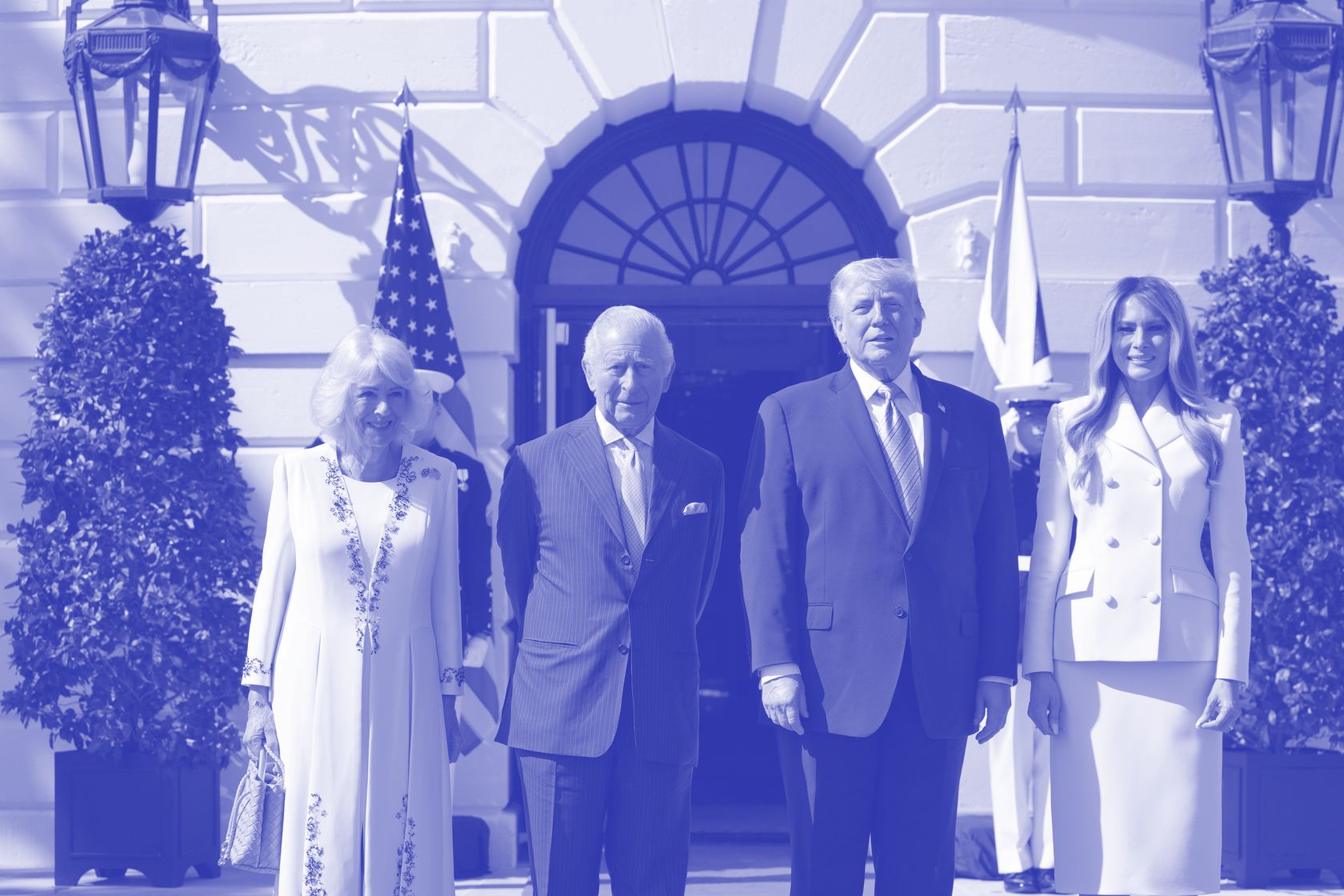
Friendly Assassin: A California man was charged with attempting to assassinate US President Donald Trump after breaching security at the White House Correspondents’ dinner over the weekend armed with a shotgun, a pistol and three knives, in what the White House said was the third major assassination attempt against Trump in two years. Prosecutors said Cole Tomas Allen, 31, of Torrance, California, arrived at the Washington Hilton on Friday local time, checked in and rushed a security checkpoint on Saturday night holding a pump-action shotgun. A Secret Service agent was shot in the chest but protected by a ballistic vest. Allen was taken into custody and suffered only minor injuries. A manifesto left with family members referred to Allen as the “Friendly Federal Assassin,” listing administration officials as targets prioritised by rank, Reuters reported. Meanwhile, Trump convened his national security team to review Iran’s latest proposal to end the war, which would reopen the Strait of Hormuz in exchange for lifting the US naval blockade and defer nuclear negotiations until later, the NYT reported citing three Iranian officials. The White House maintained its red lines, with press secretary Karoline Leavitt reiterating that Iran would not be permitted to obtain a nuclear weapon. Elsewhere, King Charles and Queen Camilla arrived in Maryland for a four-day state visit to the US, the first by a British monarch since Queen Elizabeth II visited in 2007. The visit carries an unofficial diplomatic mission to soothe tensions between Trump and Prime Minister Keir Starmer over the UK’s limited support for US military action against Iran. Charles is due to address Congress and attend a state dinner Tuesday local time. (Reuters)(NYT)(Bloomberg)
2.
Treading water: Wall Street was mixed overnight as investors braced for one of the busiest weeks of the year, with earnings from five of the Magnificent Seven technology giants, a Federal Reserve rate decision and persistent uncertainty over the Iran war all due before the week is out. Both the S&P 500 gained 0.12% and the Nasdaq rose 0.20%, both closing at record highs. The Dow fell 0.13%. Brent crude rose above USD108 a barrel. Goldman Sachs raised its Brent crude forecast to USD90 a barrel for the fourth quarter, up from USD80. Citi meanwhile lifted its second-quarter Brent forecast to USD110 a barrel from USD95, warning flows could remain disrupted through June and prices could average USD130 a barrel in that scenario. In corporate news, Qualcomm shares jumped after tech industry analyst Ming-Chi Kuo suggested the company was working with OpenAI on smartphone processors. Domino’s shares fell after revising down its full-year outlook and its CEO citing consumer sentiment at Covid-era lows. Alphabet, Microsoft, Amazon and Meta are due to report first-quarter results Wednesday (Thursday AEST), when the Fed is also expected to hold rates steady. Apple posts results the following day. (Bloomberg)(Reuters)(WSJ)
3.
Open relationship: Microsoft and OpenAI scrapped their exclusivity agreement, ending the software giant’s sole right to sell and license OpenAI’s technology and opening the door to deals with cloud rivals Amazon and Google. The companies announced the revised deal jointly. Under the new terms, Microsoft retains access to OpenAI’s models and products through 2032 and remains its primary cloud partner, with new products still appearing first on Azure. OpenAI will continue sharing revenue with Microsoft through 2030 under new caps, with those payments no longer tied to technology milestones including the achievement of artificial general intelligence, which the previous agreement explicitly named as a trigger to end those payments. Microsoft, in turn, will no longer pay a revenue share on OpenAI products it resells. The announcement comes after CNBC earlier this month reported an internal OpenAI memo saying the Microsoft partnership had been foundational but had limited its enterprise reach, and that demand since launching on Amazon’s cloud in February had been staggering. “Very interesting announcement from OpenAI this morning,” Amazon CEO Andy Jassy posted, adding the company’s models will be available on its AWS service Bedrock. “Builders will have even more choice to pick the right model for the right job,” he said. Microsoft shares were slightly higher. (Capital Brief)(Joint statement)
4.
Complex unwind: China blocked Meta’s USD2 billion ($2.78 billion) purchase of Singapore-based Manus, an AI startup which was originally established in China. The National Development and Reform Commission on Monday said it would prohibit foreign investment in Manus and in accordance with the law has “required the relevant parties to cancel the acquisition transaction.” The FT reported that an unwinding process would be complicated, as Meta has already begun integrating Manus into some of its tools. Bloomberg reported that Manus employees have already moved into the Meta offices in Singapore, and some executives have joined Meta’s AI team. Capital has already been transferred, with exiting investors Tencent, ZhenFund and Hongshan having already received their proceeds. Separately, Meta signed a deal with startup Overview Energy to secure up to 1 gigawatt of space-based solar power for its data centres by 2030. (FT)(Bloomberg)(SCMP)(CNBC)(Capital Brief)
5.
Ackman humbled: Bill Ackman’s IPO of Pershing Square USA and Pershing Square Inc is expected to raise USD5 billion ($7 billion) when it prices, the low end of a range that had targeted as much as USD10 billion. According to Bloomberg, the deal is about 85% covered by institutional investors. The publication said however that deliberations were ongoing and details could still change. The USD5 billion figure includes a USD2.8 billion private placement secured from family offices, pension funds and insurance companies, Bloomberg reported. The offering is being led by Citi, UBS, Bank of America, Jefferies and Wells Fargo. The private placement is contingent on the minimum USD5 billion being raised. As a sweetener, investors receive one Pershing Square Inc. share for every five Pershing Square USA shares purchased, with private placement investors receiving 1.5 shares on the same basis. (Bloomberg)(Reuters)
6.
Super skirmish: A fierce political fight is brewing as lobby groups argue over how to best protect Australia’s $4.5 trillion retirement savings following the collapse of Shield and First Guardian. The peak body for the nation’s largest industry funds, Super Members Council (SMC), is calling on the federal government to persevere with ambitious reform and force self-directed superannuants to pick up the bill for future losses. SMC chief executive Misha Schubert has backed Treasury, which has proposed self-managed super funds (SMSFs) either opt in and help fund the compensation scheme of last resort or be deemed ineligible to make a claim. “At last glance SMSFs make about 80% of compensation claims,” Schubert told Capital Brief. “At the moment, you’ve got a situation where minimum wage workers are being asked to pay the levy for a scheme they will never claim on,” she said. As consultation continues on Treasury’s proposals which could reshape the sector, each faction is now working to influence the final decision. (Capital Brief)
7.
Budget data: Almost half of the CEOs of mid-market businesses surveyed by KPMG expect no real growth over the remainder of 2026 amid rising interest rates and surging fuel prices. Very few are optimistic about their medium-term prospects. KPMG’s Mid-Market Pre-Budget Pulse Check surveyed 150 CEOs of “mid-market” businesses, which are largely privately- or family-owned businesses, with revenue between $10 million and $1 billion. Of these leaders, 47% do not expect real growth over the rest of the year and only 6% are optimistic about their ability to secure 10% growth or more over the medium term. The survey indicates the policies with the most support from these businesses are for the government to cut red tape (64% support), retain the instant asset write-off (44%) and help boost critical manufacturing (41%) at the upcoming 12 May budget. There is also substantial support for major tax reform (50%), with lifting GST garnering the most approval (50%). (Capital Brief)
8.
Stretch the flex: Rest chief investment officer Michael Clancy wants the federal government to give superannuation funds more flexibility with their investment activities when Treasurer Jim Chalmers unveils long-awaited changes to the performance tests. Speaking to Capital Brief in a wide-ranging interview, Clancy said the $105 billion retirement fund is supportive of the current performance tests and the discipline it imposes on those managing investments on behalf of Australians. But he flagged a desire held by many in the industry for more flexibility, amid concerns the current rules stifle investments in startups and venture capital. On the US-Iran conflict, Clancy said it has created volatility but is not a “crisis level of volatility” and that Rest’s investment team has the liquidity to take advantage of those opportunities to reinvest. Despite expectations that Rest will invest a greater proportion of its capital offshore as the fund grows over the next decade, the super fund does not have any immediate plans to open a US office. (Capital Brief)
