Trump says Iran ceasefire is over, warns more strikes
Plus: Oil surges and shares fall on Iran; Trump says US to licence Ukraine to make Patriot missiles; IMF cuts 2026 global growth forecast to 3%.

Good morning. Here’s what happened overnight and what you need to know today.
1.
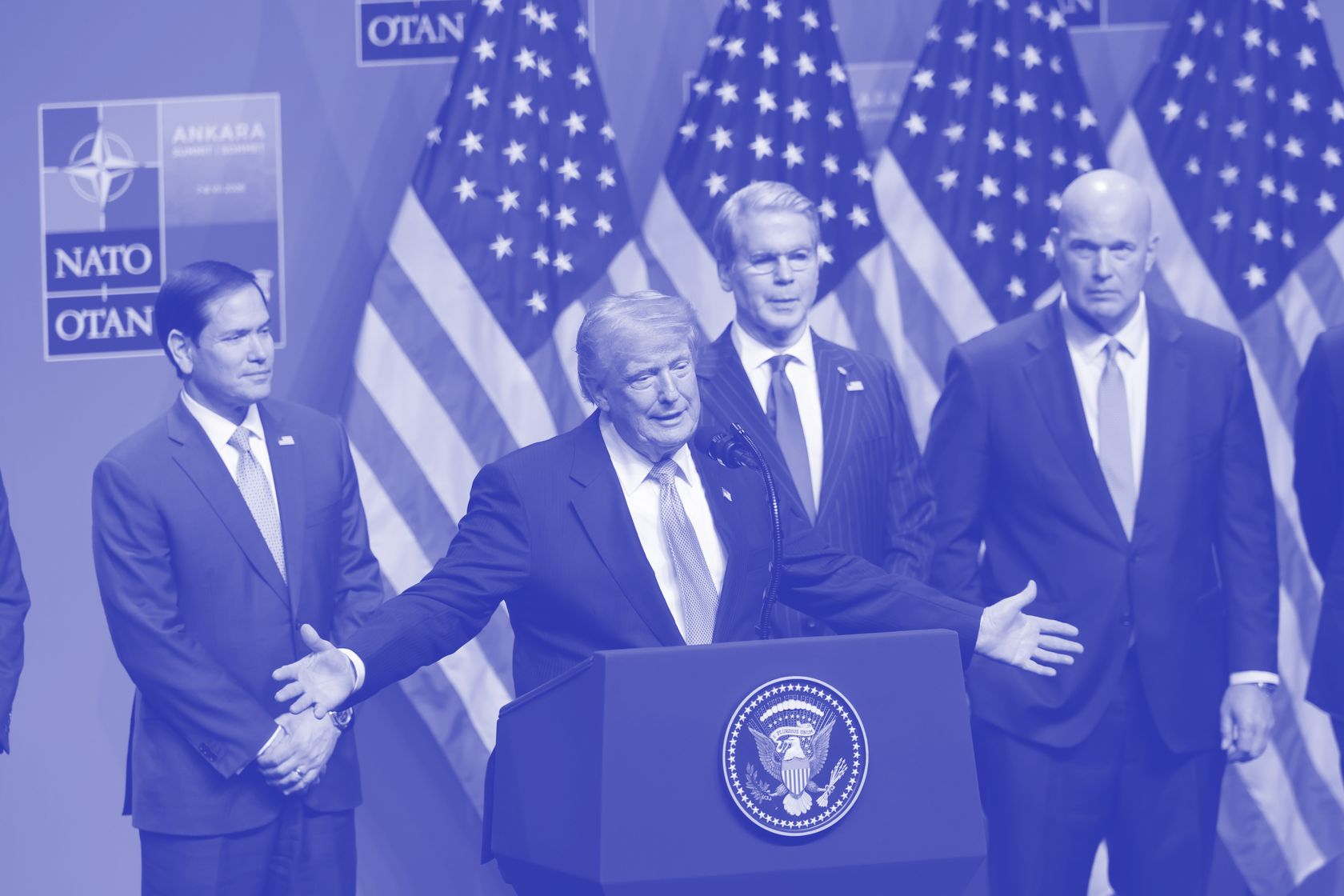
Two minds: US President Donald Trump declared his Iran ceasefire “over” and threatened fresh strikes within hours, only to insist minutes later that he did not expect a return to full-scale war. The truce he signed last month unravelled during the NATO summit in Turkey, where he called Iran’s leaders “scum” and “sick people” and warned the US would probably hit Iran again that night. “I’ll give them a little warning: We’re going to hit them hard tonight,” he said. He also floated a renewed naval blockade and a possible move on the oil hub of Kharg Island. The flare-up followed overnight US strikes on more than 80 Iranian sites, launched in response to attacks on ships in the Strait of Hormuz that Washington blamed on Tehran. Iran said it retaliated against US bases in Bahrain and Kuwait, and reported eight of its own air force and navy personnel killed in the US strikes. (NYT)(Reuters)(FT)
2.
Inflation shock: Oil prices surged and global stocks and bonds sold off after US President Donald Trump declared his Iran ceasefire over and threatened fresh strikes, reviving inflation fears that markets had begun to shake off. Brent crude briefly topped USD80 a barrel before settling up 5.2% at USD78.02. The Dow fell 577 points, or 1.09%, and the S&P 500 slipped 0.28%, though the Nasdaq edged 0.20% higher as chipmakers rallied. Bond yields jumped as traders priced in a greater chance of central bank rate rises, lifting money-market bets on a Federal Reserve hike by October. Minutes from the Fed’s June meeting showed officials’ concern about inflation mounting, with a few participants making a case to raise rates immediately. Diesel futures also leapt 11% in New York after Russia banned exports following Ukrainian drone strikes on its refineries. Elsewhere, Nvidia rose after The Information reported China plans to allow its top AI companies to buy a limited number of its H200 chips. And Italy’s UniCredit said it likely won voting control of Commerzbank, lifting its stake to just under 50% and moving closer to the landmark takeover of the German lender. (WSJ)(Bloomberg)(Reuters)
3.
Patriot games: Also at the NATO summit in Turkey, Trump said the US would grant Ukraine a licence to manufacture its own Patriot missile interceptors, meeting a longstanding request from Kyiv. Sitting beside Volodymyr Zelensky, Trump praised the Ukrainian leader as having done “an amazing job” in a sharp turn from their disastrous Oval Office meeting last year. Russian ballistic missiles killed dozens in Kyiv this week, with Ukraine unable to shoot any of them down, underscoring the critical shortage of the interceptors that are the only weapon capable of stopping them. Analysts cautioned that production could take years and hinges on US firms sharing sensitive technology. Meanwhile, NATO leaders pledged EUR70 billion in military aid to Ukraine (including previously committed funds) for 2026 and 2027, reaffirming their “ironclad commitment” to collective defence. Earlier, Trump had lashed allies, threatening to cut trade with Spain and renewing his claim to Greenland, before emerging from closed-door talks to declare “tremendous unity" at a “very successful” NATO summit. (NATO)(White House)(Reuters)(FT)(Bloomberg)
4.
Growth factors: The IMF trimmed its 2026 global growth forecast while crediting the artificial intelligence boom with keeping the world economy afloat through the Middle East war. In its latest World Economic Outlook update, the fund also slightly cut its forecast for Australia, though the economy is still seen growing faster than most G7 nations. The fund lowered its 2026 global forecast to 3%, from 3.1% in April, and lifted its 2027 projection to 3.4%. It said the world economy had weathered the war better than feared, with demand for AI and other technologies offsetting a sharp drop in energy supplies. The IMF now forecasts Australian growth of 1.9% in 2026, down 0.1 percentage points, and 1.7% in 2027. It raised its 2026 global headline inflation forecast to 4.7%, from 4.4%, citing energy and food costs. The fund warned risks remained tilted to the downside, pointing to renewed geopolitical tensions, trade fragmentation and a possible correction in AI-driven market expectations. Treasurer Jim Chalmers said Australia was well-placed to manage both the fuel shock and the AI boom. It comes after RBA chief economist Sarah Hunter said Australia may need a period of higher unemployment to bring inflation expectations down. (IMF)(Capital Brief)(AFR)(Reuters)
5.
Money factory: Firmus Technologies is close to raising USD2 billion ($2.9 billion) in fresh equity to fund its Australian assets, lifting the AI infrastructure startup’s valuation to $15.5 billion, the AFR reported citing unnamed sources. According to the report, Firmus called an extraordinary general meeting for 31 July, asking existing shareholders to vote on its biggest equity raising to date. Preference shares were offered at $230 each, giving the company a post-money equity value of $15.5 billion, it said, adding the deal was not marketed externally (so no banking syndicate needed) and was taken up by existing shareholders. The valuation does not include revenue expected from its recently announced Indonesian data centre, where it is partnering with Nvidia. Instead, the USD2 billion was pitched as the final funding piece for its Launceston projects, and will also fund early works in South Australia, where Firmus has a 600-megawatt contract with Swedish energy company Gunvor. The raising roughly doubles its equity value from just under $8 billion. It follows the neocloud delaying its initial public offering to later in the September quarter. (AFR)
6.
Label maker: Music, art and other cultural works produced by artificial intelligence would have to be labelled as such under a policy that rank-and-file Labor members are pushing the Albanese government to legislate, according to the AFR. A copy of the most up-to-date version of Labor’s draft national policy platform, to be adopted at the party’s national conference later this month, includes new legal requirements for AI labelling on music and cultural works. Under existing policy, such labelling is only recommended as best practice, not a legal requirement. The draft platform also pledges to protect the authenticity of First Nations artworks. It comes as Attorney-General Michelle Rowland is working with rights holders and AI labs on a copyright model that pays rights holders when their works are used for AI training. Earlier this week the government ruled out a text and data-mining exemption on copyright laws, after the AFR reported Anthropic was seeking one as part of a reported demand for 1.4 gigawatts of Australian data centre capacity. Albanese, who will give a major speech on AI next week, said in Brisbane the creative sector should be supported and compensated when its work is used. (AFR)(Capital Brief)
7.
No worries: Treasury brushed off concerns raised by former ASIC chair Joe Longo that the regulator risks running out of resources to pursue tough cases, insisting the body is adequately funded to punish serious corporate misconduct. It comes after Longo told Parliament the agency was running out of the cash reserves used to cover the risk of losing court battles. “Absent replenishment, this will impede ASIC’s ability to maintain its current enforcement program. We are engaging with Treasury and government about this,” he said in May. ASIC has had a record run recently, securing $800 million in civil penalties last financial year including from ANZ, HSBC and National Australia Bank. However, the money flows to the federal government rather than funding future litigation. Treasury told Capital Brief the regulator was still “well funded to fulfil its responsibilities” and any additional funding would be considered through the usual budget process. ASIC received $50 million for its special accounts this financial year but is budgeted to receive only $46.2 million next year. (Capital Brief)
8.
Yellowcake walk: Australia and India are set to sign a commercial uranium supply deal during Narendra Modi’s visit this week, unlocking exports more than a decade after the two countries agreed a nuclear co-operation pact, according to media reports. Anthony Albanese flagged the deal to reporters yesterday, saying he would have “more to say” when he meets Modi today. Only negligible shipments have flowed since the 2014 pact, held up because India, which possesses nuclear weapons and has not signed the non-proliferation treaty, could not guarantee the fuel would be used solely for peaceful purposes. Changes to Indian safeguards have now cleared the way. India aims to lift nuclear capacity tenfold to 100GW by 2047, driven by surging power demand from AI and data centres. ASX-listed miners including Boss Energy stand to benefit, alongside producer BHP, which extracts uranium at Olympic Dam. Pacts on critical minerals and defence co-operation are also expected. (SMH)(AFR)
9.
Negative aura: As construction and fit-out firm FDC gears up for one of the biggest local floats of the year later today, another listing is due to hit the ASX through the backdoor. Boston-based digital safety platform Aura will list via an all-scrip merger with ASX-listed Qoria, a local software company focused on student wellbeing, in a deal that valued the combined business at USD2.1 billion ($3 billion). It has been poorly received by Qoria’s existing shareholders, with shares more than halving in value since the deal was announced. Managing director Tim Levy told Capital Brief the exodus was triggered by a combination of factors. “The company that is buying us, and the company that is listing on the capital markets, hadn’t done disclosures yet, and so there was uncertainty about what that meant, at the same time as the SaaSpocalypse story,” he said. Aura raised USD100 million as part of the merger, which may help reassure investors when it begins trading under the ticker AXQ. Elsewhere, Ellerston-backed Southern Cross AI (SCX.ai), an AI infrastructure service provider will open its bookbuild today for an August ASX float to raise $40 million (at a $75 million market cap), according to the AFR. (Capital Brief)
