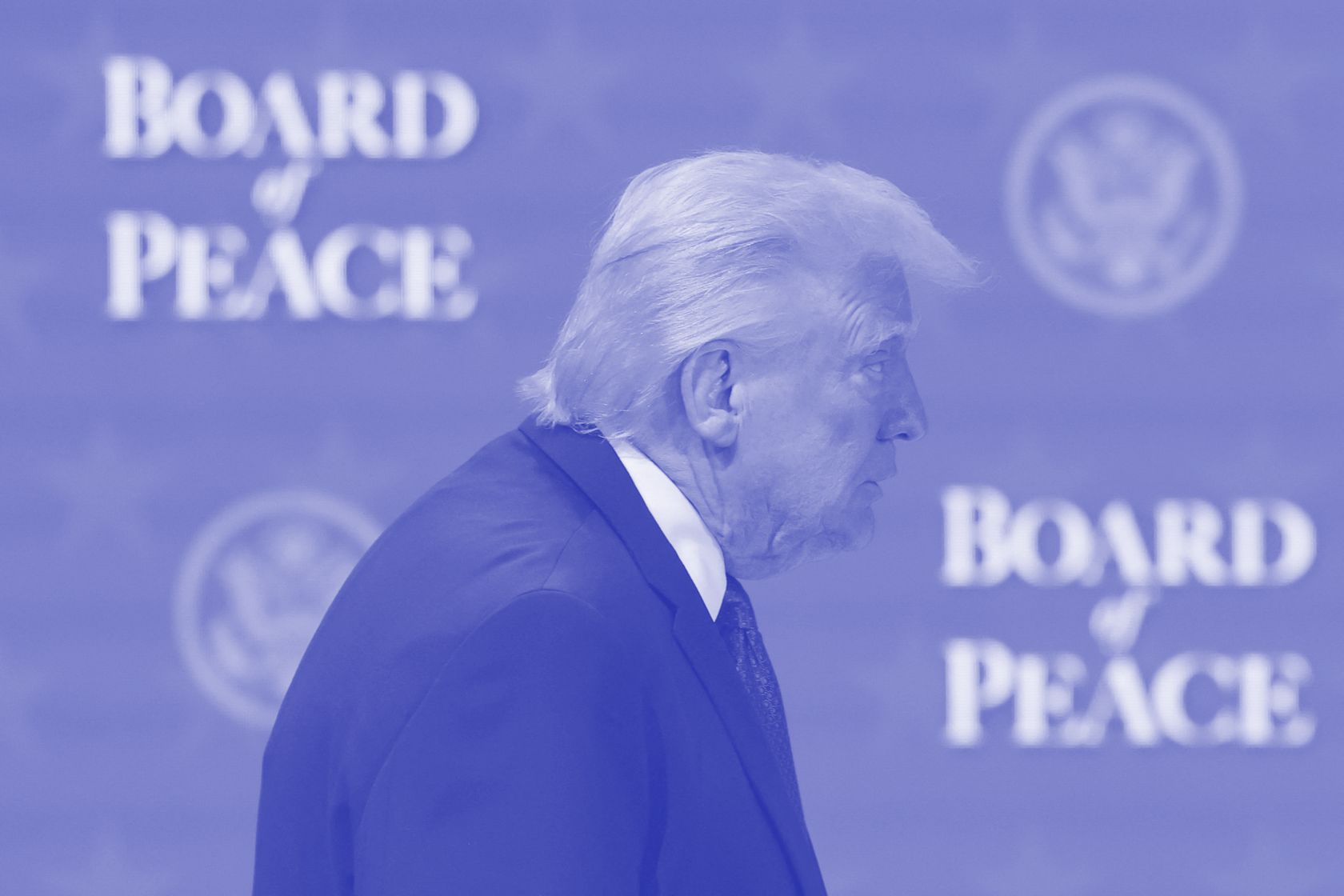
Trump says peace board members pledge over USD5b for Gaza
Plus: ‘No one writes code anymore’, says Harvey’s Pereyra; Treasury quietly halves Consumer Data Right team; US prepares for sustained conflict as Iran signals compromise.


Good morning. Here’s what happened overnight and what you need to know today.

1.
Body of peace: Donald Trump said founding member countries of his Board of Peace have pledged more than USD5 billion ($7 billion) toward humanitarian efforts and reconstruction in Gaza and are set to commit “thousands of personnel” to a UN-authorised international stabilisation and police force. Trump wrote on Truth Social that he will formally unveil the pledges when the board meets in Washington on Thursday. Gaza’s reconstruction is estimated to cost USD70 billion, based on United Nations, World Bank and European Union estimates. Meanwhile, Indonesia’s military said up to 8,000 troops are expected to be ready by late June for a potential humanitarian and peace mission, marking the first firm commitment to the proposed force. The US president said Hamas must carry out full and immediate demilitarisation as per the US-brokered ceasefire agreement. “The Board of Peace will prove to be the most consequential International Body in History, and it is my honor to serve as its Chairman,” he posted. Separately, Israel’s cabinet approved measures to begin land registration in the West Bank for the first time since 1967 and to make it easier for settlers to buy land. Finance Minister Bezalel Smotrich said: “We are continuing the revolution of settlement.” The Palestinian presidency called the move “a de-facto annexation of occupied Palestinian territory”. (AP)(Bloomberg)
2.
Legal code: “No one at our company writes code anymore,” Harvey co-founder and president Gabe Pereyra told Capital Brief in Sydney on the final day of his Australian visit last week, just as markets were panicking about whether AI will devour the software industry. With the latest coding models, he said, he can build in 30 minutes what once took a month, and “an engineer who doesn’t use AI tools wouldn’t get hired at Harvey”. But he does not believe Anthropic, OpenAI or any other model provider is about to replace entire professions, including lawyers. “The thing I always struggle to articulate is it feels like this is going to get faster than people expect, but it’s not going to get to expert level as quickly as people think,” he said. “The world’s too complicated… One company isn’t going to solve all of the world’s problems.” The legal AI startup, backed by Sequoia and OpenAI, operates in more than 60 countries, including Australia where it opened an office in September last year and has a team of 20. (Capital Brief)
3.
CDR reality: Treasury has quietly slashed in half the team managing its high-profile consumer data right program, despite repeatedly saying it is committed to rolling it out to more industries. In response to a question on notice from deputy Liberal leader Jane Hume at a Senate committee hearing published last week, Treasury revealed its CDR team has been cut to 26.4 full-time employees in November 2025, down from 52.3 three years earlier, representing a nearly 50% drop in staff. The job cuts affect an economy-wide program to make it easier for consumers to switch between service providers in various industries and a key pillar of open banking. FinTech Australia CEO Rehan D’Almeida told Capital Brief the industry body’s work with Treasury had been “very collaborative and constructive” despite prior concerns regarding policy and technology limitations, along with the slow pace of progress. CDR launched in July 2020 with the big four banks. In June 2023, the government announced it would pause the rollout to superannuation, insurance and telecommunications. In August 2024, it announced it would reset the CDR as costs were too high for small businesses to implement which led to a low uptake, with draft proposals expected to be published early this year. (Capital Brief)
4.
Iran talks: The US military is preparing for the possibility of sustained, weeks-long operations against Iran if Donald Trump orders an attack, Reuters reported citing two US officials, as Washington and Tehran prepare for a second round of indirect nuclear talks in Geneva this week. The officials said planning for a sustained campaign was under way and that the US fully expected Iran to retaliate, raising the stakes for diplomacy aimed at resolving their decades-long dispute over Tehran’s nuclear programme and averting a new military confrontation. Steve Witkoff and Jared Kushner are expected to meet Iranian officials in Geneva, with Oman acting as mediator. On Saturday, US Secretary of State Marco Rubio said Trump preferred diplomacy but that reaching a deal was “very hard to do”. Iran has signalled it is ready to compromise on its nuclear programme in return for sanctions relief. Hamid Ghanbari, foreign ministry deputy director for economic diplomacy, said, according to the semi-official Fars news agency, that “common interests in the oil and gas fields, joint fields, mining investments, and even aircraft purchases are included in the negotiations”. In an interview with the BBC in Tehran on Sunday, Deputy Foreign Minister Majid Takht-Ravanchi said Iran was “ready to discuss this and other issues related to our programme if they are ready to talk about sanctions”, pointing to Tehran’s offer to dilute its 60%-enriched uranium. He reiterated, however, that Tehran would not accept “zero uranium enrichment”. (Reuters)(BBC)
5.
Six-pack payday: After years of restraint following the 2008 global financial crisis, Wall Street is handing top bank chief executives record payouts, with six leaders collecting more than USD250 million ($353 million) combined in 2025 and each receiving at least USD40 million. The bosses of JPMorgan, Bank of America, Citigroup, Goldman Sachs, Wells Fargo and Morgan Stanley all earned USD40 million or more, with combined average pay increases of 22% on the prior year. According to Bloomberg records, the compensation surpassed records set in 2006 and 2021 and reflects a banner year in which the nation’s largest financial firms posted their biggest annual earnings since 2021. Goldman Sachs’ David Solomon was the highest paid at USD47 million, including USD10.1 million in cash bonus, USD31.5 million in stock and USD3.4 million in carried interest. Bank of America disclosed that Brian Moynihan’s pay rose 17% to USD41 million, while Citigroup said Jane Fraser’s compensation increased 22% to USD42 million and included a USD25 million retention bonus in October. JPMorgan’s Jamie Dimon received USD43 million and Morgan Stanley’s Ted Pick USD45 million. (FT)(Bloomberg)
6.
Euro backstop: The European Central Bank announced plans to widen access to its euro liquidity backstop, making it globally available and permanent from the third quarter of 2026, as it seeks to bolster the international role of the single currency amid geopolitical turmoil and shifting global alliances. The ECB said it will offer repo lines to “all central banks, unless excluded on the grounds of, in particular, money laundering, terrorist financing or international sanctions”, with the changes applying as of the third quarter. The facility will provide standing access for up to EUR50 billion. Announcing the move at the Munich Security Conference, ECB President Christine Lagarde said, “We must avoid a situation where that stress triggers fire sales of euro-denominated securities in global funding markets, which could hamper the transmission of our monetary policy.” She added, “The availability of a lender of last resort for central banks worldwide boosts confidence to invest, borrow and trade in euros.” The revamped Eurosystem repo facility for central banks, or EUREP, created in 2020 during the pandemic, allows foreign central banks to borrow euros against high-quality euro-denominated collateral. “There are no ex ante restrictions on how non-euro area central banks can use funds borrowed under the revised EUREP,” the ECB said, adding it will no longer publish country-level usage and instead disclose overall weekly drawings across all repo lines. (Reuters)(Bloomberg)(ECB)
7.
Defence reset: European leaders said they would accelerate efforts to boost their own defences and rely less on the US after US President Donald Trump’s push to annex Greenland increased European doubts about Washington’s commitment to protect the continent through NATO. At the Munich Security Conference, European Commission President Ursula von der Leyen said “some lines have been crossed that cannot be uncrossed anymore”. With Russia’s war in Ukraine about to enter its fifth year and Moscow viewed as an increasing threat, leaders said they would step up defence efforts. German Chancellor Friedrich Merz said on Friday he had “begun confidential talks with the French President on European nuclear deterrence”, adding that in an era of great power rivalry “even the United States will not be powerful enough to go it alone” as he urged Washington to “repair and revive transatlantic trust”. President Emmanuel Macron said “this is the right time for a strong Europe” and that Europe must “reshuffle and reorganise our architecture of security”, arguing the previous Cold War framework is obsolete. France is the EU’s only nuclear power. US Secretary of State Marco Rubio said transatlantic ties faced a “defining moment” but that ending the transatlantic era “is neither our goal nor our wish”. (AP)(Reuters)
8.
China’s main driver: Xi Jinping urged officials to anchor China’s economic growth around domestic demand as its “main driver”, as Beijing braces for more uncertainty abroad despite posting a record USD1.2 trillion goods trade surplus during its tariff war with the US. In remarks delivered in December at the Central Economic Work Conference and released on Sunday, Xi said China should “coordinate efforts to boost consumption and expand investment” and “fully leverage the advantages of China’s super-large-scale market”, according to comments published by Qiushi, the Communist Party’s flagship journal. “We must focus on improving people’s livelihoods and boosting future growth, stabilizing investment,” he said. China’s economy expanded 5% last year, with record exports compensating for cooling private consumption and a drop in investment, a lopsided growth model that will likely become harder to sustain in an era of rising protectionism across the world. (Bloomberg)(QSTheory)
