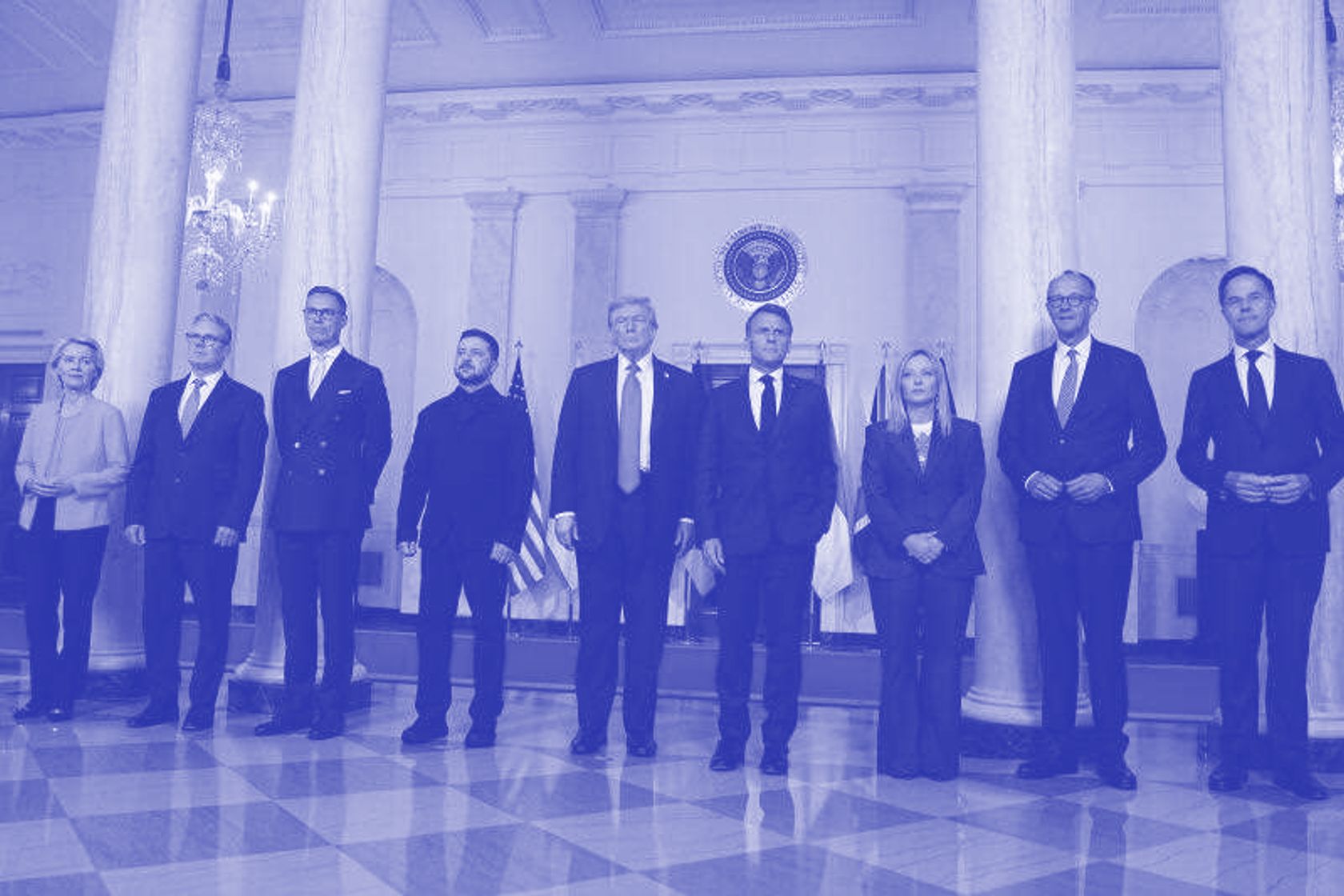
Trump says Russia will accept Ukraine security guarantees
Plus: Labor’s envoy courts OpenAI, tech giants for local AI centres; Citi takes ten senior JPMorgan bankers in global talent spree; Trump administration in talks to take 10% stake in Intel: Bloomberg.
Good morning. Here's what happened overnight and what you need to know today.
Get Standup in your inbox Signed up to Standup
1.
Trump’s trilat: US President Donald Trump said Russia would accept security guarantees for Ukraine and pledged to pursue a trilateral meeting with Vladimir Putin and Volodymir Zelensky that he said could end the war. Speaking at a hastily arranged White House summit with European leaders just days after meeting with Putin in Alaska, Trump again said a peace deal could be reached without a ceasefire, an idea opposed by Zelensky and most European leaders. “President Putin agreed that Russia would accept security guarantees for Ukraine. And this is one of the key points that we need to consider, and we’re going to be considering that at the table,” Trump said. “I’m optimistic that collectively, we can reach an agreement that would deter any future aggression against Ukraine. We also need to discuss the possible exchange of territory,” Trump added. “Ultimately this is a decision that can only be made by President Zelensky and by the people of Ukraine, working also in agreement with President Putin.” European leaders pushed for strong security guarantees with some also pressing for a cease-fire. Hours earlier, Russian attacks on Kharkiv and Zaporizhzhia killed at least 10 civilians, including two children. (Capital Brief)(Bloomberg)(WSJ)(Reuters)(NYT)
2.
AI downunder: The Labor government's point man on the digital economy, Andrew Charlton, held talks with a senior OpenAI executive to pitch the idea of Australia as a data centre hub capable of hosting artificial intelligence platforms. Charlton also met with C-Suite executives from Google, Anthropic, Nvidia, Amazon Web Services and Groq to discuss the data centre hub idea. The visit comes as Tech Council of Australia chair Scott Farquhar's proposal to loosen copyright laws to encourage Big Tech giants to train their AI models in Australia has raised alarms within creative communities and the media. Ahead of the economic roundtable in Canberra, the Productivity Commission also floated the idea that Australia's copyright laws may need to be updated for the AI age. Charlton met with OpenAI COO Brad Lightcap and chief strategy officer Jason Kwon during a trip to the US last week. (Capital Brief)
3.
Citi’s raid: Citigroup’s banking chief Vis Raghavan has accelerated a global hiring spree of former JPMorgan Chase colleagues, with at least 10 senior investment bankers now agreeing to join the rival US bank, according to the Financial Times. The latest recruits include Amit Nayyar as co-head of European technology banking, Guillermo Baygual as co-head of global M&A, Pankaj Goel as co-head of technology investment banking, BJ Vargas as head of North American equity capital markets and Ashish Agarwal as a senior real estate banker. They join five other ex-JPMorgan bankers who have already taken up senior roles at Citi, alongside senior hires from Goldman Sachs and Ares Management. The hires come as Citi grows its direct lending business through a USD25 billion ($38.5 billion) private credit venture with Apollo. The American bank ranks fifth globally in investment banking revenue with a 4.5% market share, with investment banking fees rising 13% in the second quarter. (FT)
4.
Intel deal: The Trump administration is in discussions to take a 10% stake in Intel Corp, Bloomberg reported, citing a White House official and other people familiar with the matter. The deal would involve converting some or all of the chipmaker’s USD10.9 billion ($16.9 billion) in Chips Act grants into equity, according to the report. At current market value, the stake would be worth about USD10.5 billion and could make the US government Intel’s largest shareholder. Intel shares fell over 3% on Monday (Tuesday AEST) after the report. According to the publication, the idea is part of a broader effort by the Trump administration to take a more aggressive role in strategic sectors, including semiconductors and rare earths. (Bloomberg)
5.
Israel-Palestine Conflict: Israel revoked the visas of Australian representatives to the Palestinian Authority, stating that the move was made in response to Australia's decision to recognise a State of Palestine and the recent visa cancellations of certain Israeli politicians. Israel's Foreign Minister, Gideon Sa’ar, said via X that antisemitism in Australia is rampant and that the Australian government is choosing to fuel it. Sa’ar said he has instructed the Israeli Embassy in Canberra to thoroughly review every official Australian visa request for entry into Israel. The move follows the Australian government’s refusal to grant visas to high-profile Israelis, including politician Simcha Rothman. On the Rothman decision, Home Affairs Minister Tony Burke said Australia would not accept people travelling to cause division. Sa’ar added that Australia's ambassador to Israel had been notified about the visa cancellations and the ABC reports that the decision may only affect two staff. (Gideon Sa'ar)(ABC)(The Australian)(Capital Brief)
6.
Canola commitment: China is making efforts to reopen rapeseed trade with Australia after a five-year hiatus, as it seeks to secure supplies of a key animal feed ingredient as ties with supplier Canada sour, according to sources cited by Bloomberg. Last week, Chinese agriculture trader Cofco made inquiries with major exporters in Australia on prices and to settle specific terms to book the new rapeseed crop expected in October. Bloomberg added that the state-owned trading giant accelerated its efforts to secure supplies from Australia after Beijing’s decision to impose a temporary duty of 75.8% on shipments from Canada following an anti-dumping probe. Australia and China are yet to agree on phytosanitary issues, over which China shut Australian canola out of its market from 2020, but Beijing has reportedly agreed in principle to obtain some trial cargoes from Australia. Australia is the world’s second largest canola exporter. (Bloomberg)(Capital Brief)
7.
Members only: A group of investors led by New York-based MCR Hotels is taking members-only club Soho House private in a USD2.7 billion ($4.15 billion) deal. Soho House's shareholders will receive USD9 per share, a 17.8% premium to the stock's closing price of USD7.64 on Friday. MCR and its chairman and CEO Tyler Morse will acquire the outstanding shares of Soho House not held by certain significant shareholders. The FT reports that the deal values the company’s equity at roughly USD1.8 billion, excluding debt, according to people familiar with the matter. Morse will join the Soho House board, but Ron Burkle, Soho’s executive chairman, and the existing shareholder Yucaipa Companies LLC will retain majority control. Further new equity capital will be provided by a consortium of investors led by technology investor Ashton Kutcher, who will also join Soho House’s board. (Soho House)(Bloomberg)(WSJ)(FT)(Capital Brief)
8.
Novo offer: Shares in Novo Nordisk rose after the company halved the out-of-pocket price of Ozempic in the US and gained conditional FDA approval to expand Wegovy’s use. The drugs are now offered at USD499 a month to uninsured or cash-paying patients through NovoCare, Ozempic.com, GoodRx and other platforms. Novo said the discount is not related to ongoing US government pressure over high drug prices. The offer came as the FDA approved Wegovy to treat adults with metabolic dysfunction-associated steatohepatitis (MASH) and moderate to advanced liver fibrosis, alongside diet and exercise. The approval was based on a 72-week trial showing the drug improved liver fibrosis without worsening steatohepatitis. GoodRx shares jumped over 37%. (Capital Brief)(Novo Nordisk)(GoodRx)(Bloomberg)(CNBC)