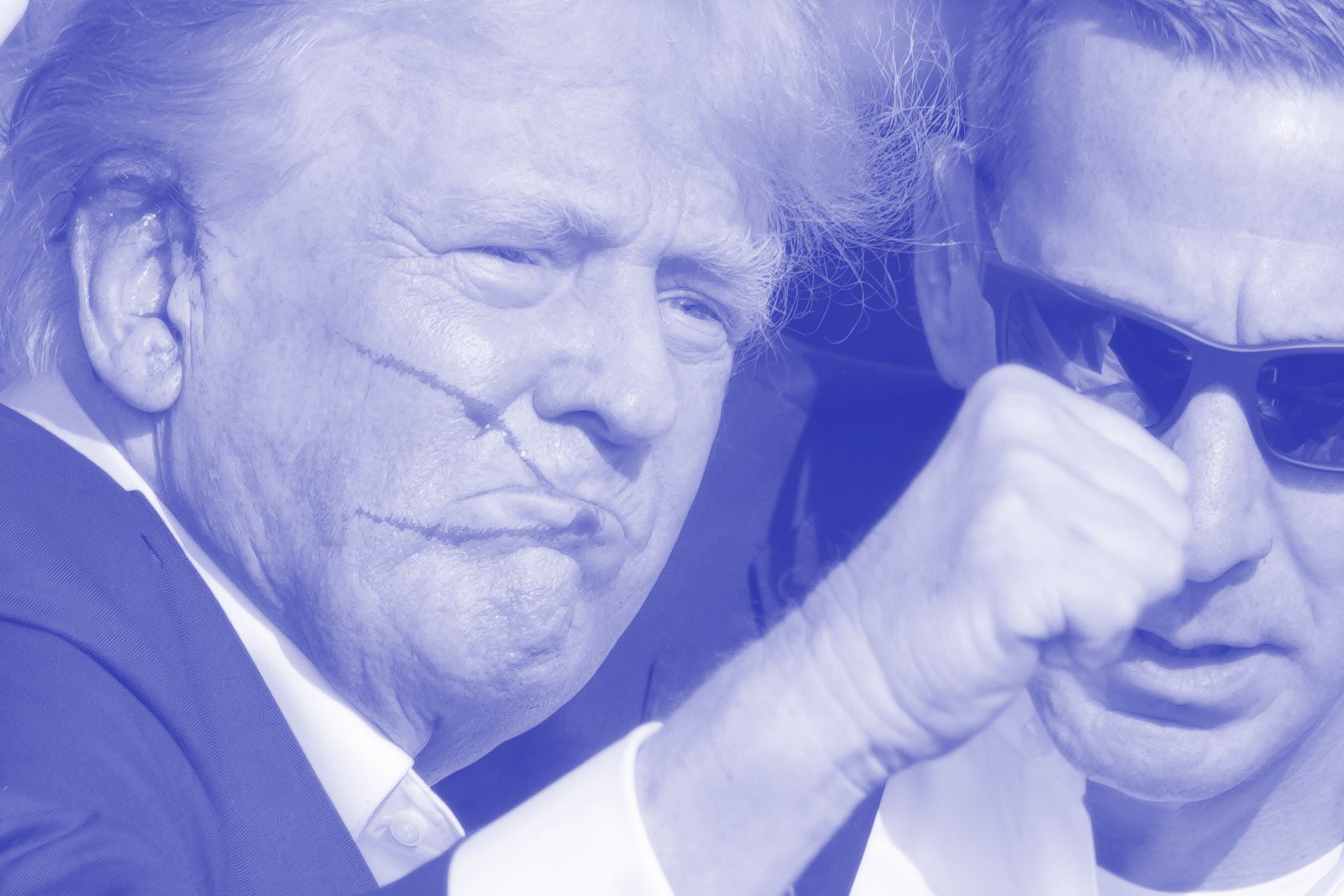
Trump vows defiance after surviving assassination attempt
Plus: Traders react to Trump shooting, bitcoin surges; Investment banking revenues surge for Citi, JPMorgan, Wells Fargo; Israeli airstrike kills 90 in Gaza targeting Hamas leaders.

Good morning. Here's what happened overnight and what you need to know today.
1.
Defiant Donald: Former President Donald Trump pledged to remain "defiant in the face of wickedness" following an assassination attempt at a Saturday rally. The assailant, identified as 20-year-old Thomas Matthew Crooks, from Bethel Park, Pennsylvania, was killed by a Secret Service sniper after firing at Trump, injuring him and killing a 50-year-old attendee. Authorities discovered explosive devices in Crooks' car, The Wall Street Journal reported citing sources with knowledge of the investigation. The New York Times also reported law enforcement officials may have found explosive materials at his residence. President Joe Biden briefly addressed the nation on Sunday afternoon, saying he had spoken to Trump in “a short and good conversation,” and that he was “sincerely grateful he is doing well and recovering.” Biden said the FBI was leading an investigation into the incident, but the motives of the assailant were still not clear, asking the public not to jump into conclusions: “I urge everyone, everyone, please don’t make assumptions about his motives and affiliations, let the FBI do their job.” Biden called for unity and directed the Secret Service to review all security measures for the Republican National Convention, scheduled to start Monday. He also requested an independent national security review of the events at the rally, promising to make the findings public. Separately, Republican-led House committees arranged their own probes of the assassination attempt. Secret Service Director Kimberly Cheatle was called to testify on 22 July before the House Committee on Oversight and Accountability, chaired by Republican congressman Mark Green. Trump, meanwhile, was recovering at his home in New Jersey. "We will fear not but instead remain resilient in our faith and defiant in the face of wickedness,” he said in post on Truth Social on Sunday. (Capital Brief) (CNN)(The New York Times)(The Wall Street Journal)(Reuters)
2.
Markets react: Bitcoin surged past USD60,000 ($88,000) after Donald Trump’s defiant response to an assassination attempt sparked speculation that his chances of winning the election have climbed. The former president, a pro-crypto advocate, was shot in the right ear during a Pennsylvania rally, but his campaign officials declared him “fine” and eager to attend the Republican National Convention in Milwaukee this week, where he will be officially nominated as the Republican candidate. Data from online betting sites Predictit and Polymarket showed a spike in his re-election chances after the incident, with images of an injured but defiant Trump pumping his fist at the crowds widely shared on traditional and social media sites worldwide. President Joe Biden’s campaign said it would pull down its television ads. Traders expect high volatility when markets open, with some investors betting the shooting boosts his odds of winning back the White House, Reuters and Bloomberg reported. Possible swings similar to post-debate trades favouring Trump last month are expected, including higher Treasury yields and a stronger US dollar. Bitcoin rose 2.7% to USD60,160.71, up from lows of USD53,000 earlier in the month. (Bloomberg)(Reuters)
3.
Deal surge: Wall Street banks saw a resurgence in investment banking, with Citigroup, JPMorgan and Wells Fargo reporting revenue increases in their second-quarter earnings. Citigroup's investment banking revenue surged 60% to USD853 million ($1.26 billion), while JPMorgan saw a 50% rise in fees, surpassing its own predictions. Wells Fargo's investment banking revenue increased by 38% to USD430 million. All three banks saw share declines on Friday, however, due to concerns about expenses and interest income. Wells Fargo's stock shed 6%, after the bank downgraded its annual outlook. Citigroup highlighted a strong deal pipeline, though noting potential impacts from the upcoming US presidential election and evolving interest rates. JPMorgan CFO Jeremy Barnum described robust M&A dialogue but muted actual deals, with IPO activity lower than expected. Goldman Sachs and Morgan Stanley are due to report earnings this week. (Reuters)
4.
Gaza strike: An Israeli airstrike killed at least 90 Palestinians in a designated humanitarian zone in Gaza on Saturday, Reuters reported citing the Hamas-controlled enclave’s health ministry. Israel said the attack had targeted Hamas military chief Mohammed Deif. Israeli Prime Minister Benjamin Netanyahu vowed to continue targeting Hamas leadership, saying more military pressure would improve chances of a hostage deal. Deif and another Hamas commander, Rafa’a Salameh, had been at the site when Israel launched the attack, a senior Israeli military official said on Sunday. Salameh was killed and Israeli security officials told Bloomberg they were “pretty confident” their attack had also killed Deif. Hamas denied Deif's death and accused Israel of using false claims to justify the attack. United Nations chief Antonio Guterres said he was “shocked and saddened” by the latest civilian deaths, which underscored “nowhere is safe in Gaza”, while Josep Borrell Fontelles, the EU’s Foreign Affairs and Security Policy representative, called for an independent probe, posting on X that the “end can’t justify all means.” Meanwhile, thousands protested in Jerusalem and Tel Aviv, demanding the release of Israeli hostages. (Reuters)(Financial Times)
5.
Meta news: Nine Entertainment issued a fresh call for the government to take strong action against Meta for not renewing licensing deals with local news outlets. In a draft submission obtained by Capital Brief, Nine also warned that if Meta bans news from its platforms in response to government action, misinformation will surge. The submission to the government’s joint select committee on social media, signed by Nine’s executive counsel Penelope Hobart, highlights recent job cuts in the media industry due to Meta’s decision. Nine, along with Seven West Media and News Corp Australia, demands Meta be designated under the News Media Bargaining Code. Meta’s regional policy chief Mia Garlick has refused to rule out a news ban, arguing news content is a small part of user feeds. Smaller publishers, however, fear a news ban will be devastating to their revenues and operations. Some have called for “must-carry” obligations to prevent a news vacuum. Treasury Assistant Secretary Tony McDonald told the committee last month that legal advice was being sought on various issues, including such obligations. (Capital Brief)
6.
Iran’s memo: Iran’s new president, Masoud Pezeshkian, vowed to create a “balance in relations with all countries,” prioritising ties with neighbouring nations and emphasised Iran will not yield to US pressure. In a letter published in the state-owned Tehran Times titled “My message to the new world,” Pezeshkian - the 69-year-old heart surgeon who won the 5 July election to replace President Ebrahim Raisi after his death in May - urged Arab countries to use “all diplomatic leverages” to push for a lasting ceasefire in the Israel-Hamas war in Gaza. He praised Iran’s close relations with Russia and China and said he looked forward to constructive dialogue with Europe despite past tensions over the nuclear agreement, accusing Western countries of failing to uphold their commitments post-US withdrawal. He condemned US sanctions, writing “Iran’s defence doctrine does not include nuclear weapons,” as he also criticised the escalation of tensions through the assassination of General Qassem Soleimani in 2020. (Associated Press)
7.
Stress test spat: Goldman Sachs is appealing the US Federal Reserve's latest stress test results, which require the bank to hold additional capital, the Financial Times reported, citing unnamed sources. The test projected Goldman would incur over USD40 billion ($59 billion) in losses in severe economic scenarios, needing higher capital reserves relative to assets. With a large trading business, Goldman already faces some of the highest capital requirements on Wall Street. CEO David Solomon publicly disputed the Fed's findings last month, arguing they don't account for the bank's recent efforts to boost stability. Goldman faces long odds in getting the Fed to reconsider its second challenge to the tests since the bank began allowing appeals in 2020. Both the Fed and Goldman declined to comment. The regulator typically announces appeal outcomes in August after reviewing the tests for errors, the FT said. The challenge comes amid broader lobbying efforts by banks against new capital regulations under the Basel III Endgame reforms. (Financial Times)
8.
Betting bias: Sports betting companies are facing scrutiny for limiting wagers from successful bettors without clear explanations, The Wall Street Journal reported. Gamblers are complaining that as they win more, platforms like BetMGM, ESPN Bet, and Caesars restrict their bets, sometimes to as little as 50 cents. Bettors and regulators are calling for transparency, asking for sportsbooks to standardise bet limits or explain their decisions. The Massachusetts Gaming Commission held a public discussion on wager limits, transparency and fairness earlier this year, but several betting companies did not attend, citing concerns that proprietary information would be made public. The companies argue they need to manage risk to stay profitable, often targeting professional gamblers who exploit odds like hedge funds exploit undervalued stocks. VIP programs, meanwhile, reward heavy losers with perks, raising further concerns over fairness and targeting practices in the industry. (The Wall Street Journal)