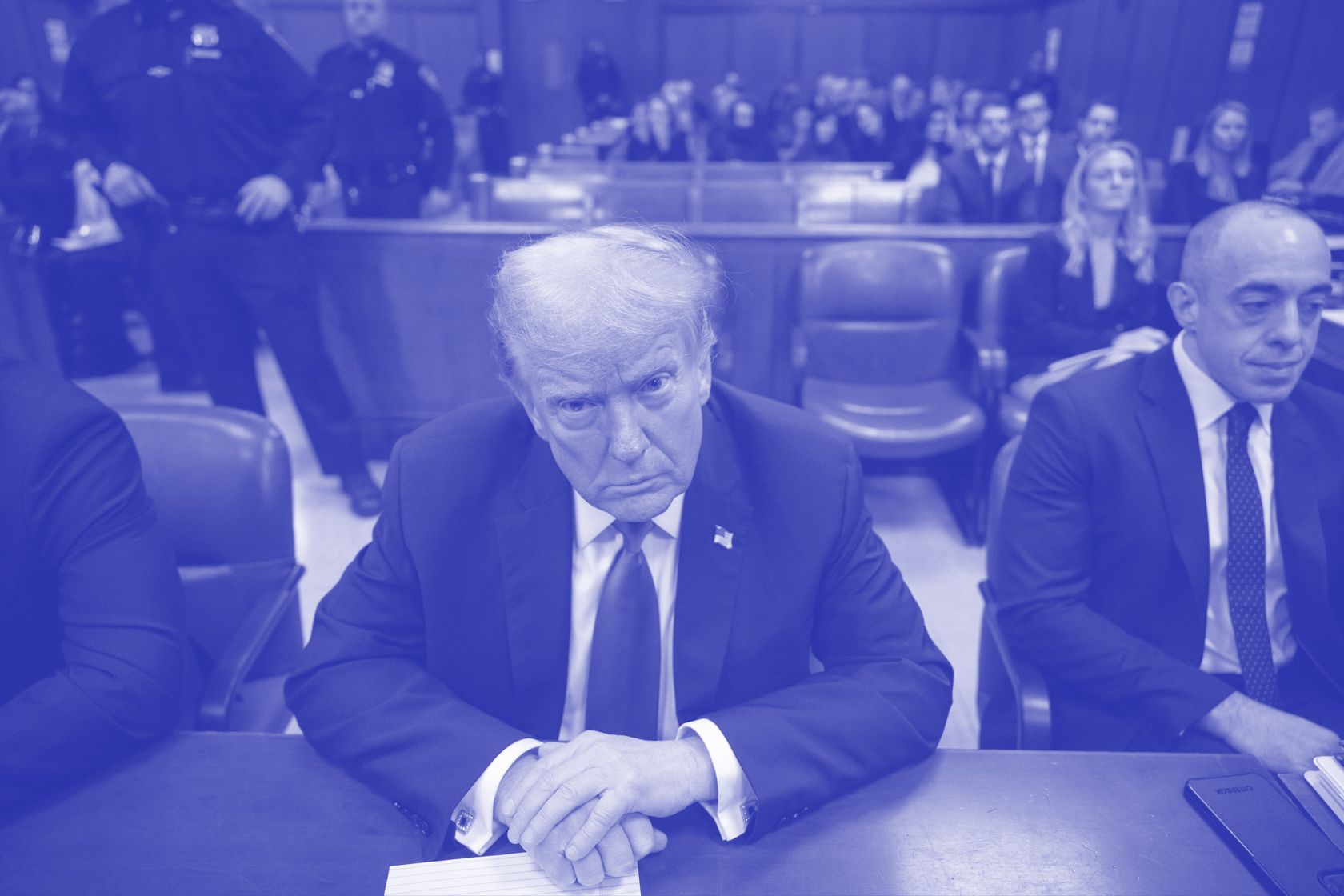
Trump's hush money trial begins
Plus: Australia's eSafety Commissioner wins injunction against Elon Musk's X; Tesla shareholders get restless about incoming earnings; TikTok prepares for court battles if US passes ban.
Good morning. Here's what happened overnight and what you need to know today.
Get Standup in your inbox Signed up to Standup
1.
On trial: The criminal trial of former US president and current presidential candidate Donald Trump has opened in New York City. In opening arguments, prosecutors alleged Trump engaged in a "criminal conspiracy" to cover up a sex scandal and secure his victory in the 2016 presidential election, while the defence argued he had engaged in actions that were legal and normal. Trump is formally charged with 34 felony counts of falsifying business records and could face up to four years in prison if convicted. This is the first ever criminal trial of an American president. It is also Trump's first criminal trial, though he has been indicted three times in other cities and has faced a litany of civil suits. During jury selection, dozens of prospective jurors drawn from the deeply anti-Trump New York borough of Manhattan were excused for impartiality reasons. (The New York Times)
2.
Content warning: The Federal Court of Australia last night granted Australia's eSafety Commissioner a temporary injunction ordering Elon Musk’s X Corp to hide content depicting the stabbing of Bishop Mar Mari Emmanuel in a church in Sydney's west. X was given 24 hours to comply with the order, which applies only to video of the attack and not to "commentary, public debate or other posts of the event". A further hearing will be held on Wednesday to determine whether the injunction will be extended. The eSafety Commissioner said in a statement that it would continue to use its powers under the Online Safety Act to protect Australians from serious online harms, including extreme violent content. (Capital Brief)

3.
Sticker shock: Tesla shareholders are preparing themselves for the company's worst financial performance in seven years as the company shifts strategy amid slowing demand. Analysts believe the results, which will be reported on Wednesday Australia time, will show the lowest gross margins since 2017. CEO Elon Musk has been signalling a narrower focus on autonomous driving, including the production of self-driving "robotaxis", worrying some investors who believe the company should focus on the long-promised Model 2, a cheaper electric vehicle. Deutsche Bank analyst Emmanuel Rosner told the Financial Times he believes this strategic pivot is "thesis-changing", and that it could significantly alter the makeup of Tesla's shareholder base. (Financial Times) (Bloomberg)
4.
War footing: TikTok is steeling itself for a protracted legal battle against a US bill which threatens to ban the app in its largest market unless its owner, Chinese tech giant ByteDance, divests. TikTok US policy boss Michael Beckerman told staff in an internal memo that the new legislation, which passed the US House of Representatives as part of a bundle of aid bills, represented "a clear violation of the First Amendment rights of TikTok’s 170 million American users". He signalled that the company would move to the courts if the bill became law, and that its passage would be "the beginning, not the end" of the process. (Financial Times)
5.
Out the door: Global consulting firms like McKinsey, Boston Consulting Group and Deloitte are stepping up efforts to push out underperforming workers with tougher performance reviews, layoffs, and voluntary departure incentives. These firms have all seen historically low levels of people leaving of their own accord. To cut headcount, McKinsey is instituting mid-year performance grading to "counsel out" more employees, while also laying off hundreds and offering severance packages to others willing to resign. The decrease in voluntary departures has reduced the normal "up or out" promotions, leading to fewer advancement opportunities across the industry as firms work to rightsize after the pandemic boom years. (Financial Times)
6.
Second opinion: Some leading economists dispute Jim Chalmers' negative assessment of the global economy's growth outlook, as the treasurer signals the next budget will target a surplus while laying the investment foundations for future growth. In comments on Sunday evening, Chalmers signalled more cost-of-living support if Australia can afford it, while describing the budget's approach on inflation as more "nuanced". But economist Chris Richardson told the AFR that "global growth is doing better than the mid-year budget update expected" and that high commodity prices and low unemployment would improve the budget's financial position. He also warned that too much spending would leave a future rate cut uncertain. (Australian Financial Review)
7.
Group buy: Investors are forming special purpose vehicles (SPVs) to pool capital and gain exposure to hot artificial intelligence startups like OpenAI and Anthropic amid explosive demand. SPVs allow smaller investors like family offices to collectively write larger checks for AI companies raising rounds at lofty valuations. The structures have become so popular that SPVs investing in other SPVs that hold stakes in leading AI companies have emerged, though some venture capitalists privately complain about the extra fees, according to anonymous sources speaking to The Information. Many smaller investors view SPVs as the best path to getting a slice of the potential upside from AI businesses. (The Information)
8.
Resignation letter: Israel's military intelligence chief has resigned due to his failure to prevent the 7 October attack by Hamas. Aharon Haliva, head of military intelligence, had been in the role for over two years, and is the first senior Israeli official to step down over the attack. Haliva had earlier accepted blame for the intelligence failures which led to Hamas successfully breaching the fortified border with southern Israel. “The intelligence division under my command did not live up to the task we were entrusted with,” Haliva said in a statement announcing his resignation. The 7 October attack left 1,200 people dead and precipitated the war in Gaza, in which a reported 34,000 Palestinians have died. (Bloomberg)