US and EU strike 15% tariff deal
Plus: China and US set to extend tariff truce 90 days: SCMP; Google threatens Albanese government over YouTube ban; Gilbert + Tobin says using AI like choosing Excel over Word tables.


Good morning. Here's what happened overnight and what you need to know today.

1.
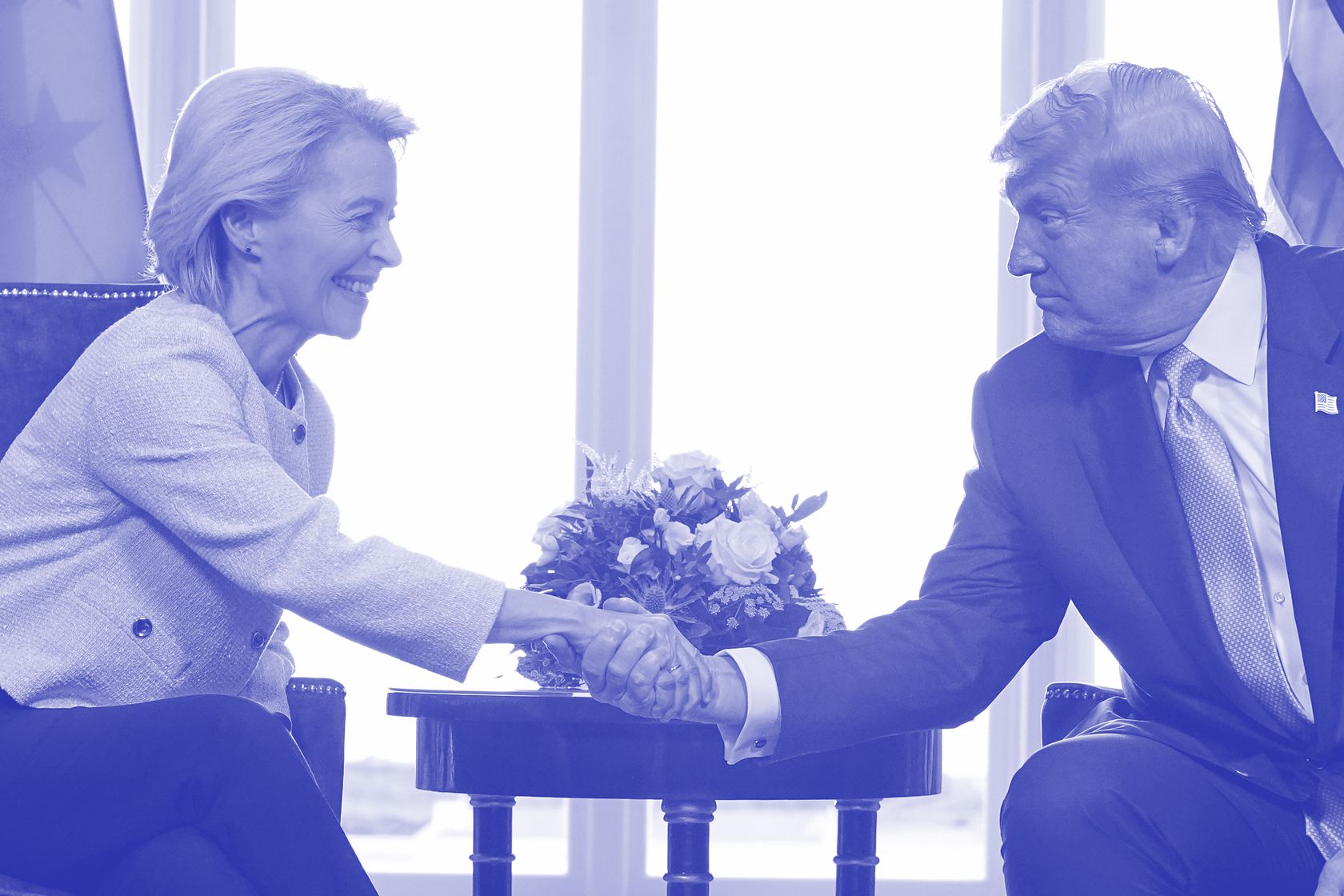
Tariff handshake: The United States and European Union reached a trade agreement on Sunday (Monday AEST) setting a 15% tariff on most EU goods, including automobiles, staving off a trade war that could have sent shock waves through the global economy. US President Donald Trump and European Commission President Ursula von der Leyen announced the deal after meeting at Trump’s golf resort in Turnberry, Scotland. Trump said the EU would buy USD750 billion ($1.1 trillion) in US energy, invest an additional USD600 billion in America, and make major purchases of military equipment. Steel and aluminium tariffs remain at 50%. Von der Leyen said the deal “will bring stability” and “predictability.” Trump had threatened a 30% duty if no agreement was reached by 1 August, while the EU had prepared retaliatory tariffs on €93 billion worth of American goods if talks had failed. (WSJ)(Reuters)(Bloomberg)
2.
Tariff extension: Beijing and Washington are expected to extend their tariff truce by another 90 days at trade talks beginning Monday in Stockholm, the South China Morning Post reported, citing unnamed sources on both sides of the negotiations. The current suspension, agreed in May, is set to expire on 12 August. At the start of the meeting with European Commission President Ursula von der Leyen in Scotland, Trump said: "We're very close to a deal with China. We really sort of made a deal with China, but we'll see how that goes.” One source told SCMP the extension would include a commitment by both sides not to impose additional tariffs or escalate the trade war. The talks, led by US Treasury Secretary Scott Bessent and Chinese Vice Premier He Lifeng, are addressing longstanding disputes, with China expected to raise US fentanyl-related tariffs and the US set to press Beijing on industrial overcapacity and tech restrictions. (Capital Brief)(SCMP)(Bloomberg)(Reuters)(CNN)
3.
YouTube threat: Google is threatening to sue the Australian government if YouTube is included in a social media ban for children under the age of 16, due to come into effect in December. In a letter to Communications Minister Anika Wells, the tech giant warned it was considering its legal position and flagged the ban could be challenged on the grounds it restricted the implied constitutional freedom of political communication. YouTube was initially exempt, but eSafety Commissioner Julie Inman Grant has argued the platform should be included, stating it was by far the most used by children and the most prevalent place where they experienced harm. On Sunday, Prime Minister Anthony Albanese told the ABC’s Insiders program that the minister would make the decision “independent of any of these threats that are made by the social media companies.” Meanwhile, the FT reported VPN use is surging in the UK following the rollout of new online safety rules in that country. (SMH)(SBS)(NewsWire)
4.
Harvey briefs: Gilbert + Tobin has rolled out Harvey, its preferred tool to assist with legal work, across its team of 650 lawyers, and CEO Sam Nickless told Capital Brief the firm is fast approaching a mindset of “Why not use AI?”, likening the shift to choosing Excel over manually sorting Word tables. The firm initially told staff to experiment with ChatGPT but not use confidential information. It now uses secure integrations, including Microsoft’s platform, ChatGPT Enterprise and its in-house chat tool, Gilbot. Harvey, which can process up to 10,000 documents at once, has proved useful in banking, company constitution reviews, law reform and negotiations. Harvey now includes a verification step for each extracted data cell, and lawyers are instructed to avoid using it for open-ended legal research to minimise hallucinations. While validating outputs still takes time, the firm says fewer hours are already being passed through to clients, and it is considering what the efficiencies mean for billing. (Capital Brief)
5.
The Signal: In the debut edition of The Signal, Capital Brief’s new weekly dispatch from media correspondent John Buckley, Nine’s looming $1.4 billion Domain exit sets the stage for deeper questions about what the company might do or sell next. Shareholders are due to vote on the transaction on 4 August. The sale has led many insiders to speculate on the future of Nine’s publishing assets. A growing number of senior staff have come to wonder whether the company might soon consider selling off its newspaper mastheads, including The Sydney Morning Herald, The Age and The Australian Financial Review. That view is not limited to staff. Some of Nine’s largest shareholders, including Pendal, have floated the possibility of Nine entertaining offers for the AFR. Some investors believe it alone could fetch up to $700 million. CEO Matt Stanton has told colleagues the newspapers remain critical. No sale process has been initiated, according to a person close to Stanton. (Capital Brief)
6.
AUKUS anchors: Australia and the UK on Saturday signed a 50-year treaty to bolster cooperation on the AUKUS nuclear submarine partnership, as the US reviews its role in the pact. Signed in Geelong by Defence Minister Richard Marles and UK Defence Secretary John Healey, the “Geelong Treaty” enables cooperation on the design, build, operation, sustainment and disposal of the SSN-AUKUS submarines, as well as workforce, infrastructure and regulatory systems. The submarines will be built in northern England and South Australia to be delivered to the Australian navy in the 2040s. The treaty is expected to be tabled in parliament this week. The UK Ministry of Defence said the treaty is expected to be worth up to £20 billion in exports over the next 25 years. (Joint statement)(Reuters)(The Guardian)
7.
Transnational repression: Hong Kong’s national security police issued arrest warrants for 19 activists based overseas, including two Australian residents. Australian citizen Chongyi Feng and resident Wong Sau-Wo are accused of launching a referendum or running as candidates in the unofficial “Hong Kong Parliament” group. Police allege the group seeks to subvert state power and overthrow the governments of China and Hong Kong by unlawful means. Bounties of HK$200,000 ($38,800) to HK$1 million have been offered for information leading to arrests. Australian Foreign Minister Penny Wong said the government “strongly objects” to the warrants and the broad, extraterritorial application of Hong Kong’s national security legislation. UK and US officials also condemned the move as “transnational repression.” HK officials said national security offences are serious crimes with extraterritorial reach and urged those named to surrender. (Penny Wong)(Marco Rubio)(UK joint statement)(ABC)(SMH)(The Guardian)
8.
Tactical pause: The Israeli military began 10-hour daily pauses in military activity in three populated areas of Gaza to facilitate the delivery of humanitarian aid, following growing international criticism over hunger in the enclave. Designated secure routes for aid convoys have also been established, and Israel, Jordan and the UAE have conducted airdrops. Gaza’s Health Ministry said six more Palestinians died from starvation in the last 24 hours, CNN reported Sunday, bringing the total to at least 133 since October 2023. The UN says less than 8% of World Food Programme trucks have reached their destination in the past 10 weeks, with most looted or delayed. Meanwhile, Prime Minister Anthony Albanese on Sunday said Israel’s March decision to block food into Gaza was a breach of international law and described the situation as a breach of decency, humanity and morality. (Reuters)(CNN)(AP)
