‘Big, beautiful’ bill passes US House, enshrining Trump’s agenda
Plus: Wall Street hits records, as jobs data lowers rate cut bets; Nvidia hits historic US$3.92 trillion value, topping Apple; European tech leaders urge two-year pause on AI regulation.

Good morning. Here's what happened overnight and what you need to know today.

1.
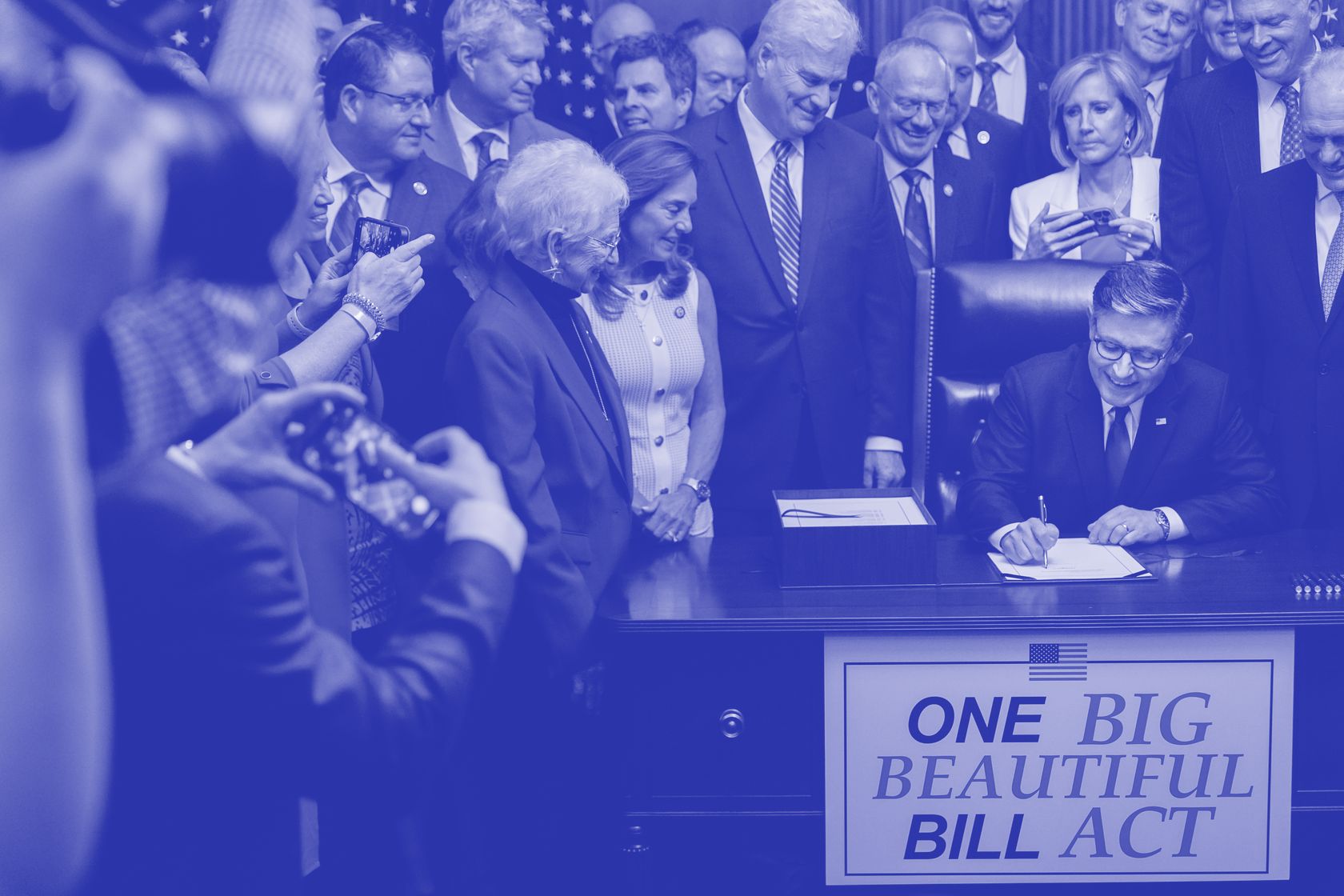
Trump’s agenda: Donald Trump secured a major legislative win, with the US House of Representatives narrowly passing his USD3.4 trillion ($5.17 trillion) tax-cut and spending bill by 218-214 votes after a marathon 30-hour session. The bill is now set for Trump’s signature ahead of his 4 July deadline. It makes his 2017 tax cuts permanent, adds new tax breaks, and ramps up spending on immigration enforcement and the military. It cuts health and welfare programs, eliminates dozens of green energy incentives, and is expected by the Congressional Budget Office to add USD3.4 trillion to the US debt. Every Democrat and two Republicans opposed the bill, which the CBO said would leave nearly 12 million more people uninsured. House Speaker Mike Johnson called it “nation-shaping legislation,” while Nancy Pelosi said it was “a betrayal” that “balloons the national debt… to reward the wealthiest.” In a marathon, historic speech ahead of the vote, Democratic leader Hakeem Jeffries called the bill a “Robin Hood-in-reverse scheme”. (WSJ)(Bloomberg)(Reuters)(Capital Brief)
2.
Data pulse: The S&P 500 and Nasdaq closed at record highs after US job growth data for June beat expectations, with nonfarm payrolls rising by 147,000 and unemployment falling to 4.1%. The data led traders to scrap bets on a July interest-rate cut and reduced the probability of a September cut to about 75%, as the solid headline numbers took pressure off the Fed to move sooner. Nearly half the jobs gain came from government hiring, especially in public education, although private payroll growth slowed to its lowest since October 2024. Treasury yields rose, with two-year yields up 10 basis points to 3.88% and 10-year rates rising 7 basis points to 4.35%. Meanwhile, US Treasury Secretary Scott Bessent said about 100 countries are likely to see a reciprocal tariff rate of 10% and expects "a flurry" of trade deals before the 9 July deadline. He also said the Trump administration will focus on finding a replacement for Fed chair Jerome Powell in the northern hemisphere fall. (Bloomberg)(Reuters)(Capital Brief)
3.
AI surge: Nvidia hit a market value of USD3.92 trillion ($5.97 trillion) on Thursday, briefly surpassing Apple's previous record and making it the world's most valuable company before closing slightly lower. That came as shares of chip design software firms such as Synopsys and Cadence Design Systems rose after the US lifted export curbs on sales to China. Elsewhere in tech, Ilya Sutskever, co-founder and former chief scientist of OpenAI, has taken over the reins of Safe Superintelligence after Daniel Gross joined Meta to lead its AI products division. (Reuters)
4.
Clock-stop: The EU said that key guidance around the implementation of the bloc’s landmark AI rules could come into effect at the end of 2025, indicating a six-month delay. Earlier on Thursday, a swathe of leaders of large European companies urged Brussels to halt introducing its landmark AI regulation. In an open letter shared by the ‘EU AI Champions Initiative,’ 44 leaders call on European Commission President Ursula von der Leyen to accept a two-year pause on the rules which they argue threaten the EU’s AI competitiveness. The letter argues the proposed postponement of the Code of Practice guidance, would send a “strong signal” that Europe is serious about simplification and competitiveness. The Code will offer guidance to AI companies around how to implement the AI regulations, which will apply to AI models including Google’s Gemini, Meta’s Llama and OpenAI’s GPT-4. It had originally been scheduled to be published in May. (Reuters)(AI Champions letter)(FT)(Politico)(Capital Brief)
5.
Putin call: US President Donald Trump pushed for a quick halt to the Ukraine war in a phone call with Russian President Vladimir Putin on Thursday, according to Kremlin aide Yuri Ushakov. That came as the US earlier this week paused shipments of some weapons to Ukraine. Ushakov told reporters Putin told Trump Moscow would keep pushing to solve the conflict’s “root causes”, shorthand for Western support for Ukraine and diminishing its sovereignty as an independent state. He added the country “will not back down from these goals.” The nearly hour-long call did not cover the US decision to pause weapons deliveries to Kyiv, Ushakov said. According to the Kremlin aide, Putin told Trump Russia remains open to negotiations with Kyiv. According to media reports, Trump is likely to speak to Ukrainian President Volodymyr Zelenskiy on Friday. (Bloomberg)(Reuters)(WSJ)
6.
Access denied: Treasury denied access to 45 briefing documents prepared for Assistant Treasurer Daniel Mulino, as the government prepares to begin work on new rules for global tech firms and superannuation. The documents were captured by a freedom of information request submitted by Capital Brief last month, seeking all briefing documents provided to Mulino by Treasury during his first week as assistant treasurer, between 12 and 23 May. Treasury Assistant Secretary Robb Preston rejected the request, citing the volume — more than 300 pages — and the presence of “sensitive information” requiring extensive review and redaction. Following the denial, a second request was submitted by this publication, limiting the scope to documents related to the assistant treasurer’s role in Labor’s efforts to compel big tech companies, including Meta, Google and TikTok, to pay news publishers. Treasury will process that request for a charge of $448. (Capital Brief)
7.
Deal sweetener: The US and Indonesia will sign trade and investment deals worth USD34 billion ($51.7 billion) on 7 July to increase Indonesian purchases from the US, Reuters reports, in efforts to strike a deal with Washington ahead of the 9 July reciprocal tariff deadline. Indonesia’s chief economic minister Airlangga Hartarto told a press briefing on Thursday that the memorandum of understanding does not represent a final agreement, “We have to see later the final announcement by our US counterparts,” he said. The country is currently facing a 32% tariff on goods imported to the US and has offered to increase US imports to smooth trade talks. Indonesia held a trade surplus of USD17.9 billion with the US in 2024. Vietnam on Thursday said that it is still finalising details of a trade deal with the US, which Trump already announced earlier this week. (Bloomberg)(Reuters)(Capital Brief)(Bloomberg)
8.
Holding pattern: Several major Canadian airports were forced to delay flights on Thursday after receiving bomb threats, the country’s air traffic authority said. “Early this morning, NAV CANADA was made aware of bomb threats affecting facilities in Ottawa, Montreal, Edmonton, Winnipeg, Calgary and Vancouver. Employees at impacted locations are safe, and a temporary ground stop has been implemented at the affected airports,” the authority said. Ottawa Police said they were investigating a “security incident” at the airport in the nation’s capital. In other French-speaking skies, a two-day strike by air traffic controllers in France began on Thursday, causing widespread delays and disrupting flights across the EU. RyanAir chief Michael O’Leary said the cancellations and delays of flights over French airspace en route to their destination due to the strike were “not acceptable”, while easyJet CEO Kenton Jarvis said France accounted for more air-traffic delays than any other European country. (Bloomberg)(X)(FT)
