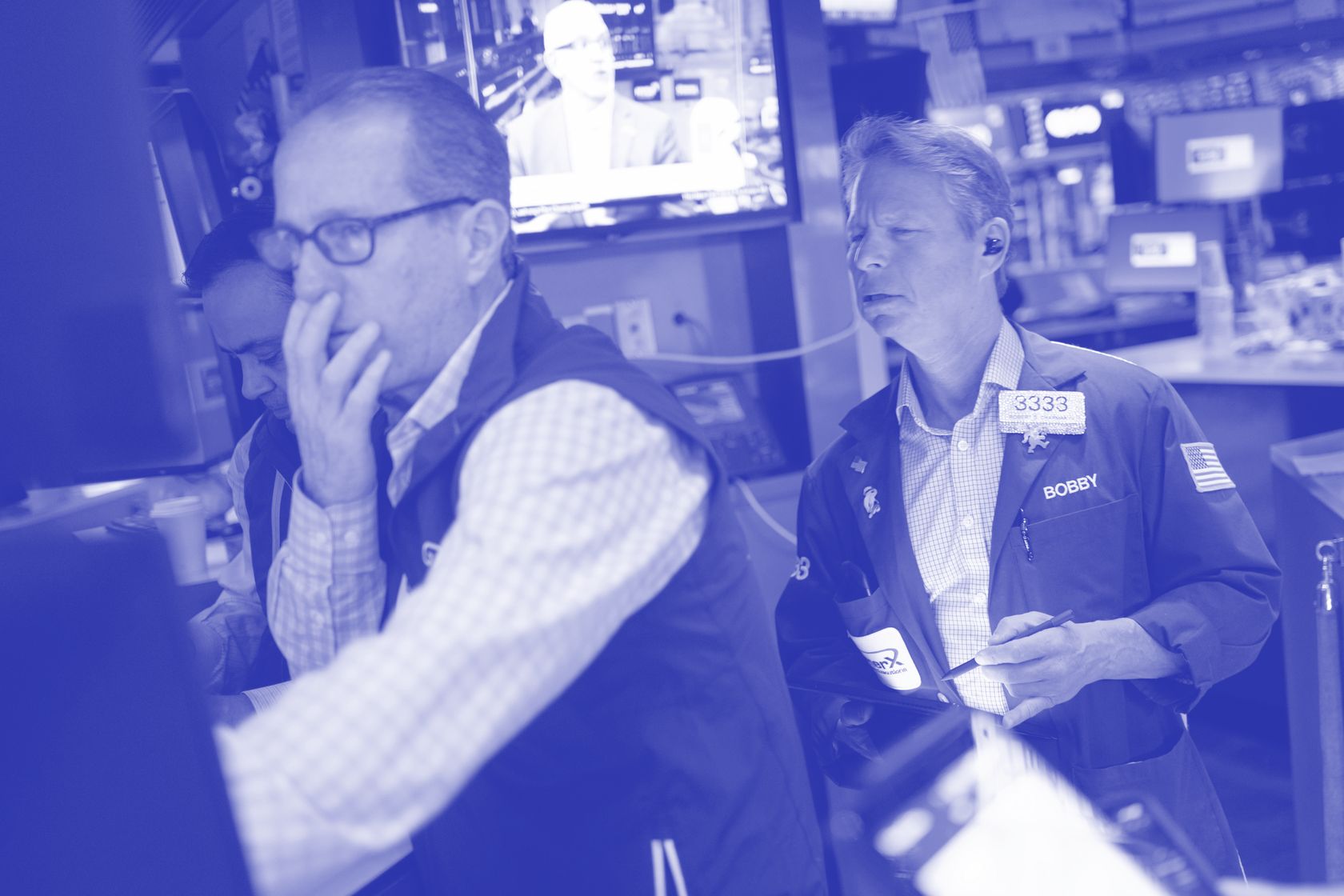
Wall Street recovers in rollercoaster end to April
Plus: Tariff shock drives first US GDP fall since 2022; China’s manufacturing contracts on tariff pain; Google pushes Gemini as iPhone AI option.

Good morning. Here's what happened overnight and what you need to know today.

1.
Whiplash April: US stocks rose slightly overnight, paring earlier losses after weak jobs data initially rattled markets, but closed out a volatile April with monthly declines. The Dow, S&P 500 and Nasdaq all reversed steep falls to finish modestly higher for the day. New data showed private payrolls rose by just 62,000 in April, far below expectations of 115,000. The early selloff eased on signs of resilient consumer spending and cooling inflation, with March spending up 0.7% and the Fed’s preferred inflation gauge slowing to its weakest pace since last autumn. Super Micro Computer and Snap each fell about 12% after cutting forecasts, while Caterpillar warned tariffs could add up to USD350 million in quarterly costs. Meanwhile, the White House said it had received trade offers from nearly 20 countries while agriculture officials said they were preparing a contingency bailout plan for farmers impacted by trade wars. (WSJ)(Reuters)(Bloomberg)
2.
Slowing pains: The US economy shrank at a 0.3% annual rate in the first quarter of 2025, the first contraction since 2022, as businesses rushed to import goods ahead of new tariffs, Commerce Department data showed. Imports surged 41.3%, subtracting 4.83 percentage points from GDP, the biggest quarterly drag from net exports on record since 1947. Consumer spending rose at a 1.8% pace, the smallest increase since mid-2023, while business investment rose at a 21.9% rate. President Trump blamed the decline on former President Biden, saying “that’s Biden. That’s not Trump,” and asked to “give us a pass on the first month.” He said tariffs “haven’t kicked in yet,” but pointed to increased equipment spending as evidence they are working. Hiring at US companies also softened to the slowest pace in nine months, with private sector firms adding just 62,000 new roles in April, less than the 115,000 expected. (Capital Brief)
3.
Tariff bite: China’s factory activity slipped into the worst contraction since December 2023, as sweeping US tariffs of 145% began to bite. The official manufacturing purchasing managers’ index dropped to 49 in April from 50.5 in March, the National Bureau of Statistics said. New export orders plunged to the lowest level since December 2022, while a subgauge of manufacturing employment contracted at the worst pace since February last year. Economists including those from Morgan Stanley and Nomura called for a speedy policy boost to counter a “worse-than-expected demand shock.” Container shipments from China to the US are already plunging, with eastbound bookings down at least a third and 17 sailings cancelled for May, the Wall Street Journal reported. Meanwhile, Reuters reported China created a list of US-made products exempt from its 125% tariffs and is quietly notifying companies. (Capital Brief) (WSJ)
4.
AI plans: Alphabet CEO Sundar Pichai said in court he hopes Google’s Gemini AI will be added as a built-in option for iPhones this year, following a series of conversations with Apple CEO Tim Cook across 2024. Apple Intelligence uses its own models and has partnered with OpenAI’s ChatGPT for integration into Siri and Writing Tools. Apple is preparing to introduce new versions of its operating systems at its developer conference the week of 9 June, a likely venue for announcing any deal. Meanwhile, Nvidia received a rare sell rating from Seaport Global, which said the benefit of artificial intelligence has been “priced in for now” and noted “AI budgets [are] likely to slow in ’26.” Nvidia shares are down more than 20% this year. Elsewhere, TikTok confirmed plans to build a €1 billion data centre in Finland as part of its Project Clover data security regime. And Meta is expected to report Q1 earnings of USD5.25 per share on USD41.3 billion in revenue. (Bloomberg)(Reuters)
5.
Safe cloud: Microsoft said it would take the US government to court if necessary to protect European customers’ access to its data centres, responding to concerns that Donald Trump could block American technology as leverage. The company announced five “digital commitments” to Europe, including a legal pledge in contracts to contest any non-European government order disrupting its EU cloud operations. It will have European cloud services overseen by a board of directors made up of European nationals and governed by European law. President Brad Smith said Microsoft aims to be “a source of digital stability” amid “geopolitical volatility.” Microsoft plans to increase its data centre capacity in Europe by 40% over two years and spend “tens of billions of dollars” annually on infrastructure. Earlier, CEO Satya Nadella said 20–30% of the company’s code is now “written by software”—meaning AI. After the close, Microsoft is expected to report USD68.42 billion ($106.83 billion) in revenue, with up to 30.3% Azure growth expected. (Microsoft)(Atlantic Council)(WSJ)(FT)
6.
Canadian clues: Both Labor and the Coalition are looking at the implications of Mark Carney's anti-Trump victory ahead of this weekend’s election, with Anthony Albanese leaning into Mark Carney’s anti-Trump victory, and Peter Dutton taking heart from the Conservative vote beating the polls. Albanese has been pursuing a similar strategy to that of Carney in Australia ahead of Saturday’s poll, painting Dutton’s policies, such as his cuts to the public service and the scrapped work-from-home crackdown, as Trump-lite. The Coalition takes solace in the fact that Carney’s result in Canada was not as strong as recent public polls suggested, with Coalition sources maintaining that their internal polling in key marginal seats is significantly better than what the public polls show. Scott Ryan, Australia’s former high commissioner to Canada, told Capital Brief that Trump’s effect in Canada was unique and that the impact on Australia was not nearly as significant. (Capital Brief)
7.
Soaring sales: House prices in Australia climbed for a third consecutive month to a record high in April, defying rising global uncertainty and sharpening focus on Labor and the Coalition’s respective housing policies just days ahead of the election. Cotality’s (formerly CoreLogic) Home Value Index advanced 0.2% in April, with every major city recording a rise. Darwin and Hobart were the biggest gainers, up 1.1% and 0.9% respectively, while the bellwether markets of Sydney and Melbourne edged up 0.2%. Despite seeing the weakest Easter auction clearance rate since 2019, Cotality research director Tim Lawless said that with incoming rate cuts from the RBA expected as well as greater certainty post-election, the firm expects further modest rises in value this year. Housing policies on both sides of the aisle have garnered significant attention this election campaign, with both parties being criticised for tabling policies that risk adding upward pressure on house prices. (Bloomberg)(Reuters)(Capital Brief)
8.
Tough talks: Washington and Kyiv hit a snag just before signing a framework minerals deal on Wednesday, as disputes resurfaced over terms finalised in marathon talks. A draft seen by the FT outlines plans for a joint US-Ukraine fund to boost investment in mining, energy and related technology. Kyiv had secured a concession that only future US military aid would count as Washington’s contribution. But, as Ukraine’s envoy travelled to the US to meet with Treasurer Scott Bessent, she was warned to sign all agreements or return home. US sources accused Kyiv of reopening settled terms; Ukraine rejected that account, saying its parliament must ratify the fund. Meanwhile, Russian drone attacks on Kharkiv and Dnipro killed one and injured 50. Separately, Iran will meet Britain, France and Germany on Friday for nuclear talks, ahead of a weekend US-Iran meeting in Italy aimed at easing tensions. (FT)(Reuters)
