The BRICS bloc's unwieldy expansion
The disparate grouping of emerging market economies has designs on reshaping the US-led global order but may now struggle to find a unified voice.


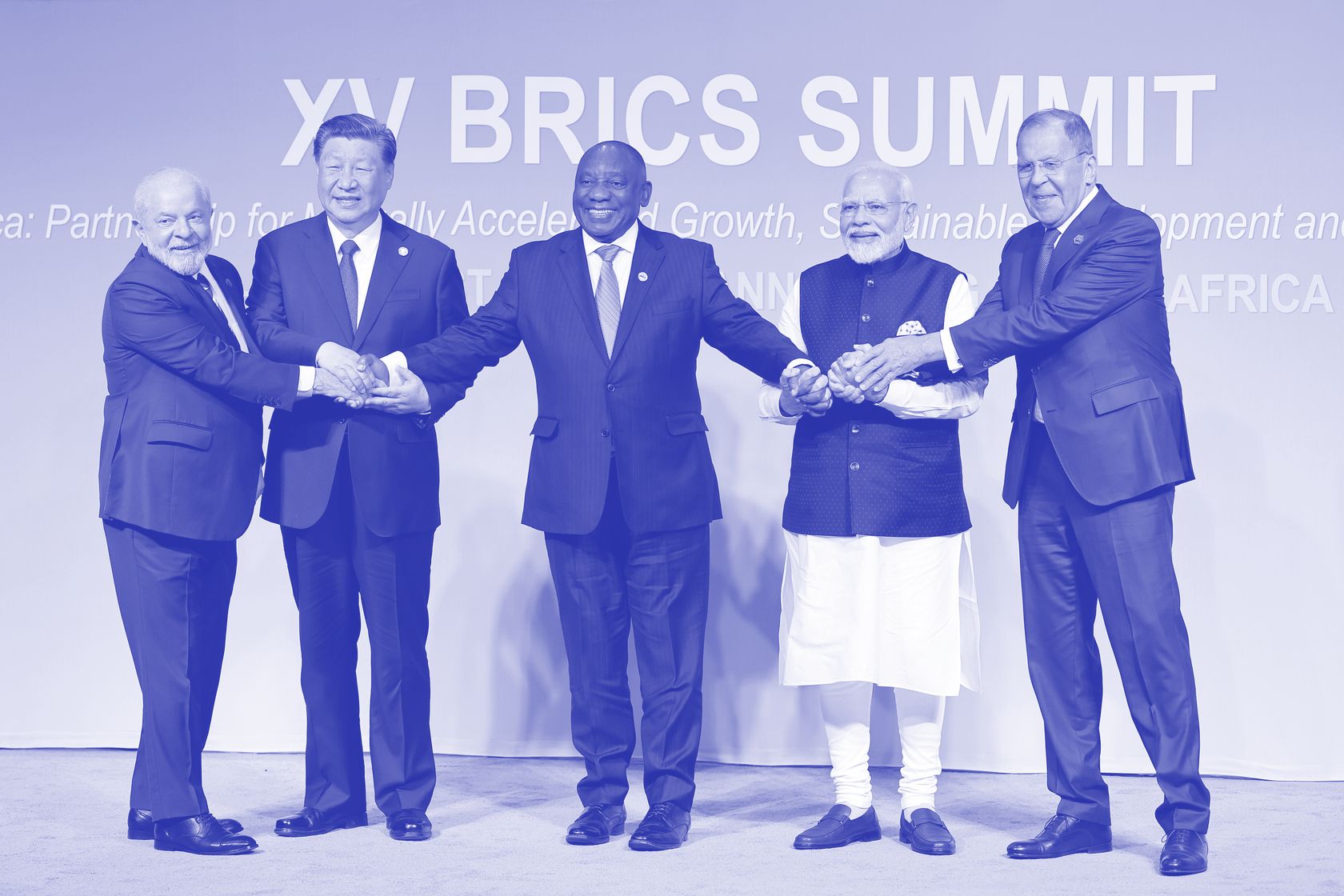
The BRICS bloc of Brazil, Russia, India, China and South Africa will add six new members, as Beijing and Moscow push for the disparate grouping of major developing economies to contest the global dominance of the United States and its Western allies.
Argentina, Egypt, Ethiopia, Iran, Saudi Arabia and the United Arab Emirates will join the existing five members from the start of next year, it was announced at a summit in Johannesburg on Thursday. Xi Jinping, China’s president, said the “historic” expansion, the first since South Africa joined in 2010, would prove a “new starting point for BRICS cooperation.”
It remains to be seen how effectively the enlarged bloc will find a unified voice on the world stage. The strategic rivalry between the two biggest economies in the grouping, China and India, has threatened to overshadow the bloc’s expansion ambitions and direction. The addition of an eclectic mix of autocracies and middle income democracies makes for an unwieldy collective, united mostly by a desire to rebalance what they see as an outdated global order.
The expansion, most notably the inclusion of Iran and Saudi Arabia, is regardless seen as a win for both China, which has been pushing hard for expansion to grow its political clout, and an isolated Russia. Russian President Vladimir Putin, who did not attend the three-day Johannesburg summit in person due to an arrest warrant issued by the International Criminal Court, is keen to demonstrate he still has friends. In contrast, India and Brazil have been forging closer ties with the West and have held reservations over the potential dilution of their influence in the bloc.
