Albanese to meet Trump in Washington in October after earlier snubs
Plus: Trump in scathing UN attack, says Ukraine can reclaim all territory with EU support; Powell rejects political bias claims as 'a cheap shot’; NATO vows to defend itself against ‘reckless’ Russian actions.

Good morning. Here's what happened overnight and what you need to know today.

1.
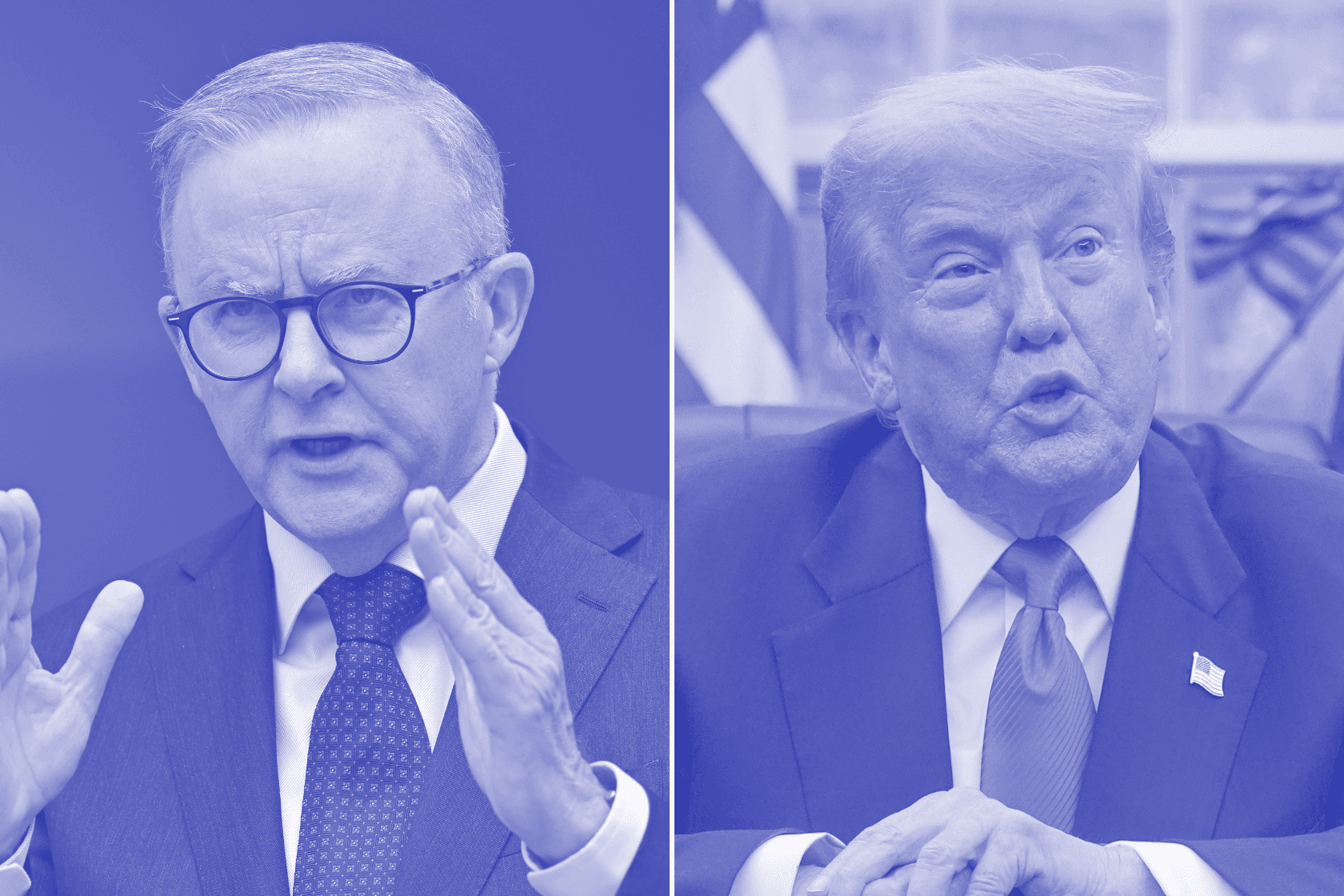
Date set: Anthony Albanese will hold his first face-to-face meeting with Donald Trump in Washington on 20 October, the White House confirmed. The stand-alone meeting will be Albanese’s third US trip in six months, after he was left off Trump’s schedule in New York this week and a planned G7 meeting in June was cut short when Trump returned to Washington. The leaders are expected to discuss the AUKUS nuclear submarine deal, Trump’s demands for Australia to spend as much as 3.5% of GDP on defence, and US trade tariffs. Confirmation came after Trump’s 57-minute UN address in which he dismissed moves by allies including Australia to recognise Palestinian statehood, called climate change “the greatest con job ever perpetrated on the world,” attacked migration, and mocked the UN. While in New York, Albanese and Penny Wong represented Australia at the assembly and promoted the Future Made in Australia agenda at a Macquarie investment forum. (Capital Brief)(ABC)(The Guardian)(AFR)
2.
Trump broadside: US President Donald Trump used his return to the UN stage to launch a scathing attack on the organisation, while denouncing migration and climate policies as a “double-tailed monster” that is “destroying a large part of the free world and a large part of our planet.” He said climate change was “the greatest con job ever perpetrated on the world” and that it was time to end the “failed experiment of open borders”. Trump also accused the UN of “funding an assault on western countries” by supporting migrants and asylum seekers, and said the organisation had “not even tried to help” in efforts to end global conflicts. Trump said Europe must “immediately cease all energy purchases from Russia,” and that if they do, the US would “impose a very strong round of powerful tariffs” on Russia, which he claimed would “stop the bloodshed.” Despite the scathing speech, Trump later told Secretary-General António Guterres the US was “behind the United Nations 100%.” Speaking to reporters ahead of his meeting with Ukrainian President Volodymyr Zelensky, Trump said NATO countries should shoot down Russian military aircraft that enter their airspace, though he added US support would “depend on the circumstance”. After the meeting Trump posted that Ukraine could, with the support of the EU, reclaim all its territory from Russia. Calling Russia a “paper tiger” in “BIG Economic trouble,” the comments marked a shift from his earlier view that Putin held the advantage. (WSJ)(AP)(Bloomberg)(Reuters)
3.
Powell pushback: US Federal Reserve Chair Jerome Powell dismissed accusations that the Fed is politically motivated, calling them “just a cheap shot,” and said the central bank keeps its “head down” and does its job. Speaking at the Greater Providence Chamber of Commerce, Powell said "many people don't believe" the Fed is letting the data drive decisions. He added, "but the truth is, mostly people who are calling us political, it's just a cheap shot." His comments follow political pressure, including President Trump’s legal push to remove Governor Lisa Cook, and the appointment of Stephen Miran, who is on unpaid leave from the White House Council of Economic Advisers. Miran has argued for deeper rate cuts, while others urge caution due to persistent inflation. Speaking in Rhode Island, Powell said the US faces a “challenging situation,” with inflation risks tilted to the upside and employment risks to the downside. He offered no new signal on rate cuts and warned that tariff-driven price increases must not become lasting inflation. Markets fell as he spoke. (Capital Brief)(Fed speech)(Q&A session)(Bloomberg)
4.
Dangerous game: NATO on Tuesday promised that its response to Russia’s “reckless actions” will continue to be “robust” and that it would use all necessary military or non-military tools to defend itself. Following a meeting of the North Atlantic Council to discuss last week’s incursion into Estonia’s airspace by Russian fighter jets, NATO said that the incident is part of a “wider pattern of increasingly irresponsible Russian behaviour.” This is the second time in two weeks that the Council has met under Article 4, after Polish jets shot down Russian drones over its territory. NATO since bolstered its posture along its eastern flank and said its “commitment to Article 5 is ironclad.” Meanwhile, Copenhagen and Oslo airports were closed for hours on Monday after several drone sightings in its airspace, while the US Secret Service thwarted a telecom plot in New York used to threaten senior US government officials ahead of the UN General Assembly. (NATO)(Capital Brief)
5.
Rapid expansion: UK fintech Revolut plans to expand to over 30 new geographies by 2030, which will see the fintech plough USD13 billion ($19.7 billion) into its expansion as it also works to attain 100 million users. The investment includes USD500 million in previously announced spending in the US and a USD1.2 billion commitment to its Western Europe hub in France. The company, which is currently seeking a USD75 billion valuation in a secondary share sale, boasts 65 million users globally and plans to attract the next 35 million by mid-2027. The company noted that the investments will also drive further growth in European markets as well as launches in new markets across Latin America, APAC, and the Middle East. Revolut's US CEO Sid Jajodia told Reuters that the fintech is "actively looking" at whether to acquire a US bank or to apply for its own banking licence there to assist the fintech’s US ambitions. (Revolut)(Reuters)(Capital Brief)
6.
Economic outlook: The Organisation for Economic Co-operation and Development (OECD) urged governments to find ways to engage cooperatively on global trade and work to make trade policy more predictable amid an interim economic outlook that warns the full effect of US tariffs is yet to be felt. Global GDP growth is tipped to decrease from 3.3% in 2024 to 3.2% in 2025 and 2.9% in 2026. While the global economy has seen more resilient growth in the first half of 2025 than expected, the OECD notes this is due to strong AI-related outcomes in the US and fiscal support in China outweighing trade headwinds. Australia’s growth outlook has remained unchanged, with the interim projections confirming an expected economic growth rate of 1.8% in 2025 and 2.2% in 2026. The OECD noted the overall effective US tariff rate rose to 19.5% at the end of August, the highest it has been since 1933. (Capital Brief)(OECD)
7.
Crypto Czar: Coinbase pushed the Albanese government for a national crypto champion similar to David Sacks’ White House “Crypto Czar” role as the industry braces for an update to long-awaited legislation as early as this week. The crypto exchange's APAC managing director, John O'Loghlen, raised the suggestion during recent talks with Assistant Treasurer Daniel Mulino, who will be responsible for spearheading permanent crypto rules. Though influenced by the US’ example (where VC and PayPal alum David Sacks was titled ‘White House Crypto Czar’ to champion Trump’s crypto legislation), O'Loghlen said such a role would not carry the same "crypto czar" title — a particular nomenclature associated with the Trump administration. Many in the industry are hoping for a meaningful update on legislation on Thursday, when Mulino will open a regulatory summit hosted by Digital Economy Council of Australia, which some hope will be a forum for a progress update on the government’s legislation development. (Capital Brief)
8.
Network takedown: The US Secret Service said it dismantled a network of devices in the New York area that was used to threaten senior US government officials and could have crippled the city’s telecommunications system ahead of the UN General Assembly. Agents seized more than 300 SIM card servers and 100,000 SIM cards from several locations within 35 miles (56 kilometres) of New York City, equipment capable of sending 30 million anonymous texts per minute and disabling cell towers, according to officials. The devices were linked to multiple telecommunications-related threats against senior US government officials, as more than 150 world leaders gathered for the meeting. Early analysis showed ties to at least one foreign nation and known criminals, including cartel members, though the connections are unclear Bloomberg reported. A law enforcement source told ABC News the plot is believed to be connected to the Chinese government. The probe is ongoing. (Capital Brief)(Bloomberg)(ABC News)(USA Today)
