Albanese touts under-16 social media ban at UN, EU shows interest
Plus: Labor to reveal draft laws to regulate crypto platforms; Intel seeking Apple investment in turnaround bid: Bloomberg; China sets 2035 target to cut emissions 10%

Good morning. Here's what happened overnight and what you need to know today.

1.
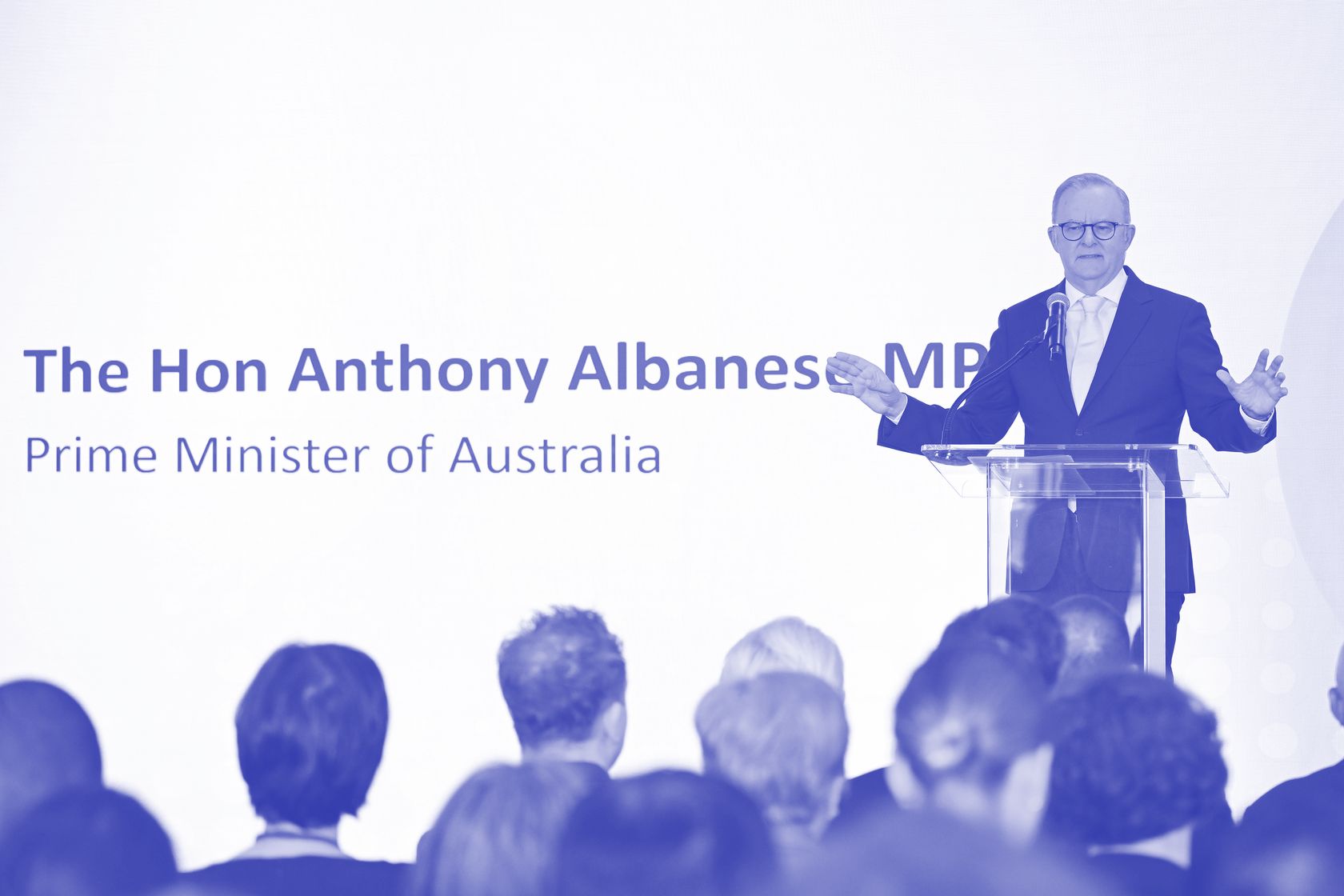
Albo’s pitch: Anthony Albanese touted Australia’s world-first social media age ban to global leaders at the United Nations General Assembly in New York. From 10 December, children under 16 will be barred from using platforms including Instagram, TikTok and Snapchat. Albanese told leaders the change will give kids “three more years of being shaped by real life experience – not algorithms.” Speaking alongside Albanese, European Commission President Ursula von der Leyen said she would look into implementing something similar in Europe, including a “digital majority age”. The event also drew the leaders of Greece, Malta, Fiji and Tonga. Parents and campaigners joined Albanese, including Bathurst mother Emma Mason, whose daughter Matilda “Tilly” Rosewarne died in 2022 after being bullied on social media. At a reception for world leaders in New York, Albanese met US President Donald Trump for the first time, and the pair posed for a selfie. A formal meeting is scheduled for 20 October in Washington. (Capital Brief)(The Daily Telegraph)
2.
Legitimising crypto: Assistant Treasurer Daniel Mulino will this morning unveil draft legislation outlining Labor's long-awaited cryptocurrency regulatory regime, which will expand existing financial services rules to encompass digital assets. The legislation proposes that "digital asset platforms" and "tokenised custody platforms" be formally introduced as financial products to be governed under the Corporations Act, rules overseen by ASIC. Crypto companies will need Australian Financial Services Licences to offer those products. Falling afoul of ASIC's rules will result in fines of "up to the greater of $16.5 million, three times the benefit obtained or 10% of annual turnover," according to Treasury. Platforms that facilitate under $10 million in transactions and hold no more than $5,000-per-customer will be exempt. The exposure draft Treasury is releasing on Thursday will kick off a consultation process with industry, out of which a formal bill will come. Submissions close on 24 October. (Capital Brief)
3.
Chip chase: Intel has approached Apple about securing an investment, as part of efforts to bolster a business that’s now partially owned by the US government, Bloomberg reported citing unnamed sources. The two companies have also discussed how to work more closely together, according to the sources. The talks have been early-stage and may not lead to an agreement, the news agency said, adding Intel has also reached out to other companies about possible investments and partnerships. A deal with Apple, which switched to in-house processors in the past five years, would represent further validation of Intel’s turnaround bid, though it’s unlikely Apple would switch back to Intel processors. Nvidia invested USD 5 billion in Intel last week, while SoftBank Group announced a USD 2 billion investment last month. Intel CEO Lip-Bu Tan is attempting a comeback with the backing of the federal government, which in August acquired a roughly 10% stake in the company through a deal brokered by the Trump administration. The companies have not commented. (Bloomberg)
4.
Painstaking efforts: China, the world’s largest polluter, pledged to cut greenhouse gas emissions 7% to 10% from peak levels over the next decade. In a videotaped address to a UN climate summit in New York, President Xi Jinping said the goal represents China’s best efforts under the Paris Agreement and would require “both painstaking efforts by China itself and a supportive and open international environment.” China also outlined plans to raise non-fossil fuels to over 30% of total energy consumption and expand wind and solar capacity more than six times 2020 levels. It comes as renewable installations have set records in the past two years, but authorities have also approved a large volume of new coal-fired power capacity. Separately, Premier Li Qiang announced China will no longer seek new special treatment for developing countries in WTO negotiations, a move seen as easing trade tensions with the US. WTO Director General Ngozi Okonjo-Iweala praised the decision. (Capital Brief)(Bloomberg)(China Daily)(WSJ)
5.
Lobby line-up: Optus appointed a Labor-linked lobbying firm, Fitzpatrick & Co Advisory, as it prepares for a bruising fight with state and federal governments over the failure in its triple-zero network that led to four people dying while trying to contact emergency services. Founded by Eamonn Fitzpatrick, a former press secretary to Kevin Rudd and Julia Gillard and boasting other clients including the Sydney Airport Corporation and Droneshield, it was added to the lobbyist register on Tuesday. The register also notes that Optus has retained TG Public Affairs, a Liberal-linked lobby group, since 2023. Optus is in the uncomfortably familiar position of national pariah for the past week since it announced that a systems failure led to its emergency services network losing function for several hours across three states. Meanwhile, the Federal Court on Wednesday fined Optus $100 million for unconscionable conduct through its phone sales. (Capital Brief)
6.
Physical expansion: Macquarie Group is seeking to grow its liquefied natural gas business by ramping up physical trading as part of its effort to capture a larger share of the fast-growing market, Bloomberg reported citing unnamed sources. The company is pursuing long-term LNG supply deals of up to 10 to 15 years and taking positions in shipping and assets, the news agency said. The plans are being developed via a non-banking unit. It is looking to expand its team in the coming months, with more hires in locations including London, according to the sources. Macquarie recently hired former Equinor ASA executive Samuele Ravelli to lead its global LNG trading business. Macquarie has remained active in the LNG market over the last decade, offering solutions including risk management, financing and physical execution, while several other banks consider returning to physical trading after pulling back due to regulatory pressure more than ten years ago. (Bloomberg)
7.
Rescue swaps: US Treasury Secretary Scott Bessent said that the US is considering a USD20 billion ($30.4 billion) swap line with Argentina and that it is prepared to buy the South American country’s dollar bonds as Argentinian President Javier Milei struggles to manage extreme market volatility. Bessent said that he and Trump spoke extensively with Milei, and that the “US Treasury stands ready to purchase Argentina’s USD bonds and will do so as conditions warrant. We are also prepared to deliver significant stand-by credit via the Exchange Stabilization Fund.” On the swap line, Bessent said that the Treasury is working closely with the Argentine government to “prevent excessive volatility.” Earlier this week Bessent said that “all options for stabilisation are on the table.” The Argentine peso climbed 2.4%, while dollar bonds jumped across the curve. Notes due in 2035 rose about 4 cents, erasing losses seen since the Buenos Aires election. (Bessent X)(Capital Brief)(Bloomberg)
8.
Ice blood: A shooter opened fire on a US immigration enforcement facility in Dallas on Wednesday morning, killing two detainees and critically wounding a third, the Department of Homeland Security told media. The gunman, described by officials as a sniper, fired from a nearby rooftop and died from a self-inflicted gunshot wound. Ammunition found at the scene included a round marked “ANTI-ICE” in blue writing, FBI officials said. No law enforcement agents were hurt, but a federal law enforcement official described the shooting as “an act of targeted violence” against the federal agency, Bloomberg reported. Officials said the gunman fired indiscriminately, including at a van in the detainee entrance area where the victims were shot. The Dallas ICE field office, which processes detainees before they are transferred to long-term detention, has held more than 8,400 people since President Trump took office, according to The New York Times. It is known locally as the site of weekly morning prayer vigils in support of immigrants. (Capital Brief)(Bloomberg)(NYT)
