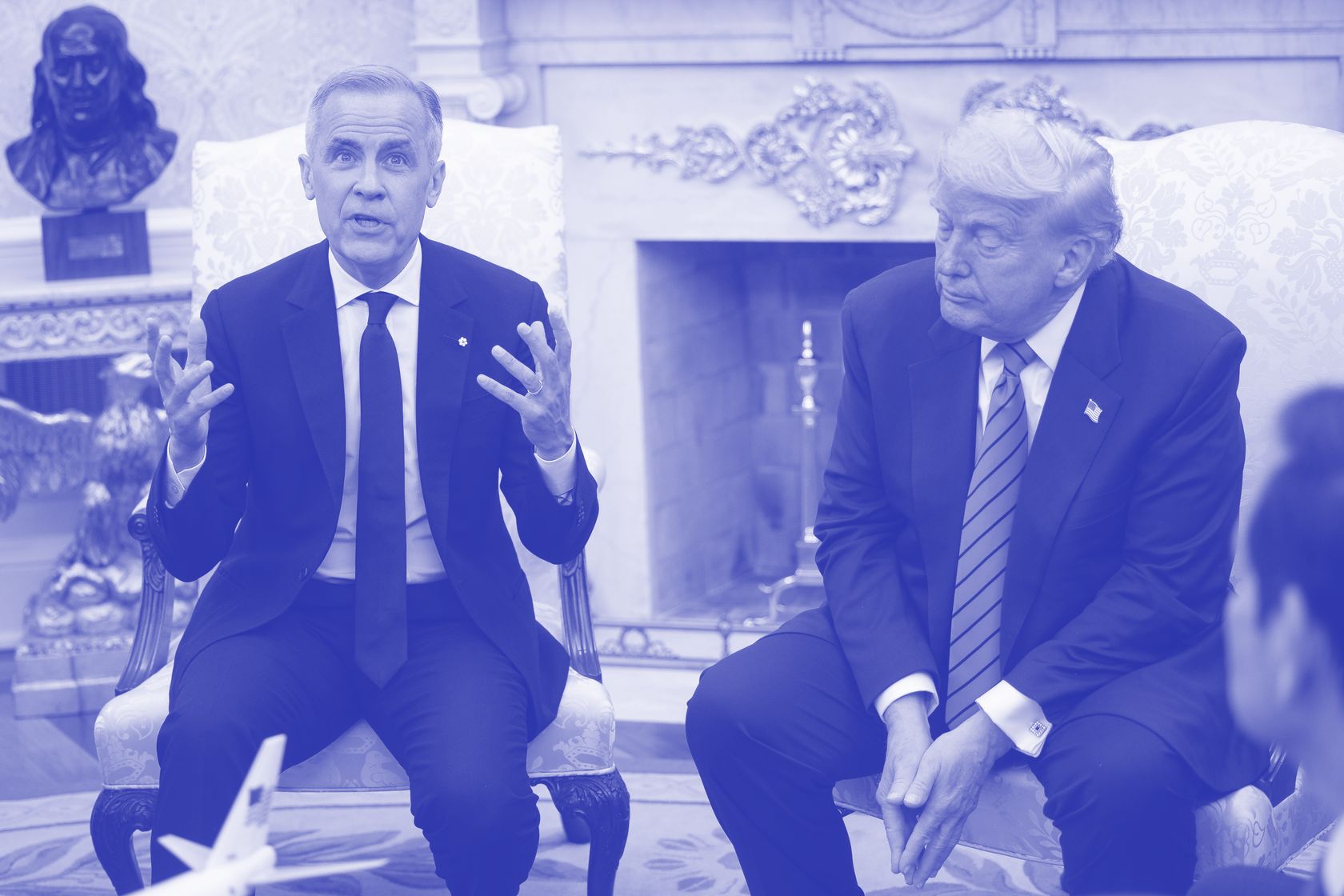
Carney tells Trump Canada 'won’t be for sale, ever'
Plus: UK and India strike post-Brexit free trade deal worth $52.8b; UK and US near trade deal, says FT; Tim Wilson takes back Goldstein from teal independent Zoe Daniel.

Good morning. Here's what happened overnight and what you need to know today.

1.
Eh Nope: Canadian Prime Minister Mark Carney told US President Donald Trump that Canada “won’t be for sale, ever,” during their first meeting at the White House since Carney’s election. Trump, who has repeatedly said Canada should become the 51st US state, replied, “Never say never.” Carney added, “Respectfully, Canadians’ view on this is not going to change.” The meeting came amid tensions over trade, with Trump posting shortly beforehand that the US doesn’t need “ANYTHING” from Canada. Both leaders said the USMCA would need to change, and Trump said it could be renegotiated or terminated. Earlier, Trump teased a “very big announcement” about “a very important subject” before he visits the Middle East next week, but didn’t provide details, beyond saying it was “very positive”. And the US Supreme Court allowed Trump’s ban on transgender people in the military to take effect while legal challenges proceed. (NYT)(AP)
2.
Stronger ties: Britain and India clinched a landmark free trade agreement, expected to boost bilateral trade by £25.5 billion ($52.8 billion) by 2040. Finalised after over three years of stop-start negotiations and amid global tariff upheaval driven by Donald Trump, it is the UK’s biggest trade deal since leaving the EU and India’s most ambitious. The pact will slash tariffs on British exports including among many others, whisky, cars, cosmetics and medical devices. India’s trade ministry said 99% of Indian exports to the UK will face zero duty, while the UK government said tariffs will be reduced on 90% of UK goods exported to India, with 85% becoming fully tariff-free within a decade. The deal includes provisions on procurement, giving British firms access to Indian government contracts, rules of origin that permit tariff reductions even when using foreign inputs, and exemptions from dual social security contributions for temporary workers. It still requires legal checks and ratification. (Capital Brief)(UK Govt)(Reuters)(Bloomberg)
3.
Dictating tariffs: The UK and US are close to agreeing a trade deal that would cushion the impact of Donald Trump’s “liberation day” tariffs by granting lower-tariff quotas for UK steel and car exports, the Financial Times reported, citing officials in London and Washington. The deal, which could be signed this week, includes quotas that would shield some UK goods from the full 25% tariffs imposed in February and March. The UK has offered concessions on the digital services tax, tariffs on US auto exports and agricultural products, but will not accept US food production standards, the report said. Talks are ongoing “at speed”, though disagreements remain over pharmaceuticals. Separately, Treasury Secretary Scott Bessent told Congress that deals could be announced “perhaps as early as this week”, but confirmed that “China, we have not engaged in negotiations with as of yet.” In the Oval Office, Trump said he would prescribe tariff terms, appearing to move away from the idea of engaging in back-and-forth negotiations. (FT)(Fox Business)
4.
Teal spill: Tim Wilson is projected to reclaim the Melbourne seat of Goldstein from teal independent Zoe Daniel, becoming the first Liberal to regain a teal-held seat since 2022 and the only metropolitan seat across the capital cities won by the Liberals at this election. Wilson leads Daniel by 387 votes after a strong showing in postal ballots, with about 9000 still to be counted and trending in his favour. Daniel, who celebrated on Saturday night, has not conceded. In Kooyong, Monique Ryan leads Liberal Amelia Hamer by 1002 votes, while in Bradfield, Gisele Kapterian is 178 votes ahead of independent Nicolette Boele, according to the Australian Financial Review. Despite these contests, Climate 200-backed independents increased their vote and pushed Labor to the brink in Bean and Fremantle. (AFR)(The Australian)(Nine)
5.
Deficit deluge: The US trade deficit surged to a record high in March as importers rushed to buy foreign goods ahead of planned tariffs. Bureau of Economic Analysis data showed the deficit widened 14% to a record USD140.5 billion ($216.6 billion), driven by a surge in imports to USD346.8 billion. Nearly all of the USD22.5 billion spike in consumer goods imports came from pharmaceuticals, which the Trump administration has threatened with levies. Despite the ballooning deficit, global supply chain pressures eased in April. The New York Federal Reserve’s index fell to -0.29, down from a revised -0.17 in March, signalling lower-than-normal strain even amid rising trade uncertainty. (WSJ)(BEA)(Reuters)(NY Fed)
6.
Silent dissenters: Germany’s conservative leader Friedrich Merz was elected Chancellor in a second parliament ballot held on Tuesday, having failed to gain the required 316 votes earlier in the day. The Bundestag elected the CDU MP with 325 of 618 votes cast. The second ballot was arranged following hours of consultations with constitutional experts and members of the CDU/CSU coalition, as Merz and his coalition scrambled to digest the shock results. Despite Merz’s coalition holding 328 seats between them, the first vote only secured 310 votes in the secret ballot. The identities of the MPs who dissented may never be known, and there is a risk that those who voted against Merz may fundamentally oppose parts of the coalition’s agenda. Merz will be sworn in by the Bundestag speaker and is scheduled to visit Paris on Wednesday to meet with Emmanuel Macron. The DAX pared back most of its earlier losses, down just 0.4% after dropping as much as 2.1% after the first vote. (Capital Brief)(Bundestag)
7.
Mid-East conflict: Donald Trump said the US will stop bombing Yemen’s Houthi group “effective immediately,” saying the Iran-backed rebels had agreed to stop attacking US ships. Trump said the Houthis told the administration “they want to stop the fighting,” and the US would “honour that.” Oman confirmed it mediated a ceasefire in which “neither side will target the other, including American vessels, in the Red Sea and Bab al-Mandab Strait.” Houthi official Mohammed al-Bukhaiti declined to confirm a deal had been reached, and said the group is ready to stop attacking US military ships if strikes end, but would “definitely continue” operations “in support to Gaza.” Since March, the US military has carried out more than 1,000 strikes in Yemen, killing “hundreds of Houthi fighters and numerous Houthi leaders,” the US military said. The ceasefire followed a Houthi missile strike near Tel Aviv’s airport, prompting Israeli strikes on Sanaa airport and Hodeidah port. (Bloomberg)(Axios)(Reuters)(UN)
8.
Double order: DoorDash announced a duo of deals on Tuesday, bringing Deliveroo and SevenRooms under its umbrella to push forward with its aggressive expansion plans. Announced alongside Q1 earnings, DoorDash said it will buy UK-based Deliveroo for around £2.9 billion ($6 billion), a 29% premium to Deliveroo’s closing price on Monday. DoorDash will shell out USD1.2 billion in the all-cash deal for SevenRooms. The almost $8 billion DoorDash is splashing out underscores the company’s ambitions to compete in the tightly held food delivery and reservations space. Deliveroo CEO and founder Will Shu is set to bag £170 million in the deal. Uber has also announced plans to buy an 85% stake in Turkey’s Trendyol GO food delivery business in a USD700 million all-cash deal. The sales follow Prosus’ €4.1 billion purchase of Just Eat in February, which saw Prosus pay a 22% premium on the group’s share price high in early 2025. (Capital Brief)(DoorDash)(CNBC)
