Trump's Treasury pick sparks bond rally
Plus: Israel-Hezbollah ceasefire deal days away, officials say; Macy’s rogue employee hides $236m expenses; UniCredit bids $16b for domestic peer BPM, Commerzbank on ice.


Good morning. Here's what happened overnight and what you need to know today.

1.
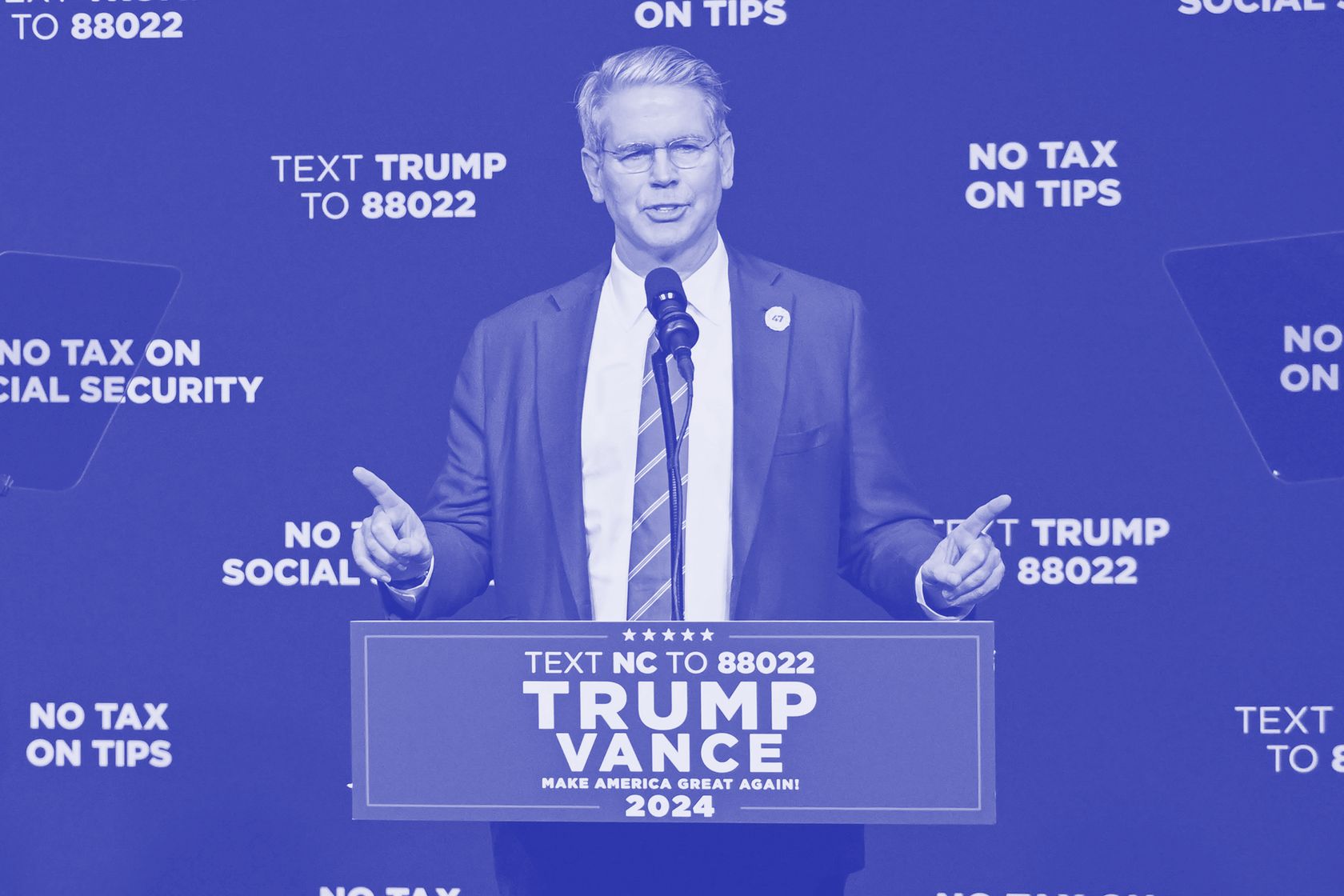
Market relief: US Treasuries surged on Monday, with 10-year yields falling 11 basis points to 4.3% in what was interpreted as a reaction to President-elect Donald Trump's nomination of Scott Bessent as Treasury Secretary. Bessent’s support for a gradual implementation of tariffs and fiscal discipline is viewed as a potential counterbalance to Trump’s aggressive trade policies. The dollar index dropped 0.9%, its steepest one-day decline since August, while the euro gained 0.9% against the US dollar. Equities responded positively, with the S&P 500 and Nasdaq rising 0.8% and 1% respectively. In Asia, Japan’s Nikkei 225 and South Korea’s Kospi both gained 1.3%. “The Bessent selection certainly doesn’t fully negate the potential fallout from a renewed focus on trade wars and tariffs, although by eliminating some of the more extreme scenarios, the market has surely derived a degree of comfort in the outlook for the bond market,” Ian Lyngen, head of US rates strategy at BMO Capital Markets told clients. (FT)(Bloomberg)
2.
Ceasefire moves: Israel is set to discuss a US-mediated ceasefire deal with Hezbollah at a cabinet meeting on Tuesday, Reuters reported citing an Israeli official. Terms include an initial 60-day suspension of hostilities during which Hezbollah retreats north of the Litani River, about 30 kilometres away from the Israeli border, and the Lebanese army takes control of the border region, according to Bloomberg. “We are close to a deal,” the Israeli ambassador to the US, Michael Herzog said Monday. “It could happen within days,” he said, adding some final points still needed to be addressed. Israel wants to secure the return of displaced citizens to their homes, but far-right coalition member and National Security Minister Itamar Ben-Gvir, said the truce would be a missed opportunity to crush Hezbollah, as Israeli strikes continued pounding Lebanon. The news drove oil prices lower with Brent crude futures falling 2.69% to USD73.15 and the WTI down 2.92% to USD69.16. (Reuters)(Bloomberg)
3.
Delivery leak: Macy’s, the largest department store chain in the US, delayed its Q3 earnings results and briefing after revealing a single employee intentionally hid up to USD154 million ($236 million) in delivery expenses between Q4 2021 and Q3 2024. In a preliminary release, the company showed a 2.4% drop in net sales during the quarter ending 2 November to USD4.74 billion, below market estimates of USD4.77 billion. CEO Tony Spring said the accounting issue didn’t impact cash management or vendor payments, and the employee was no longer with the company. The Wall Street Journal noted the incident comes amid a growing shortage of qualified accountants in the US, driven by declining enrolments in accounting programs and an increasing number of retirements, leaving key positions unfilled for longer periods. Macy’s will release its 3Q results and full year outlook by 11 December. (Capital Brief)(Macy’s)(WSJ)
4.
M&A angles: UniCredit launched an all-stock €10.1 billion ($16.29 billion) unsolicited bid for domestic peer Banco BPM, offering a 0.5% premium on BPM's recent share price to create Italy’s largest bank by market capitalisation. The move follows BPM's recent purchase of a 5% stake in state-backed Monte dei Paschi di Siena (MPS) and its €1.6 billion bid for fund manager Anima Holding. “The Italian banking sector, which is one of our two biggest markets, is potentially consolidating,” UniCredit dealmaker-in-chief, CEO Andrea Orcel, said. “We cannot remain absent from that move.” Orcel’s bid follows a hostile reception in Germany to UniCredit’s pursuit of Commerzbank earlier this year. Orcel said any potential acquisition and integration of Commerzbank would only be pursued after the potential absorption of Banco BPM, which the company expects could be completed by June 2025. Banco BPM has not commented on the unsolicited offer. (Capital Brief)(UniCredit)(FT)
5.
Media agenda: Labor is finalising media reforms addressing Meta’s decision to end $70 million in annual deals with Australian publishers and establishing a new framework for journalism-related policies. The reforms were listed for discussion at Monday morning’s federal cabinet meeting, including a potential levy on digital platforms to redistribute revenue to publishers and an update to the News Media Assistance Program, a framework to support public interest journalism. Sources told Capital Brief announcements could come as early as Tuesday, though cabinet agendas are subject to last-minute changes. The government’s decision could affect approximately $200 million in annual revenue for publishers from Google and Meta. It comes as the government moves to pass social media legislation banning under-16s from platforms, which has drawn calls from Google and Meta for a delay until a 2025 age-assurance trial concludes. (Capital Brief)(The Guardian)
6.
Fiscal blues: Deloitte Access Economics forecasts a $33.5 billion deficit for 2024-25, up from $28.3 billion, driven by falling company tax revenue amid softer economic conditions and lower commodity prices. Deloitte expects company tax receipts to decline by $18 billion over four years compared to official forecasts, although income tax is projected to exceed expectations by $8.2 billion due to a strong jobs market. Net debt is expected to climb to 23.2% of GDP by 2027-28, higher than the 21.9% forecast in May. Treasurer Jim Chalmers acknowledged the budget position would weaken but said it would “still be much stronger than what we inherited.” Deloitte partner Cathryn Lee warned global elections this year showed “the politics of inflation is diabolical for incumbents. As such, the balance between spending and inflation will be front of mind heading into an election in the first half of 2025.” (Capital Brief)
7.
Bitcoin binge: MicroStrategy purchased 55,500 bitcoins for USD5.4 billion ($8.32 billion) between 18 November and 24 November, funded through proceeds from convertible notes and share sales. The bitcoins were acquired at an average price of USD97,862, it said, in a period when the cryptocurrency was trading near all-time highs. The bet brings MicroStrategy’s total holdings to approximately 386,700 bitcoins, valued at USD38 billion based on current prices. Led by CEO Michael Saylor, Micro has embraced a strategy of heavily leveraging Bitcoin since 2020, acquiring tokens at an average price of USD56,761. Despite shares rising over 500% this year, MicroStrategy’s stock fell 16% last week amid criticism of its leveraged approach. (Bloomberg)
8.
Giving legacy: Warren Buffett donated USD1.14 billion ($1.76 billion) in Berkshire Hathaway shares to four family foundations, continuing a philanthropic commitment made nearly two decades ago. About 1,600 Class A shares will be converted into 2.4 million Class B shares, distributing 1.5 million shares to the Susan Thompson Buffett Foundation and 300,000 each to the Sherwood Foundation, Howard Buffett Foundation and NoVo Foundation. Buffett, 94, has cut his Class A shares by almost 57% since 2006, and his net worth is now USD150.2 billion, making him the world’s seventh-richest person, according to Bloomberg. Earlier this year, Buffett said the Gates Foundation would no longer receive donations after his death, with his children overseeing a new charitable trust. He appointed three unnamed successor trustees, noting that “the massive wealth I’ve collected may take longer to deploy than my children live.” (Bloomberg)
