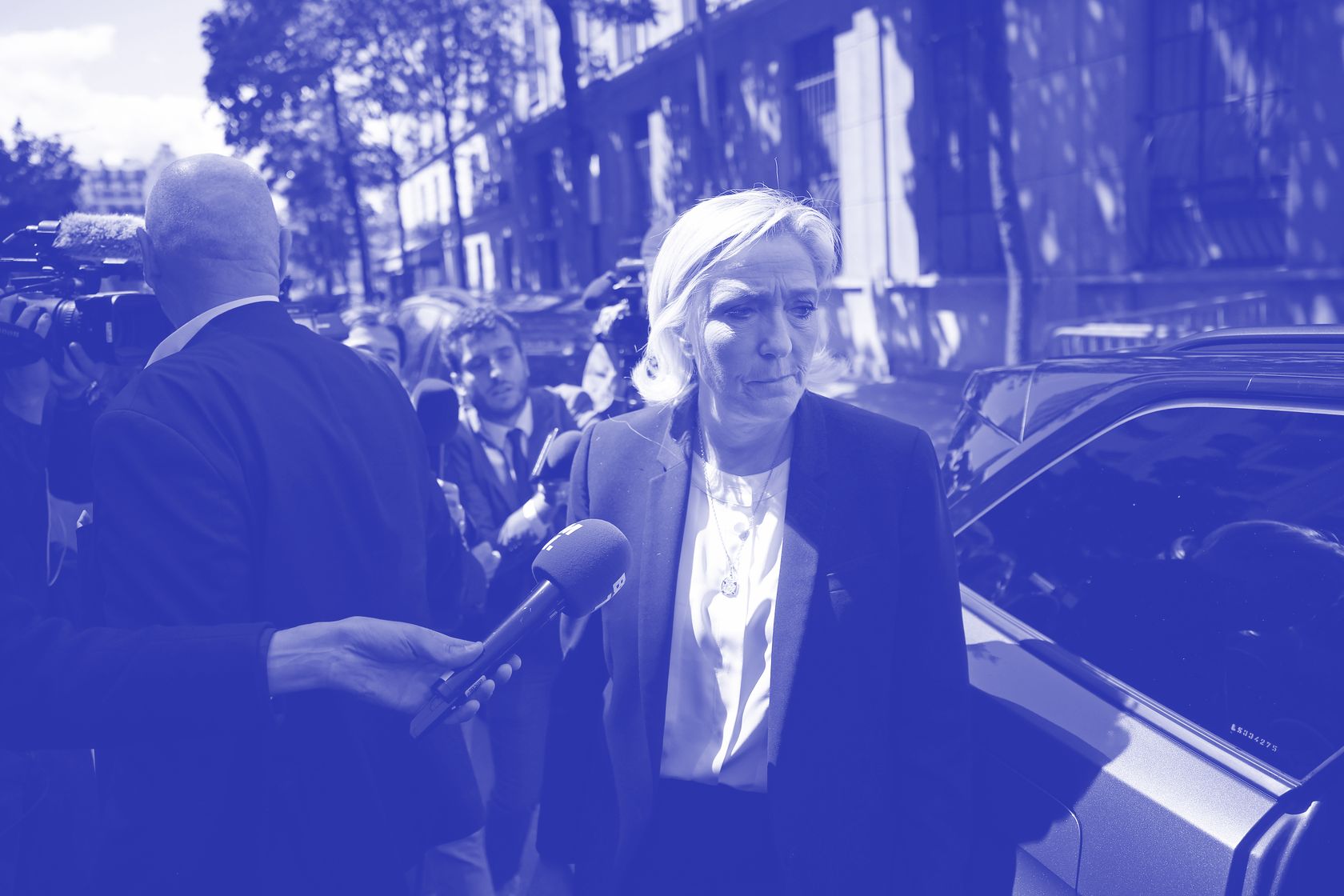
Le Pen’s RN projected short of French majority
Plus: Hezbollah retaliates with over 200 rockets launched at Israel; UK investors ready for first Labour victory since 2005; Amazon joins Saks Fifth Avenue’s $3.9b Neiman Marcus acquisition.


Good morning. Here's what happened overnight and what you need to know today.

1.
RN short: Marine Le Pen’s National Rally (RN) is projected to fall short of an absolute majority in Sunday’s French legislative election, according to polls cited by Bloomberg. Projections show the RN and its allies securing between 190 and 250 of the 577 National Assembly seats, well below the 289 needed to easily pass bills and implement their agenda. To block the RN, rivals have withdrawn over 200 candidates from the runoffs, creating a unified opposition. The left-wing New Popular Front is expected to win 140 to 200 seats, while President Emmanuel Macron's centrist alliance is projected to secure between 95 and 162, according to Ifop, Odoxa, OpinionWay and Toluna-Harris Interactive polls. Macron’s decision to call an election sparked a major selloff in French assets, but as the likelihood of an RN absolute majority wanes, assets prices have recovered. The CAC 40 Index rose 0.8% on Thursday, while the euro and French bonds remained stable. (Bloomberg)
2.
Hezbollah retaliates: Hezbollah said it launched over 200 rocket and drone attack at Israel on Thursday in response to the killing of a top commander the previous day. It was the second major attack in as many days after Israeli forces killed senior commander Mohammed Nasser on Wednesday. Nasser was the third high-ranking official killed in nearly nine months of cross-border fighting along the Lebanon-Israel border. Iran-supported Hezbollah said its rockets and drones targeted 10 Israeli military sites. The attacks caused fires in northern Israel and light injuries to two women, but no casualties. Israel intercepted most of the projectiles and responded by striking Hezbollah launch posts in southern Lebanon. Triggered by the conflict in Gaza, the hostilities between Hezbollah and Israel have been steadily escalating for months, raising fears of a full-scale war, which both parties have expressed a desire to avoid. Meanwhile Israel is considering a new proposal from Hamas that could lead to a cease-fire deal in Gaza, and Israeli Prime Minister Benjamin Netanyahu held a call with US President Joe Biden and Vice President Kamala Harris. (Reuters)(Aljazeera)
3.
Labour victory: As UK voters headed to the polls, investors prepared for Labour's first victory since 2005. With pre-election polls consistently favouring Keir Starmer's Labour, Rishi Sunak's Conservatives face a likely defeat after three years of political turbulence post-Brexit, multiple prime ministers and internal scandals. Starmer, 61, is a former human rights lawyer and will face numerous challenges without strong financial backing. Prime Minister Rishi Sunak, who voted early, warned Labour's policies could harm the economy. The stock market, however, has remained stable leading up to the election, with the FTSE 100 climbing 0.9% on election day, its best performance in nearly two months. Investors seemed optimistic about a potential Labour win, though some high-net-worth individuals are taking precautions, such as cashing in investments and relocating. A Labour win could lead to closer EU ties and to pressure on pension funds to invest in domestic companies. Labour's manifesto promises pro-business policies and tax reforms, appealing to both local and international investors, while also planning to tax the wealthy. (Bloomberg)
4.
Luxury fusion: Saks Fifth Avenue’s parent company has struck a USD2.65 billion ($3.94 billion) deal to acquire rival Neiman Marcus, merging the two largest US luxury department stores to create a new entity, Saks Global, in which Amazon will hold a stake, the companies said in a statement. The merger, endorsed by both companies' boards, is seen as a strategy to consolidate operations, negotiate better terms with suppliers and compete more effectively in the luxury market. Amazon will provide technology and logistics support to the combined group which is expected to have annual sales of around USD10 billion, The Wall Street Journal reported, citing unnamed sources. The transaction will be financed by Saks's owner, Canadian retail conglomerate Hudson’s Bay Company (HBC), with a combination of equity from existing investors and USD1.15 billion in debt from Apollo Global Management affiliates, the statement said. HBC also secured a USD2 billion revolving asset backed loan from Bank of America, Citigroup, Morgan Stanley, RBC Capital Markets and Wells Fargo. Marc Metrick, CEO of Saks’s e-commerce site, will lead the new company. (Wall Street Journal) (Media release)
5.
Sleepy Joe: Amid a crisis of confidence, US President Joe Biden is fighting for his political life and spent Independence Day trying to stamp down calls for him to drop his bid for re-election. In a radio interview that aired on Thursday morning, US time, Biden acknowledged his missteps last week, saying he “screwed up,” referring to his performance on the debate against Donald Trump, where he often misspoke and appeared to lose his train of thought. The president also reportedly told Democratic governors at an emergency meeting on Wednesday that he needed more sleep and fewer events at night. According to The New York Times, when Josh Green of Hawaii, who attended virtually and is a physician, asked Mr. Biden about his health, the president replied, “It’s just my brain,” a remark that some in the room took as a joke but others found puzzling. Biden’s energy levels and sharpness will be heavily scrutinised at several Independence Day events Thursday, and at a much-anticipated ABC News interview due to air on Friday night, local time. (The New York Times)
6.
China charge: For the first time, Tesla's Model Y has been included in a list of electric and plug-in hybrid vehicles eligible for government purchase in China, according to official Chinese media. The eastern Jiangsu provincial government listed 56 new energy vehicle models for use as service cars by public organisations on 6 June, with Tesla's Model Y and Volvo's XC40 standing out among predominantly Chinese-branded EVs and hybrids. Tesla, which previously faced restrictions on entering certain government and military compounds in China, gained approval after the country’s top auto industry association deemed its data collection practices compliant. In April, CEO Elon Musk visited China to meet Premier Li Qiang, and despite a 9% drop in deliveries of China-made vehicles in the first half of 2024 amid ongoing US-China tensions, Tesla is bolstering its presence in the Asian country, planning to build a data training centre and introduce its Full Self Driving software. (Reuters)
7.
EV tariff: The European Union confirmed new tariffs on electric vehicles made in China, effective from Friday and lasting at least four months, after negotiations with the Chinese government and lobbying from the German car industry and others failed to halt them. The move targets Chinese manufacturers BYD, Geely and SAIC with tariffs of 17.4%, 19.9%, and 37.6%, respectively on top of a pre-existing 10% tariff. The EU Commission last month said Chinese EV companies, supported by government subsidies, undercuts European competition by selling at lower prices. European manufacturers like Volkswagen, BMW, Mercedes-Benz and Stellantis, facing competitive pressure from Chinese firms, have opposed the tariffs due to fears of a trade war. A final decision on the tariffs is expected in November, which would then extend for five years. (Wall Street Journal)(The Guardian)
8.
Maple byte: Canada has introduced a previously flagged digital-services tax applying a 3% levy on revenue from companies providing digital services to Canadians or selling their data. Prime Minister Justin Trudeau's cabinet ordered the digital tax, seen as a measure to ensure digital businesses contribute fairly, to be implemented from 28 June 28, or last Friday, and is retroactive to sales dating back to 2022. The move had repeatedly sparked warnings of trade retaliation from the US Congress and the Biden administration and critics argue the tax violates Ottawa’s obligations under both the US-Mexico-Canada trade deal, known as USMCA, and the World Trade Organization. The dispute centres on a global tax accord from 2021, supported by the Biden administration, which aims to standardise multinational company taxation but has yet to be implemented, leading Canada to proceed with its own digital-services tax, projected to generate C$2.3 billion in the current fiscal year. (The Wall Street Journal)
