Trump partly shielded from prosecution, US Supreme court rules
Plus: Tech giants tap nuclear power for AI data centres; French election bets propel stocks; BlackRock buys Preqin for £2.55b in alternative assets push.


Good morning. Here's what happened overnight and what you need to know today.

1.
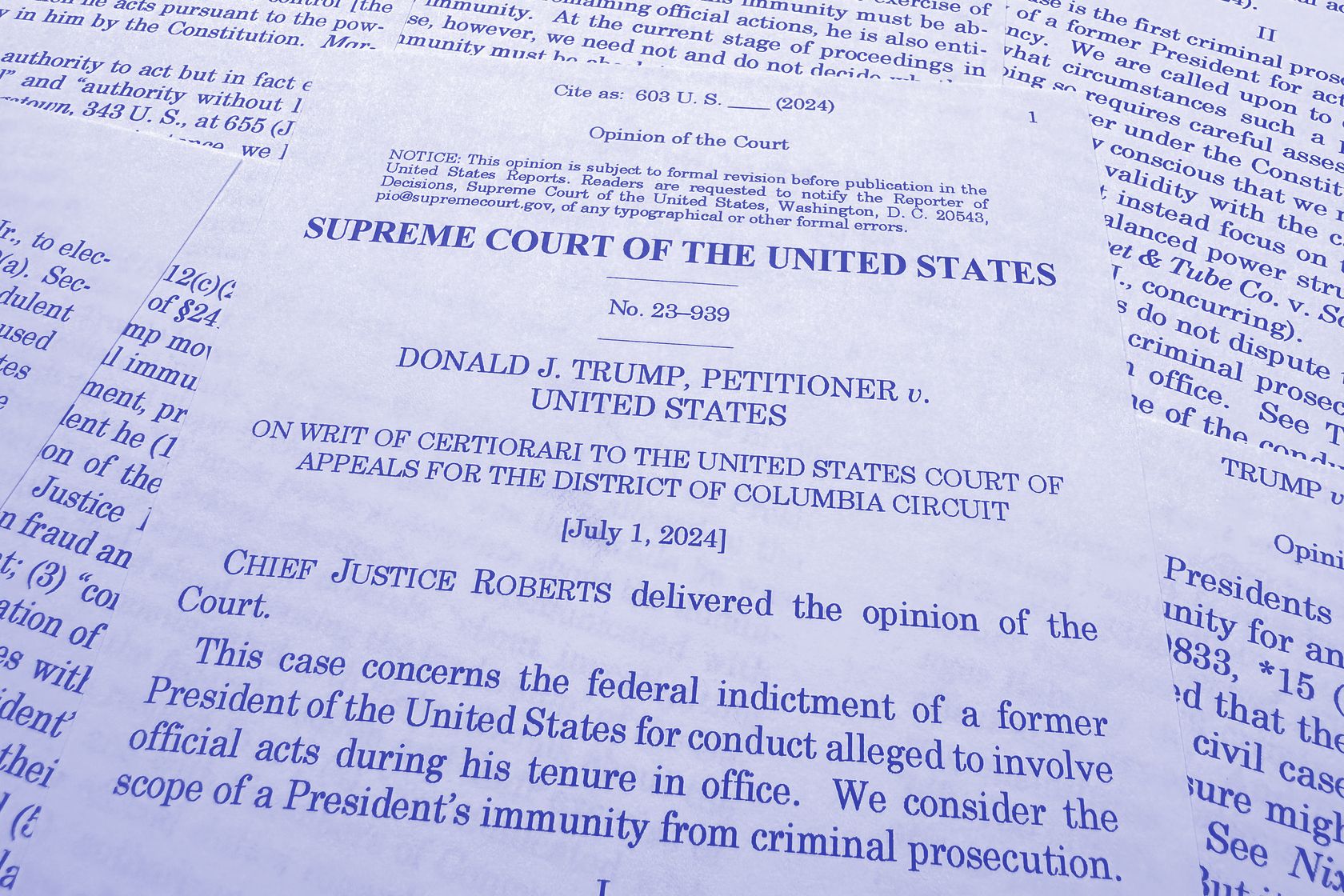
Historic ruling: The US Supreme Court ruled that former President Donald Trump is entitled to some immunity from prosecution, which may delay his trial on charges of attempting to overturn the 2020 election. The 6-3 decision, split along partisan lines, determined that Trump is immune from prosecution for his official acts as president, marking the first time since the nation’s 18th century founding that the Supreme Court has declared former presidents may be shielded from criminal charges in any instance. Chief Justice John Roberts stated that while the president is not above the law, Congress cannot criminalise his conduct in executing constitutional responsibilities. The Supreme Court's three Democratic appointees strongly dissented against the ruling, arguing the decision effectively elevates the president above the law. Trump faces charges of conspiracy and obstruction related to his efforts to stay in power after losing the election. The case now returns to the lower court to determine if Trump's actions were official or private. The ruling makes a pre-election trial unlikely, and if Trump wins the election, he could potentially order the Justice Department to drop the charges. (US Supreme Court)(Capital Brief)(New York Times)
2.
Nuclear-powered AI : Tech giants are targeting US nuclear power plants to supply electricity for new data centres and fuel the AI boom, risking the diversion of stable power from the grid. According to The Wall Street Journal, about a third of US nuclear power plants are in talks with companies like Amazon Web Services, which is nearing a deal with Constellation Energy, producer of more than a fifth of the nation's nuclear power. Amazon also recently purchased a USD650 million ($975 million) nuclear-powered data centre in Pennsylvania, and several others were in talks, the journal said. The arrangements promise nearly uninterrupted, carbon-free power, supporting the climate commitments of wealthy tech companies while meeting the rising demand for AI infrastructure. However, the deals could raise prices for other customers and hinder broader emission-cutting goals, as the likely result will be a higher reliance on natural gas to replace diverted nuclear power. Tensions about cost, reliability and emission goals are already emerging in states like Connecticut, Maryland, New Jersey and Pennsylvania. (The Wall Street Journal)
3.
Bourse surge: French banking stocks surged on Monday, propelling a broader rise in French equities, as traders bet the second round of the election this weekend would deny the far right or far left a majority in the National Assembly. Shares of BNP Paribas, Credit Agricole, and Societe Generale jumped by 3-4%, while bond default insurance costs dropped. The CAC 40 rose 1%, outperforming the regional STOXX 600's 0.32% gain. The euro also strengthened, rising to a two-week high against the dollar. But French assets remain over 5% below their levels before President Emmanuel Macron called the election on 9 June. French 10-year bond yields rose to 3.33%, as political risk remains high, with a hung parliament or even an absolute majority win by the far-right National Rally (RN) still a possibility. The RN and allies secured 33% of the vote, with the final outcome dependent on further alliance-building and the parliamentary run-off on 7 July. (Reuters)(Financial Times)
4.
Data power: BlackRock will buy UK-based private markets data firm Preqin for £2.55 billion ($4.84 billion) in cash, marking the world’s largest money manager’s first venture into financial information provision as it accelerates a push into alternative assets. BlackRock is paying 13 times Preqin’s expected 2024 revenue of USD240 million, beating bids from S&P Global and Bloomberg to acquire the company, the Financial Times reported. The deal, expected to close by year-end, will expand BlackRock’s Aladdin technology system and follow its USD12.5 billion purchase of Global Infrastructure Partners in January. Preqin, founded Mark O’Hare – who owns 80% of the company – tracks the performance of private equity and hedge funds and will remain a separate offering while its data will also be integrated into BlackRock’s eFront, Aladdin’s private market solution. Private markets, the fastest growing segment in asset management, are expected to reach nearly USD40 trillion by the decade's end, driving demand for relevant data. (Prequin release)(Blackrock release)(Financial Times)
5.
Swipe fee flip: The US Supreme Court ruled that the six-year statute of limitations for challenging regulations begins when a regulation first affects a company, rather than when it is issued. The decision gives companies more time to file lawsuits against regulations. The case, Corner Post v Board of Governors of the Federal Reserve System, involved a 2011 regulation of debit-card swipe fees. Lower courts had dismissed the 2021 case because the statute of limitations had expired. The Supreme Court's ruling reverses this, extending the timeframe for legal challenges. It follows another landmark decision last week by the Supreme Court, overturning Chevron deference, a foundational doctrine that required courts to defer to executive agencies' interpretations of ambiguous statutes. In her dissent, Justice Ketanji Brown Jackson argued that these decisions could undermine the functioning of federal agencies, leading to a surge of lawsuits against them. (The New York Times)
6.
Platform politics: The US Supreme Court declined to rule on the constitutionality of laws in Florida and Texas aimed at limiting social media companies' power to moderate content, returning the cases to lower courts for further analysis. These laws, promoted by Republicans to combat alleged bias against conservative views, have faced criticism for potentially violating the First Amendment rights of the platforms. They were also seen partly as a response to platforms banning Donald Trump after the 6 January 2021 attack on the Capitol. Florida’s law prevents social media from barring political candidates, while Texas’ law prohibits removing content based on user viewpoints. Federal appeals courts have reached conflicting conclusions on these laws. The Biden administration supported the social media companies, arguing that a ruling against them would amplify hate speech and disinformation. The Supreme Court's decision leaves the issue unresolved, pending lower court evaluations. (The New York Times)
7.
Russian risk: Italy’s UniCredit launched a legal challenge against the European Central Bank's (ECB) directive to cut its business dealings in Russia. The Italian bank, with one of the largest exposure to Russia among western banks, requested the EU's General Court to clarify the legality of the ECB's demands. The ECB has asked lenders still involved with Russia, more than two years after Moscow invaded Ukraine, for a “clear roadmap” to exit the country. UniCredit is concerned that the ECB's terms exceed the current legal framework and could have unintended negative consequences. It also asked for a suspension of the ECB's order while the court case proceeds. The ECB had instructed Eurozone banks to expedite their withdrawal from Russia due to reputational and legal risks, although western sanctions and Russian restrictions complicate the process. UniCredit has reduced its Russian cross-border exposure by 91% and local exposure by 65%. (Reuters)(Bloomberg)
8.
Rockets fired: The Palestinian militant group Islamic Jihad launched rockets into Israel on Monday as clashes intensified in Gaza, with Israeli tanks advancing further into the enclave. The rockets, about 20 in total, caused no casualties. The display of militant strength comes nearly nine months into Israel's offensive in Gaza. Residents in eastern Khan Younis, southern Gaza, reported receiving evacuation orders through phone calls from Israeli sources. Prime Minister Benjamin Netanyahu said Israel was nearing its goal of dismantling Hamas' military capabilities, but that less intense operations would continue. Meanwhile, Israel released 54 Palestinian detainees, including Mohammad Abu Selmeyah, the director of Al Shifa Hospital, arrested by the military when its forces first stormed the medical facility in November. Selmeyah claimed detainees were abused, deprived of food and medicine and that some had died due to these conditions. (Reuters)
