Trump says oil prices will fall after the US-Israeli war on Iran ends
Plus: Trump threatens to cut all trade with Spain, attacks UK’s Starmer as “not Winston Churchill”; Global stocks slide and oil soars; Albanese defends $90b-plus Sydney-Newcastle high-speed rail cost.

Good morning. Here’s what happened overnight and what you need to know today.

1.
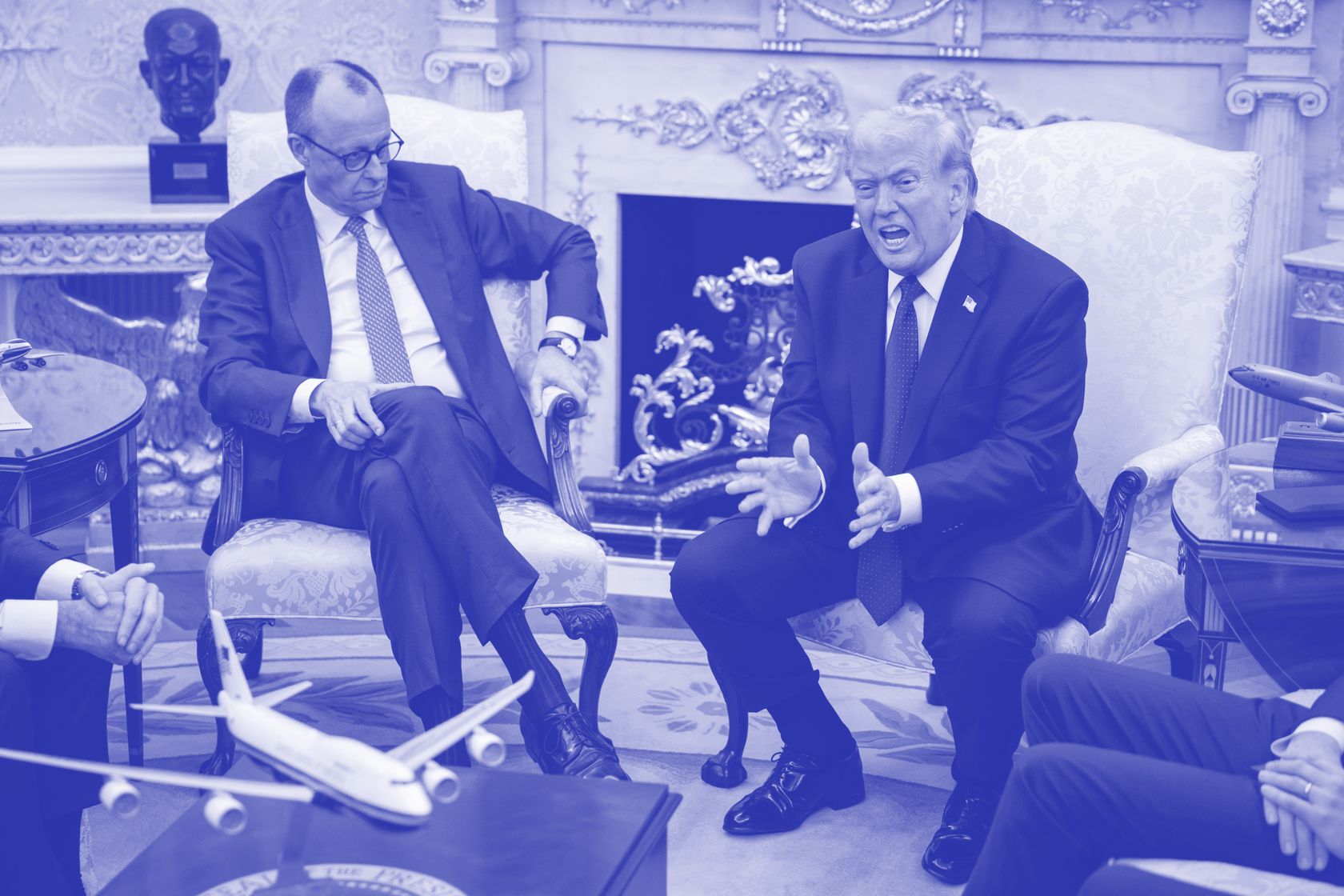
US-Iran war: The US-Israeli war on Iran raged on into its fourth day as Israel struck the building where Iran’s clerics had been convening to choose a new supreme leader, Iran attacked the US Embassy in Riyadh twice and Iraqi oilfields began shutting down as the Hormuz crisis choked off tanker traffic and filled storage to capacity. At the White House, Donald Trump hosted German Chancellor Friedrich Merz, the first world leader to meet with the US president in person since the conflict began. He said oil prices would drop once the war ended, predicting they would fall lower than before. He said the US had already knocked out Iran’s navy, air force, air detection and radar. Writing on Truth Social earlier, he said the US had a virtually unlimited supply of medium and upper-medium grade munitions and that wars could be fought forever using just those supplies. At the White House he said most people he had in mind to replace Iran’s leadership were dead, warning the worst-case scenario would be someone “as bad as the previous person” taking power. Trump also pushed back on suggestions that Israel had forced his hand, saying he believed Iran was planning to attack first and that if anything, he may have forced Israel’s hand. Merz acknowledged the conflict was damaging economies and said he hoped the US and Israeli militaries would bring it to an end as soon as possible, while affirming Germany was on the same page as Washington and Israel on removing the Tehran regime. Iran has put the death toll from the US-Israeli strikes at 787, while six US troops have been confirmed killed. (Capital Brief)(WSJ)(Bloomberg)(FT)(AP)
2.
Ally fire: Trump also used his Oval Office meeting with Merz to lash out at two NATO allies. He threatened to cut all trade with Spain after it refused US access to its military bases for the Iran strikes, saying “Spain has been terrible” and instructing Treasury Secretary Scott Bessent to cut off all dealings with the country. Spain’s foreign minister José Manuel Albares said Spain would not allow its jointly operated bases to be used for attacks on Iran, which Madrid has condemned. Trump also renewed his criticism of British Prime Minister Keir Starmer, saying “this is not Winston Churchill that we’re dealing with,” complaining that the UK’s handling of the Chagos Islands (which houses a US naval and bomber base) had cost the US several days of logistical delays. Starmer had initially refused to allow US forces to use British bases for the Iran strikes, saying the government did not find legal basis for offensive action. He has since allowed limited and defensive use of UK bases after Iran struck US allies in the region. When asked about the impact of the UK’s decision to withhold support for the US-Israeli strikes on its ongoing trade talks with Washington, UK Chancellor of the Exchequer Rachel Reeves said: “You can’t make a decision about whether to get British armed forces involved in a conflict because it may or may not make it more likely to get a trade deal. We judged that there was not a legal basis for offensive action on Iran.” (WSJ)(Bloomberg)(FT)(AP)
3.
Oil shock: Oil surged and global stocks slid as the war in Iran showed no signs of de-escalation and the Strait of Hormuz remained all but shut, heightening fears of a prolonged disruption to energy markets and a possible surge in inflation. The Dow industrials was about 1% lower in afternoon trading after paring steeper losses, while Brent briefly topped USD85 a barrel for the first time since mid-2024 and European natural-gas prices soared 22%, extending Monday’s massive surge. The S&P 500 had also pared losses to be only 0.78% lower in the afternoon. The Nasdaq too was only 0.80% lower. Ten-year Treasury yields rose, the dollar strengthened, spot gold fell, and Bitcoin slipped, as Iraq also began to shut production at the Rumaila field and West Qurna 2, taking about 1.2 million barrels a day offline on Tuesday. Bloomberg also reported supertanker day rates on the benchmark Middle East-to-China route exceeded USD481,000 a day on Tuesday, a fresh record, having quadrupled since mid-February, as shipping traffic through the Strait of Hormuz remains largely halted. Elsewhere, the private credit market was also rattled after Blackstone’s flagship credit fund BCRED saw a surge in redemption requests, with its shares and those in peers like Ares Management and Blue Owl Capital also falling. (WSJ)(Bloomberg)(Reuters)
4.
Do the locomotion: Anthony Albanese pushed back at critics of his multibillion-dollar high-speed rail project between Sydney and Newcastle, predicting massive economic and jobs benefits as part of what he describes as genuine nation building. Amid estimates the project will cost more than $90 billion, Albanese, writing exclusively for Capital Brief, said the 194km project will generate $250 billion in economic activity and create 99,000 jobs. “As a former infrastructure minister I can tell you, the only thing that moves fast in this process is the train,” Albanese wrote. “But we are moving. Eventually so will those trains, stopping only at stations at Newcastle, Lake Macquarie, Central Coast and Sydney Central — with future stations at Parramatta and Western Sydney International [Airport]”. While colleagues admire his unfaltering commitment to the project, some are intimidated by its scale and cost. Opposition infrastructure spokeswoman Bridget McKenzie questioned the price tag and the timing while the nation faces a housing shortage. “This is a lot of money…It will be a test of the government’s fiscal responsibility”, McKenzie told Capital Brief. (Capital Brief)
5.
Credit shakeout: Apollo Global Management boss Marc Rowan warned a “shakeout” is coming for private credit firms, as the USD1.8 trillion ($2.56 trillion) industry faces mounting concerns over rising defaults on loans to software companies and redemptions at business development companies. Speaking at a Bloomberg conference on Tuesday in New York, Rowan said: “This will be a shakeout — I don’t think it is going to be short term.” For weeks, private credit executives have fielded questions from investors about whether the industry can withstand sustained pressure if the software sector is upended by AI in coming years. Rowan also pointed to “a string of blow ups in bank loans” as evidence of broader strains in credit markets. The comments also come as the collapse of Market Financial Solutions in the UK last month left banks including Barclays, Jefferies, Banco Santander and Wells Fargo nursing potential losses amid allegations of financial irregularities. Atlas, Apollo’s structured-credit arm, had about GBP400 million of exposure to MFS, about 1% of its balance sheet. It is pursuing legal avenues to maximise recoveries. Apollo’s shares have slumped close to 30% so far this year, compared with an about 1% decline in the S&P 500 Index. (Bloomberg)
6.
Charm offensive: Nasdaq-listed bitcoin miner turned AI data centre builder IREN ramped up a charm offensive in its home city, sponsoring the Sydney Swans AFL team and buying billboard advertising space in and around Macquarie Park, near several operational and proposed data centres. But the neocloud’s co-chief executive Dan Roberts has remained coy about any move to open facilities on Australian shores, having previously complained about excessive red tape. On Tuesday, he told Capital Brief that while “It’s positive to see AI and digital infrastructure getting attention at a national level”, he would like to see a sustained difference in execution, “things like permitting timelines and grid connection speed”. He added that progress in that area would help unlock more large-scale investment. Despite its focus on North America to date, Roberts said the company would “absolutely like to deepen those relationships in key markets like APAC.” (Capital Brief)
7.
Grow growth: Mental health platform, Grow Therapy, raised USD150 million ($215.1 million) in Series D financing, valuing the startup at USD3 billion. The raise was led by existing backers TCV and Growth Equity at Goldman Sachs Alternatives, with new investors BCI and Menlo Ventures joining Sequoia, SignalFire, and Transformation Capital. The 2020-founded US startup, which connects patients with therapists and psychiatrists covered by insurance, now generates over USD1 billion in annual revenue, CEO Jack Cooper told Bloomberg. While the company reached profitability in 2023 and has raised USD328 million to date, Cooper said that Grow is not currently focusing on an initial public offering but building “our company more effectively in the private markets.” Grow said it is now accessible to 220 million Americans, who have coverage through Grow’s 125+ health plans, across more than 26,000 providers. (Grow Therapy release)(Bloomberg)(Capital Brief)
8.
Off air: ARN Media has taken the Kyle and Jackie O show off air “effective immediately” after Jackie “O” Henderson said she cannot continue to work with co-host Kyle Sandilands. The media company said that it has terminated the services agreement with Henderson and offered her the possibility of an alternative show on the network. ARN said that Sandilands’ behaviour during the show on 20 February constituted an “act of serious misconduct which is in breach of ARN’s services agreement with Quasar Media”, Sandilands’ private company. ARN has given Sandilands 14 days to remedy the breach. Should Sandilands fail to remedy the breach, ARN will terminate its agreement with Quasar Media. The interchange in question saw Henderson suggest she do a “fixed star astrology chart” on Andrew Mountbatten-Windsor after his arrest, before Sandilands criticised her “fixation” with astrology, rendering her “almost unworkable...you were off with the fairies.” The comments prompted an on-air argument. The rupture would end a 25 year on-air partnership between the two hosts, who signed a $200 million, 10-year agreement in 2023 to continue presenting the controversial breakfast show. (ASX)(ABC)(Capital Brief)
