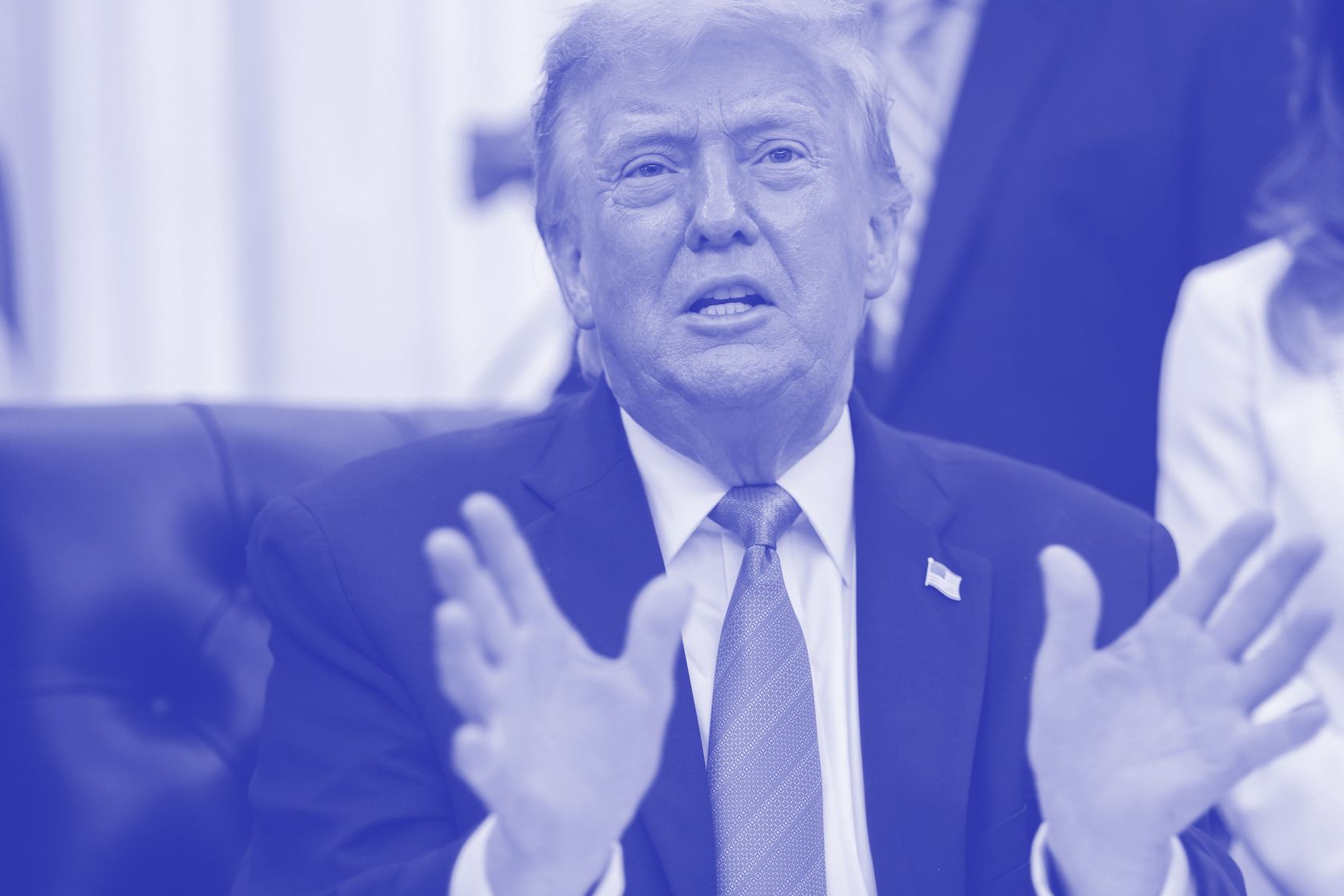
Trump vows to hit Iran ‘very hard’
Plus: Chipmakers crash the party on Wall St, Super Micro tumbles 28%; SpaceX demand rockets, Warren begs SEC grounding; Startups sweat as carveout drifts away.

Good morning. Here’s what happened overnight and what you need to know today.
1.
Crude diplomacy: US President Donald Trump said the US would be attacking Iran “very hard” after warning Tehran had “taken too long to negotiate a deal” and would “have to pay the price". “We hit them hard yesterday, and we’re going to hit them again hard today,” Trump told reporters at the White House. The threats followed US strikes on nearly 20 Iranian targets around the Strait of Hormuz, carried out after Trump blamed Tehran for the downing of a US Apache helicopter. Iran’s Revolutionary Guards said they retaliated with missile and drone attacks on US bases in Jordan, Kuwait and Bahrain. Most missiles and drones were intercepted. Meanwhile, the US military said one of its aircraft fired precision munitions into the engine room of a chemical and fuel tanker in the Gulf of Oman after the crew repeatedly failed to comply with directions, the eighth vessel struck under its blockade of Iranian ports, Reuters reported. Three Indian seafarers were missing after the attack and India summoned a top US diplomat in protest. Iran said US strikes destroyed two water reservoirs in its southern Hormozgan province, cutting off drinking water to 20,000 people, which foreign ministry spokesman Esmaeil Baghaei called “a calculated war crime”, the NYT reported. State broadcaster IRIB later reported water was restored within 12 hours. Trump also revealed a “secret mission” he said had moved more than 100 million barrels of oil through the strait. (Capital Brief)(AP)(NYT) (FT)(Reuters)
2.
Chips down: Another selloff in AI stocks dragged Wall Street sharply lower overnight, with the S&P 500 falling 1.62% to a five-week low, the Dow dropping 1.87%, and the Nasdaq losing 1.98%. The closely watched semiconductor index fell 3.57%, while Super Micro Computer tumbled 27.98% after announcing plans to raise USD7 billion through equity offerings to fund AI server production. Cancer drugmaker Parabilis Medicines surged 58% in its US trading debut after an upsized IPO, while Canadian generic drug maker Apotex Health also jumped in Toronto’s largest IPO in five years. Meanwhile, renewed US-Iran tensions added to investor uncertainty after Trump said the US would attack Iran again “very hard”. Brent crude settled 1.8% higher at USD93.10 a barrel, paring gains after Trump said the US military had secretly escorted ships carrying more than 100 million barrels of oil out of the Strait of Hormuz. The FT reported about 15 ships a day are escaping the strait via a risky route hugging Oman’s coastline under US air cover, most of them oil tankers, citing people with knowledge of the transits. Separately, Trump baffled Wall Street by congratulating Citigroup and CEO Jane Fraser for topping first-quarter M&A advisory rankings by value, which the bank does not actually hold, with most league tables placing Citi behind Goldman Sachs, Morgan Stanley and JPMorgan. (WSJ)(Bloomberg)(AP)(Reuters)
3.
Musk have: SpaceX’s IPO has attracted demand for more than four times the available shares ahead of books closing, Bloomberg reported citing people familiar with the matter. The Elon Musk-led rocket, satellite and AI firm is offering 555.6 million shares at a fixed USD135 each to raise about USD75 billion at a roughly USD1.8 trillion valuation, in what is expected to be the biggest IPO ever. The deal is set to price on Thursday New York time and trade on Friday under the symbol SPCX. Senator Elizabeth Warren urged the SEC to delay the listing, writing that the valuation “requires numerous leaps of faith” and that index rule changes would force passive investors into the stock with “no choice in the matter.” The FT Alphaville column calculated benchmarked fund managers will have to buy USD14.2 billion of SpaceX stock by 3 July following fast-track changes across several indices. SpaceX has told investors it has lined up investment-grade ratings from three major bond graders despite a first-quarter net loss of USD4.28 billion, Bloomberg reported citing unnamed sources. Morningstar pegs SpaceX’s value at just USD780 billion, while ARK Invest expects it at USD2.5 trillion by 2030. (Bloomberg)(FT)(Quartz)
4.
Capital punishment: Startups fear they won’t get a carveout from Labor’s sweeping tax changes until the end of the year, with any exemption not expected in the bill put to the Senate this month but in a second tranche of legislation. That means August at the earliest, though likely closer to MYEFO in December, Capital Brief reported. Prime Minister Anthony Albanese is pushing to pass the budget’s key elements by the end of the month, despite objections from startups and VC to the removal of the 50% CGT discount. Multiple sources told Capital Brief the idea to spread the CGT change across all asset classes was put forward by Treasury as little as a month before budget day, with no-one in Cabinet appearing to understand the effect on startups. “This reeks of policy on the run," former prime minister Malcolm Turnbull said yesterday. Tech lobbyist Sam Maher from GovTech Australia said “the legislative timetable appears to be running ahead of the evidence base.” But Albanese insisted incentives for smaller businesses remained in place. “People don’t set up businesses in order to sell them straight away, they set up businesses to grow them,” he told the ABC. “Taxation being based upon real gains is a sensible way forward”. (Capital Brief)
5.
Token gesture: Australian fintechs are urging banks to deepen their commitments to collaborative innovation, rather than working exclusively among themselves to help deliver an estimated $24 billion in annual efficiency gains to consumers as fast as possible. With the tokenised asset program Project Acacia now complete, it is less a question of whether banks will embrace tokenisation than whether they will try to keep fintechs out. The two sides are locked in a contest over who captures those gains. Fintech Imperium Markets CEO Stu Burns told Capital Brief bank executives need to understand “they have an impediment to innovation” and “they need to get involved”, pointing to wholesale markets that he said still run on “email and spreadsheet and manual data entry”. Macropod CEO Drew Bradford said “the cynic in me thinks that there’s a lot of people around the world that make money from friction”, while rival stablecoin issuer AUDC’s CEO Effie Dimitropoulos has an alternative theory: the banks want to own the technology. There is a case in point. Parallel to Project Acacia, the four major banks established a Deposit Token Working Group with no fintechs involved. (Capital Brief)
6.
Gearing down: ANZ chief executive Nuno Matos can already see how the Albanese government’s proposed changes to negative gearing will hit the banks and flow through the market as investors retreat. “The mortgage market will slow down. It has been growing at around 8% to 9% before, it’ll probably grow at 5% to 6%,” Matos told the Morgan Stanley Australia conference in Sydney yesterday. His comments are the first from a big four bank CEO on the tax changes since the budget was announced last month. Matos refused to discuss the politics of the proposal but said he believed it would achieve its ultimate aims. He suggested investor lending could fall by anywhere from 5% to 20% but wouldn’t guess at the magnitude. “God knows ... but it will go down because that’s the intention of the policy”, he added. Analysts have forecast a 25% reduction in investor loans, especially impacting Commonwealth Bank and Westpac, while Matos’s interlocutor, Morgan Stanley analyst Richard Wiles, has said the changes signify the end of a 30-year property super cycle. Separately, Matos argued the big four’s retreat from wealth management and insurance after the banking royal commission left the industry narrower and less profitable. He said returns on capital have fallen from 16-17% 15 years ago to about 9-10% now and that banks “have to find a way to go back into” those businesses.(Capital Brief)(AFR)
7.
Grid lock: Firmus Technologies co-founder Oliver Curtis will be forced to provide evidence in a dispute between two Sydney businessmen over $140 million of shares in the AI infrastructure startup, the AFR reported. It would be Curtis’s first return to court in a decade after his 2016 insider trading conviction. Former business partners and private credit financiers Ben Madsen and Simon Raftery are embroiled in legal action over the shares, with Raftery laying claim to a third and alleging Madsen developed a scheme to transfer the disputed 1.1 million shares to his brother, according to the paper. Court orders made on Tuesday will require Firmus executives including co-chief executive Tim Rosenfield, chairman Ted Pretty, and the fathers of Curtis and Rosenfield to provide evidence ahead of a planned IPO later this year. Firmus did not comment. Separately, Canberra dental robotics startup Dentroid was valued at $265 million after signing a partnership with French dental giant Septodont, which invested in a just-closed $32 million raising, the AFR reported. (AFR)
8.
US inflation: US consumer prices rose 4.2% in the 12 months to May, the largest increase since April 2023, data from the Labor Department showed. Energy accounted for more than 60% of the 0.5% monthly rise, with gasoline up 7% on the month and 40.5% on the year. Core prices, which exclude food and energy, rose 0.2% from April, below the 0.3% economists polled by Bloomberg had forecast, and 2.9% on the year. A separate Labor Department report showed inflation-adjusted hourly earnings fell 0.7% on the year, a second consecutive monthly decline. After the report, traders maintained bets the Fed will raise rates by December, with pricing implying about a 60% chance of a hike by October. It comes as the central bank is expected to hold its benchmark rate at 3.50%-3.75% at next week’s meeting, its first under new chairman Kevin Warsh, Reuters reported. “The longer the Middle East conflict persists, the broader and more persistent inflationary pressures are likely to become,” EY-Parthenon chief economist Gregory Daco said in a note. (Capital Brief)(BLS)(Real earnings summary)(WSJ)(Bloomberg)(Reuters)