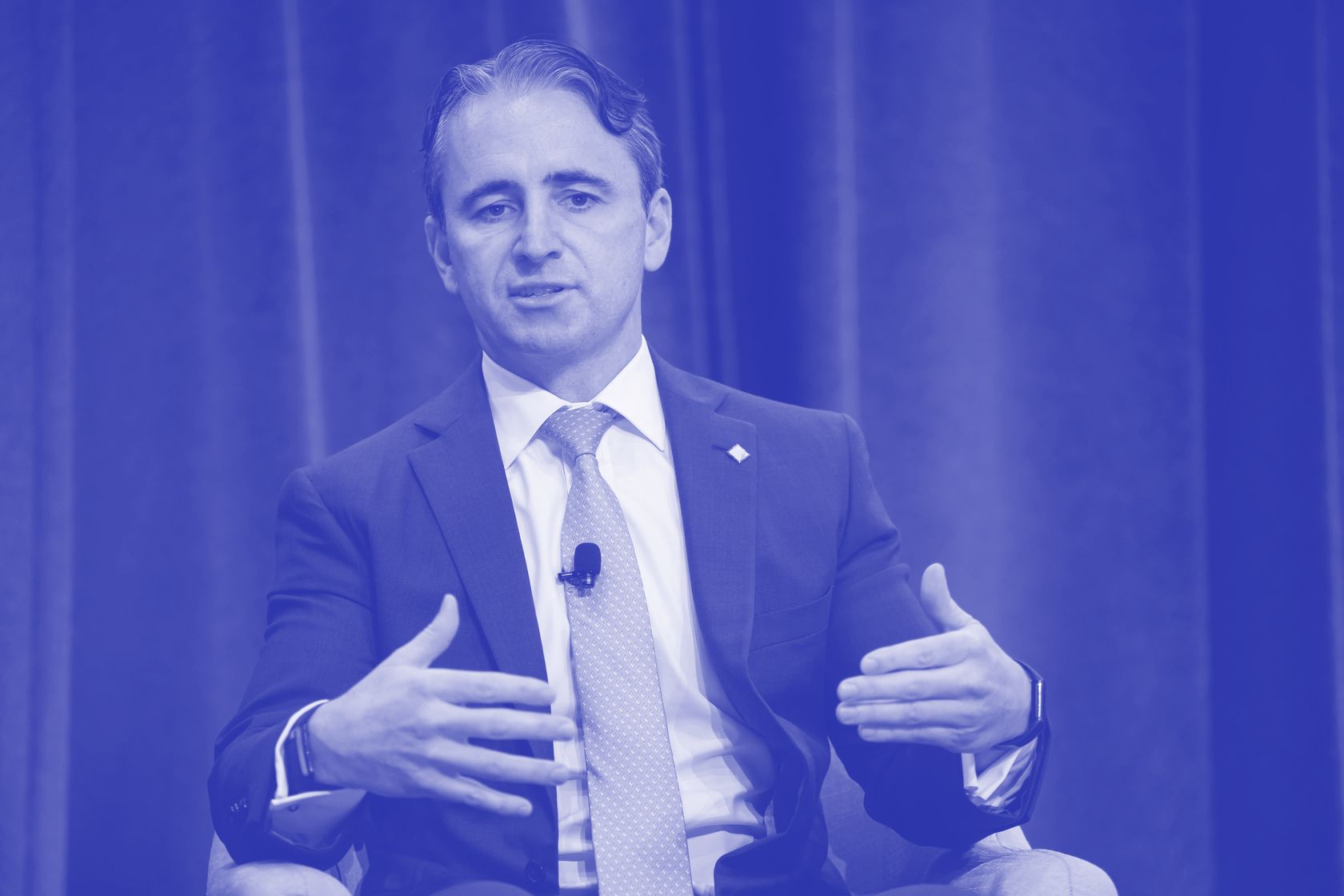
CBA’s Comyn says he’s the one exec not approached by rivals
Plus: Liberal Party’s pollster Freshwater faces replacement after election loss; Nvidia eyes AI chip for China, says Reuters; SoftBank’s Son proposes US-Japan sovereign fund, says FT.

Good morning. Here's what happened overnight and what you need to know today.

1.
Talent wars: Westpac has poached CBA’s head of data and analytics, Andrew McMullan, as its new chief data, digital and AI officer, reporting to CEO Anthony Miller, Capital Brief can reveal. “I’m probably the only one in my executive team the other banks haven’t approached,” CBA CEO Matt Comyn told Capital Brief, expressing frustration at rivals’ ongoing raids on his senior team. McMullan had been overseeing CBA’s migration of data platforms to AWS Cloud, which Westpac is also pursuing through its UNITE program. It follows Westpac’s recent recruitment of Evelyn Halls from ANZ, Nathan Goonan and Paul Fowler from NAB and CBA. More high-level moves are expected as ANZ’s new CEO Nuno Matos, an outsider, has just started at the Melbourne-headquartered bank. “It’s a really competitive and disruptive time in the industry given the leadership changes, and I’m seeing many of our people approached,” Comyn said. (Capital Brief)
2.
Bullsh**t radar: The Liberal Party's pollster, Freshwater, is facing intense scrutiny and a fierce backlash following Labor’s landslide at the election, with insiders expecting it to be replaced when its $1.5 million-plus contract ends on 30 June. The polling, once seen as a strategic advantage, has become ground zero for the blame game as the Liberal Party comes to grips with its worst ever election defeat.Capital Brief spoke to dozens of party and campaign insiders who were granted anonymity to speak candidly about the catastrophic election result, and the role polling played in it. They say they feel bruised and discredited following the campaign, which has already resulted in a split in the Coalition and could see the party out of power for multiple terms. "I was still telling journalists in that last week that they're missing these big swings in outer-suburban seats — Gorton, Hawke, Whitlam," one senior Liberal said. “It was all bullsh**t." (Capital Brief)
3.
Cheap as chips: Nvidia is planning to launch a new AI chip for China at a significantly lower price than its H20 model, with mass production set to start as early as June, according to sources cited by Reuters. The new GPU with Blackwell architecture will reportedly cost USD6,500-USD8,000, ($10,075 - $12,400) compared to its predecessor at USD10,000-USD12,000. The chips will use conventional GDDR7 memory instead of more advanced high-bandwidth memory and will not need TSMC's advanced packaging. In April, Nvidia said it would take a charge of about USD5.5 billion tied to its H20 graphics processing units after the US government informed the company it will require a licence to export the chips to China and a handful of other countries. On Saturday, CEO Jensen Huang said that Trump’s re-industrialisation plans were “very visionary,” despite recently admitting that the company had to walk away from USD15 billion in sales due to tariffs. (Reuters)
4.
Sovereign associates: SoftBank’s Masayoshi Son is considering creating a joint US-Japan sovereign fund, the FT reports, to make large-scale investments in tech and infrastructure across the US. The joint fund has reportedly been discussed at the highest political levels in Washington and Tokyo and would need around USD300 billion ($465 billion) in initial capital with significant leverage to be effective. Japanese PM Shigeru Ishiba said he expects that a planned meeting between the two countries during the G7 meetings in mid-June would be a “milestone” in the talks. Sources told the FT the US Treasury and Japanese finance ministry would be joint owners and operators of the fund and that the vehicle could later be opened to other investors. US Treasury Secretary Scott Bessent is reportedly looking for revenue streams outside of raising taxes and wants to craft a deal that could become a “blueprint for a new sovereign-to-sovereign financial architecture.” (Financial Times)(Capital Brief)
5.
Major strikes: Russia launched 367 drones and missiles at Ukrainian cities over the weekend in its largest aerial attack since the war broke out. Ukrainian officials said the assault killed at least 12 people and injured 60, with cities including Kyiv, Zhytomyr and Mykolaiv targeted. Ukrainian leader Volodymyr Zelensky condemned the strikes and called for further economic sanctions against Russia, and said the “Silence of America, silence of others around the world only encourage Putin…Sanctions will certainly help.” While the largest prisoner exchange of the war took place over the weekend, with over 1,000 soldiers and prisoners swapped between the warring nations, Trump’s talks with Russia’s Vladimir Putin failed to result in a ceasefire nor further sanctions from the US last week. Meanwhile, British security officials are investigating possible Russian involvement in three arson attacks on properties connected to UK PM Keir Starmer. (Capital Brief)(Reuters)(Zelensky X)(Politico)(WSJ)(FT)
6.
Bad prognosis: Healthscope could enter receivership this week, after lenders refused to accept its offer to take board control to enable a solvent restructure, according to media reports. The company has been struggling to find a way to pay an outstanding $1.6 billion in debts, and around 20 lenders will now determine what happens to the country’s second-largest private hospital group. Just six of Healthscope’s 37 hospitals are profitable, according to The Australian, and the company was reportedly holding just $110 million cash on its balance sheet for operating costs. The AFR says the company has not given up on efforts to avoid receivership but it is not optimistic, adding that foreign holders of Healthscope’s debt are pushing for fast solutions which could prompt receivership and asset sales. However, local lenders are more supportive of solutions which minimise disruption to the group’s operations and over 18,000 employees. (Capital Brief)(AFR)(The Australian)(Capital Brief)
7.
Steel stunner: US Steel shares jumped over 21% after US President Donald Trump on Friday said he’d approved a USD14.9 billion ($23.1 billion) “planned partnership” with Nippon Steel, which he said would create “at least 70,000 jobs” and add “USD14 billion to the US economy,” with most investment in the next 14 months. The Committee on Foreign Investment in the US cleared the deal’s security risks this week, Reuters reported, removing the final hurdle. Trump’s decision reversed former President Joe Biden’s January block. He also announced a rally at US Steel’s Pittsburgh facility on 30 May. US Steel and Nippon Steel praised the move, calling it a “game changer,” while the United Steelworkers union warned it could “further erode domestic steelmaking capacity and jeopardize thousands of good, union jobs.” Shares closed at USD52.01, near Nippon’s USD55-per-share offer. (Reuters)(Bloomberg)
8.
Powell defence: Federal Reserve chair Jay Powell, speaking at Princeton’s commencement, urged students “to take none of this for granted” and praised US universities as a “crucial national asset” amid the Trump administration’s escalating attacks on higher education. The administration has barred Harvard from enrolling international students and cut billions in funding, actions temporarily blocked by the courts. Powell, appointed by Trump but criticised by him for not cutting interest rates, told students: “At the end of the day, your integrity is all you have.” Elsewhere, Trump on Friday threatened a 50% tariff on EU goods starting 1 June and a 25% levy on imported iPhones, citing dissatisfaction with slow EU trade negotiations and putting pressure on Apple to manufacture in the US. Meanwhile, European ports reported worsening congestion due to labour shortages and low Rhine River levels, with waiting times up 77% in Bremerhaven. (FT)(Reuters)(Bloomberg)(CNN)
