Exclusive polling shows One Nation nipping at Labor’s heels
Plus: AI doomsday thought bubble hammers software, private capital stocks; Wall Street rattled by tariff chaos; The EU suspends ratification of its trade deal with US.

Good morning. Here’s what happened overnight and what you need to know today.

1.
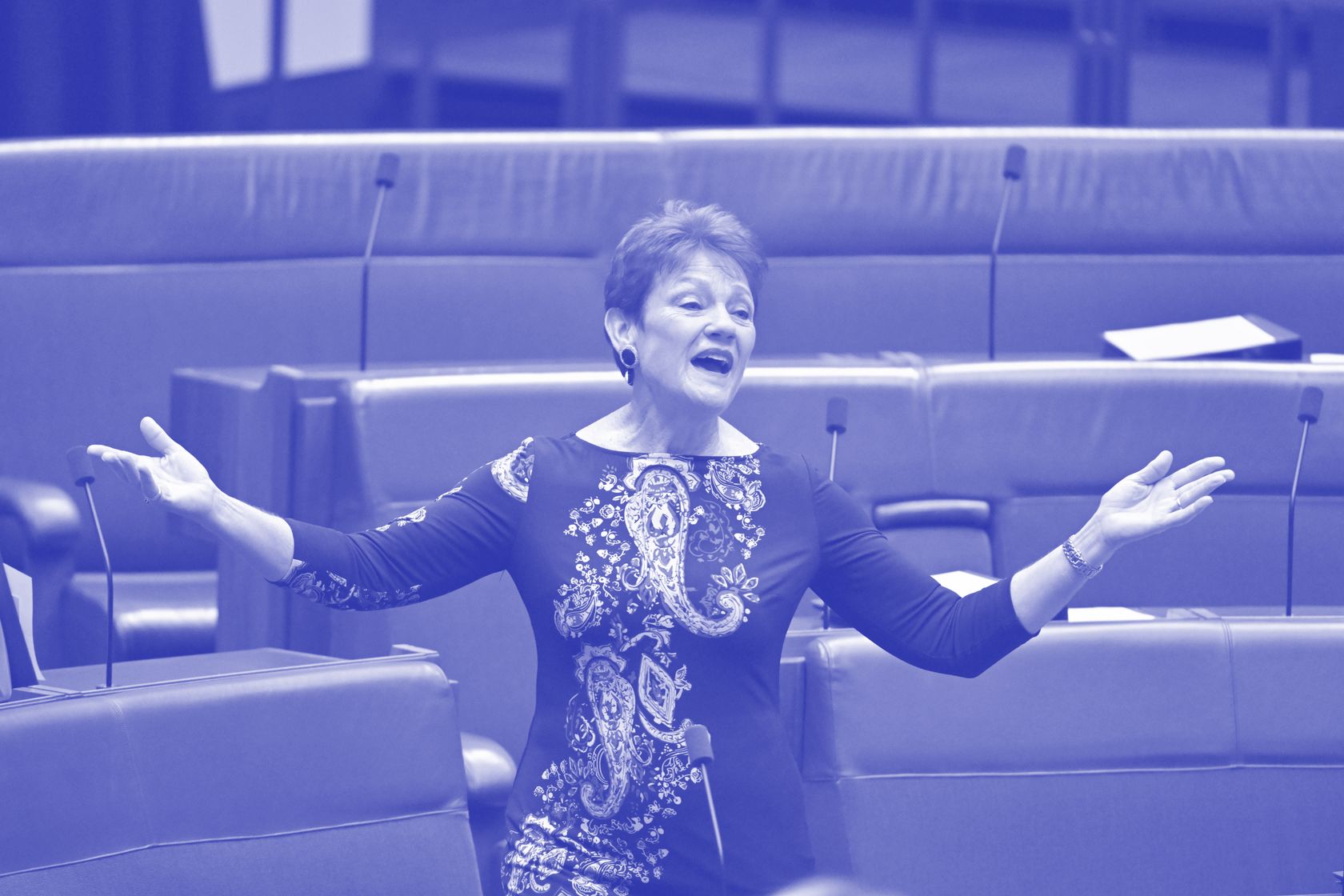
On the brink: One Nation is on the brink of overtaking Labor on primary votes and more Australians have a favourable view of leader Pauline Hanson than Prime Minister Anthony Albanese, according to exclusive Capital Brief/Demos AU polling. The poll finds that One Nation’s primary vote has climbed to 28%, one point behind Labor (29%) and well ahead of the Coalition under new leader Angus Taylor (21%). The poll showed Albanese (37%) continuing to lead Hanson (25%) and Taylor (19%) as preferred prime minister. Albanese’s net favourability rating (-17) was well behind the One Nation leader’s (-1), with just 29% of respondents saying they had a positive view of him, compared to 46% who said they had a negative view. If the numbers were replicated at an election, DemosAU predicted Labor would be re-elected with between 76 and 85 seats, One Nation would pick up between 43 and 54, and the Coalition would win between nine and 20. The Liberals’ decision to axe Taylor’s predecessor, Sussan Ley, this month appears to have arrested the Coalition’s slide, with its vote remaining steady for the first time since last year. (Capital Brief)
2.
Doom scroll: A viral Citrini Research report laying out the potential risks artificial intelligence could pose to the global economy sent delivery, payments and software stocks into a sharp selloff even as the report itself was explicitly framed as a thought exercise, not a prediction. Citrini published the piece on Sunday, describing a hypothetical scenario set in June 2028 where AI disruption has caused mass white-collar unemployment, declining consumer spending, software-backed loan defaults and economic contraction, what Citrini called a “negative feedback loop with no natural brake” or “the human intelligence displacement spiral”. The scenario projects a 10.2% US unemployment rate and a 38% S&P 500 peak-to-trough crash. DoorDash, American Express, KKR and Blackstone all slumped more than 8%. Uber, Mastercard, Visa, Capital One and Apollo Global Management were also lower. DoorDash co-founder Andy Fang said in an X post that “agentic commerce will be transformative to the industry.” Thomas George, a portfolio manager at Grizzle Investment Management told Bloomberg the report left anyone holding the named stocks “with less conviction.” Elsewhere, ASML has developed a way to boost the power of its EUV chip-making light source to 1,000 watts from 600 watts, a breakthrough the Dutch company says could enable customers to produce up to 50% more chips by 2030, Reuters reported. (Citrini)(Bloomberg)(WSJ)(Reuters)
3.
Market reax: US stocks slid on Monday as a fresh wave of anxiety over AI’s impact on corporate profits collided with renewed tariff uncertainty. The S&P 500 was 1% lower in afternoon trading, the Dow down 1.5% and the Nasdaq 1.17% lower. Software stocks bore the brunt of the selling after the widely circulated post by Citrini Research painted a hypothetical scenario in which AI profoundly disrupts the economy and drives US unemployment above 10% by 2028. Private capital companies were caught up in the rout, amid concerns that market volatility could slow fundraising and delay asset sales. The broader unease followed the Supreme Court’s Friday ruling voiding most of Trump’s tariffs. Investors sought safety in bonds and gold, while Bitcoin fell 4.3% to USD64,677. The 10-year Treasury yield declined six basis points to 4.02%. In corporate news, Eli Lilly shares rose after Novo Nordisk’s obesity drug fell short against its drug in a Copenhagen trial. And PayPal shares rose after Bloomberg reported it is attracting takeover interest from potential buyers after a stock slide wiped out almost half its value. Elsewhere, Anthropic CEO Dario Amodei is set to meet US defence secretary Pete Hegseth tomorrow, Bloomberg reported, citing a senior Pentagon official, as contract talks between the AI startup and the Pentagon remained deadlocked over the company’s insistence on guardrails for use of its technology. (Bloomberg)(WSJ)(Reuters)
4.
Deal freeze: The EU froze ratification of its trade deal with the US on Monday, injecting fresh economic turbulence into an already strained transatlantic relationship. The move came after Trump’s own replacement tariffs threatened to leave European exporters worse off than the agreement was designed to protect them. The European Parliament’s trade committee, which had been due to vote Tuesday on the Turnberry Deal struck last July, suspended legislative work after the US Supreme Court last week struck down Trump’s use of emergency powers to impose tariffs. Trump moved rapidly to replace those levies, first announcing a 10% global tariff on Friday under separate legal authority before raising it to 15% on Saturday, a rate that stacks on top of existing duties. For example, that would push tariffs on products like European cheese to nearly 30%. “The situation is now more uncertain than ever,” trade committee chair Bernd Lange said. India also postponed planned trade talks. Meanwhile, Trump warned trading partners not to “play games” with the court ruling, threatening higher tariffs and signing off “BUYER BEWARE!!!” in a post on Truth Social. (Bloomberg)(NYT)(NBC)(WSJ)
5.
Succession regression: Prime Minister Anthony Albanese confirmed his government would support the UK removing Andrew Mountbatten-Windsor, formerly Prince Andrew, from Australia’s line of succession. Albanese made the revelation in a letter to UK Prime Minister Keir Starmer, who is considering the move after Mountbatten-Windsor was arrested on suspicion of misconduct in public office, as he faces allegations that he shared sensitive material with the late financier and convicted sex offender, Jeffrey Epstein, while he was UK trade envoy. Mountbatten-Windsor has been released from custody but remains under investigation. Albanese confirmed his government would “agree to support” Starmer’s ultimate decision, saying Australians viewed the allegations against the former prince as “grave” and “take them seriously”. Albanese wrote that he agreed with King Charles that “the law must now take its full course and there must be a full, fair and proper investigation.” (Capital Brief)(The Times)
6.
Memo man: Former UK ambassador to the US Peter Mandelson was arrested on suspicion of misconduct in public office following allegations he passed confidential government information to Jeffrey Epstein, after emails released by the US DOJ detailed his dealings with the convicted sex offender. London’s Metropolitan Police confirmed officers arrested the 72-year-old at his home in Camden on Monday and took him to a London police station for interview. The arrest followed search warrants at two addresses in Wiltshire and Camden. The criminal investigation was triggered earlier this month after receiving complaints, including a referral from the UK government, which passed on communications between Mandelson and Epstein. Emails released late last month showed Mandelson forwarding an internal Downing Street memo drafted on June 13, 2009 (the same day he shared it) setting out tax policy proposals to encourage private-sector investment after the financial crisis and the possibility of making GBP20 billion of asset sales to reduce government debt. He included the comment: “Interesting note that’s gone to the PM.” In another email on May 10, 2010 (hours before the fact) he wrote: “Finally got him to go today...”, appearing to refer to Gordon Brown’s resignation as Labour leader and prime minister. According to the FT, the files also showed that while serving as UK business secretary and de facto deputy PM, Mandelson shared details of a EUR500 billion EU bailout of the Eurozone. Mandelson has denied wrongdoing. (FT)(NYT)(Reuters)(Bloomberg)
7.
Brutal axing: Jeff Howard abruptly stepped down as chief executive and managing director of Southern Cross Media on Monday, less than two months into the role and just one day before the company is due to release first half results for FY26. Howard was tapped to lead the company, which completed its merger with the Stokes family’s Seven West Media last month. Asked why Howard was making such an abrupt departure, a senior executive told The Australian the decision to move on him was “not really a surprise”. A statement posted to the ASX after market close on Monday said former Southern Cross chief executive John Kelly will step in as interim head of the company’s TV and audio divisions. Sources told the SMH that Kelly has been asked to run the whole company on a permanent basis. The merger combined Seven West’s assets with Southern Cross’ Triple M and Hit radio brands and several regional radio stations. At the time, the all-scrip reverse takeover was the subject of controversy for bypassing a Southern Cross shareholder vote. Meanwhile, CEO and managing director of Steadfast group, Robert Kelly, advised the board of his intention to retire, with a successor to be named by August this year. (Capital Brief)(ASX)(SMH)(The Australian)
8.
Blue, Blue Owl: Metrics Credit Partners has been distancing Australia from the US in discussions with investors, using its monthly investor call to mitigate potential concerns about private credit after one of the biggest players in the US, Blue Owl, moved to freeze redemptions. During a video conference on Monday, Metrics chief executive Andrew Lockhart said Australia doesn’t have a deep extensive tech sector nor have investors in the local market necessarily wanted to deploy capital in the sector. A lot of software companies in the US and UK were acquired by PE firms, “which were then financed by private credit providers, and that was a significant area of lending in US and UK markets.” Last week, Blue Owl changed its open-ended Blue Owl Capital Corporation II fund from allowing quarterly redemptions in favour of periodic payouts to stem investor outflows amid fears of over-exposure to software. Meanwhile, Navigator Global Investments chief executive Stephen Darke told Capital Brief he spent the first five minutes of every investor meeting on Monday focused on major shareholder Blue Owl. “I’ve spent today making sure that I’m not defending them. I’m just indicating that its impact on NGI is zero,” Darke said. (Capital Brief)
