Iran strike tests fragile Hormuz truce
Plus: Dimon narrows internal succession candidates to two; Apple raises Mac and iPad prices worldwide on memory costs; Tech megacaps drag Wall St lower as chipmakers soar.


Good morning. Here’s what happened overnight and what you need to know today.
1.
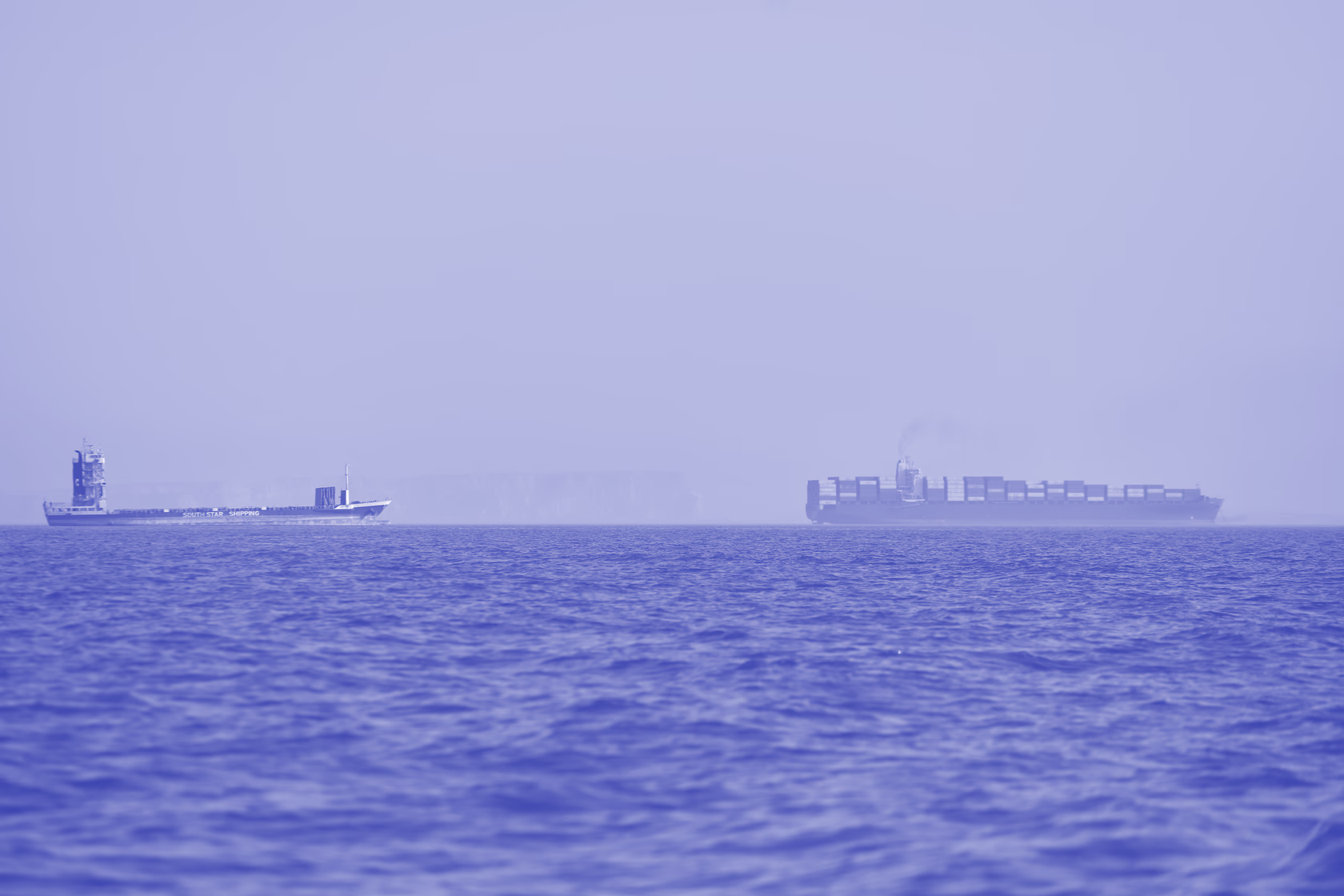
Hormuz attack: Iran’s Revolutionary Guard attacked a Singapore-flagged cargo ship, the Ever Lovely, in the Strait of Hormuz, US officials told Reuters and the WSJ, testing the interim deal signed last week by Washington and Tehran to end the war and reopen the vital waterway. The vessel was hit by a projectile near the Omani coast and sustained damage to its bridge, UK Maritime Trade Operations said. A White House official said there were no deaths or environmental damage and that the ship was able to continue sailing, Bloomberg reported. The official cautioned it was too soon to say who was responsible, saying the US was examining whether the strike was ordered by senior Revolutionary Guard figures or a rogue decision by lower-level personnel. The attack came hours after the IRGC warned ships against using routes Tehran had not sanctioned, and after at least four tankers turned back while attempting to cross on the Omani side. The UN’s International Maritime Organization paused the evacuation operation it had launched on Tuesday to escort hundreds of stranded ships out of the Gulf, saying the attacked vessel was not part of its programme. Brent crude turned higher after the incident, touching session highs above USD75 a barrel. Traffic had been rebounding since the ceasefire took effect last week. (WSJ)(Reuters)(Bloomberg)(FT)
2.
Two horses: JPMorgan named investment banking veteran Doug Petno and markets chief Troy Rohrbaugh co-presidents, elevating the two insiders as the leading contenders to eventually succeed CEO Jamie Dimon. The bank also announced the retirement of consumer bank chief Marianne Lake, long seen as a top candidate for the job. Petno becomes sole CEO of the commercial and investment bank, which he had co-run with Rohrbaugh. Rohrbaugh, who built his career in markets and trading, will take over the consumer and community bank from Lake, gaining experience across the firm’s two biggest businesses. Both received USD30 million retention bonuses in restricted stock vesting through 2028. Lake, a 25-year veteran who served as CFO before running the consumer operations, decided to step aside once it became clear she was no longer in the running, The Wall Street Journal reported citing unnamed sources. Dimon, who turned 70 this year, has said he expects to remain “for a few years as CEO, and maybe a few after that, as executive chairman”. JPMorgan shares rose about 2% in morning trading. (JPM)(WSJ)(Reuters)
3.
Bitten Apple: Apple shares fell as much as 6.2% overnight before closing 6.15% lower, after the company raised prices on its Macs and iPads worldwide, saying it could no longer shield customers from soaring memory and storage chip costs driven by the AI data centre boom. “We have never seen a component price increase this much, this quickly. We have shielded our customers from these increases so far, but we have now reached a point where we need to begin raising prices on a number of products, including today’s increases for iPad and Mac,” the company said in a statement. Mac prices rose roughly 15% to 20% and iPad prices 15% to 25%, in one of the broadest increases in the company’s history. iPhone, Apple Watch and AirPods prices were unchanged, though Apple hinted at further increases. The increases came a week after chief executive Tim Cook said price rises had become “unavoidable”, and a day after memory maker Micron reported gross margins above 80%. Apple is not alone: Microsoft said its Xbox consoles will rise by up to USD150 worldwide from August 1, citing the same memory and storage squeeze, while laptop makers Dell, HP, Lenovo and Asus have flagged similar increases. (WSJ)(Reuters)(FT)
4.
Chip off: Wall Street’s tech megacaps sold off overnight, dragging the Nasdaq and S&P 500 lower even as blockbuster results from Micron lifted chipmakers. The Nasdaq finished down about 0.46% and the S&P 500 ended near flat, while the Dow rose 0.14%. All of the Magnificent Seven fell, led by Apple, which had its sharpest one-day fall since April 2025 after raising prices to counter soaring memory costs. Micron rallied almost 16% after its results beat estimates and it forecast the chip shortage extending beyond 2027, lifting peers including Sandisk, which jumped more than 20%, Qualcomm and Western Digital. Meanwhile, Commerce Department data showed the Fed’s preferred inflation gauge, the PCE price index, rose to 4.1% in the year to May, its highest since 2023 and more than double the 2% target. (WSJ)(Reuters)(Bloomberg)
5.
Amp it down: Culture Amp laid off 70 staff, roughly 9% of its workforce, in its third major round of redundancies in three years. The cuts at the Melbourne HR tech company come just seven months after it shed 60 roles in November 2025, and follow the appointment of Caroline Rawlinson as CEO in January, after co-founder Didier Elzinga stepped down to become executive chair. “Culture Amp is making organisational changes across a number of teams to align investment with our refreshed strategic priorities,” Rawlinson told Capital Brief, saying the world of work “is changing faster than most of us have ever seen”. The latest restructure is understood to cut out middle-management to enable faster decision-making, while a source familiar with the matter pointed to significant C-suite movement since Elzinga’s departure, including the exit of chief revenue officer Katharina Matsui in May. Despite the upheaval, a source with knowledge of the company’s finances put revenue at between USD180 million and USD200 million, with approximately 7,500 customers globally. The cuts come after investor Blackbird Ventures marked down the value of its Culture Amp holding by 23.5% at its November investor day, alongside a writedown of fellow SaaS unicorn SafetyCulture. (Capital Brief)
6.
Cap raise: Airwallex raised USD320 million ($462.5 million) in a Series H round, lifting the Melbourne-founded payments company’s valuation to USD11 billion, from USD8 billion last December. The round was led by returning investor Addition, with participation from Baillie Gifford, Hummingbird, QED Investors, T Rowe Price, Hedosophia, Haun Ventures, Washington University in St Louis and Amex Ventures. The company said the funding would accelerate product development across what it calls autonomous finance and agentic commerce, expand its infrastructure and regulatory footprint into new markets and scale the teams building its AI software. Airwallex also unveiled two products. T:0, a platform that automates bookkeeping, forecasting, taxes, compliance and reporting, currently in private beta. And Airi, a consumer wallet incorporating a one-click checkout that lifted successful checkout conversions for digital merchants by up to 14% in early testing. Airwallex has long been expected to float on US markets, but the timing now sits behind an Austrac anti-money-laundering investigation, with an auditor’s report due soon, and US scrutiny of its China ties after Keith Rabois branded it a “Chinese backdoor” in December, which Co-founder and CEO Jack Zhang denies. (Capital Brief)(Airwallex)
7.
Retail therapy: Robinhood Ventures Fund I bought roughly USD25 million of Canva Class A common stock on 24 June, the closed-end fund said in a statement, to give retail investors a slice of the Australian design company. RVI, which began trading on the NYSE in March, holds a concentrated portfolio of mostly private companies including Airwallex, Databricks, OpenAI, SpaceX and Stripe, and is pitched as accessible to retail investors with no accreditation requirements or minimums. Canva CFO Kelly Steckelberg said the firm was pleased to welcome RVI and to see more retail investors participate in its growth, adding that more than a quarter of a billion people now use the platform every month. The investment lands the same week Canva launched Canva Grow 2.0, a creative marketing automation platform unveiled at the Cannes Lions festival. The update lets users build, publish and track ad campaigns across TikTok, LinkedIn and Meta without leaving the app, building on a string of AI acquisitions including Ortto and Mango AI. (Robinhood)(Capital Brief)
8.
Spray cleared: The US Supreme Court sided with Bayer overnight, overturning a USD1.25 million ($1.8 million) jury award to a Missouri man who said Roundup weedkiller caused his cancer, in a 7-2 decision that could curtail thousands of similar lawsuits. The majority opinion, written by Justice Brett Kavanaugh, found that federal law overrides the claim the man, John Durnell, had brought under state law: that Bayer failed to warn users Roundup could cause cancer. Kavanaugh wrote that allowing the claim would require a cancer warning on Roundup’s label, conflicting with the label approved by the Environmental Protection Agency, which has determined glyphosate does not cause cancer and has not required a warning. The dissenting judges argued that Durnell’s claim mirrored federal law rather than adding to it, because the statute already bars selling a pesticide whose label lacks a necessary warning, and that EPA approval of the label is not conclusive proof the product complies. They said the ruling leaves Durnell “without a remedy for the significant harms he has suffered”. Durnell was diagnosed with non-Hodgkin lymphoma after years of exposure to glyphosate. Shares in Bayer, which acquired Roundup maker Monsanto for USD63 billion in 2018, shares rose 18%. (Capital Brief)(US Supreme Court)
9.
Whistle gaps: A deceptively simple question sits at the heart of the KPMG audit leaks scandal: what makes a whistleblower a whistleblower? In the legal sense, it is far more complex than someone coming forward with allegations of wrongdoing. So complex that the whistleblower at the centre of the scandal might not actually be one. KPMG has repeatedly described him as a “whistleblower” and told last week’s parliamentary joint committee he is “undoubtedly one”, but has refused to confirm he has protected status, which the whistleblower argued “creates an intentional state of paralysis”. The complication stems from KPMG’s structure as a partnership, not a corporation. Partnerships are excluded from private sector whistleblower regimes, though tax whistleblower protections do cover them. “This causes problems for people trying to figure out whether or not they are protected,” Human Rights Law Centre associate legal director Kieran Pender told Capital Brief, calling for protections to be improved “as a matter of urgency”. Former whistleblower and Tasmanian independent MP Andrew Wilkie said the situation was not unique to KPMG, whose reputation is “now in the toilet”. (Capital Brief)
10.
Ground zero: The death toll from two powerful earthquakes in Venezuela climbed to at least 188, with more than 200 people trapped and thousands feared dead as rescuers searched the rubble of collapsed buildings across the north of the country. The US Geological Survey, using predictive modelling, said the toll would most likely run into the thousands, with a substantial probability of exceeding 10,000, Reuters reported. The magnitude 7.2 and 7.5 quakes struck less than a minute apart on Wednesday evening local time near Morón on the Caribbean coast, around 160 kilometres west of Caracas, the USGS said. The second was Venezuela’s strongest since 1900. Jorge Rodriguez, head of the national assembly and brother of interim President Delcy Rodriguez, said at least 250 buildings were damaged or destroyed, and a crowd-sourced website listed more than 35,000 people unaccounted for, a figure Reuters could not verify. The coastal state of La Guaira, which Delcy Rodriguez called a “disaster zone”, was among the worst hit, with volunteers in places digging by hand. She declared a state of emergency and announced a USD200 million reconstruction fund. The disaster is an early test for Rodriguez, who took office in January after US Delta Force troops captured former president Nicolás Maduro. The US said it was deploying USD150 million in humanitarian aid along with disaster response and search-and-rescue teams, with President Trump saying Washington was “ready, willing and able to help”. (Reuters)(AP)(BBC)
