South Africa’s ANC could lose majority in watershed election
Plus: Tesla rejects criticism from proxy advisor; Aramco auction to coincide with OPEC meeting on Sunday; HK convicts democratic activists.

Good morning. Here's what happened overnight and what you need to know today.
1.
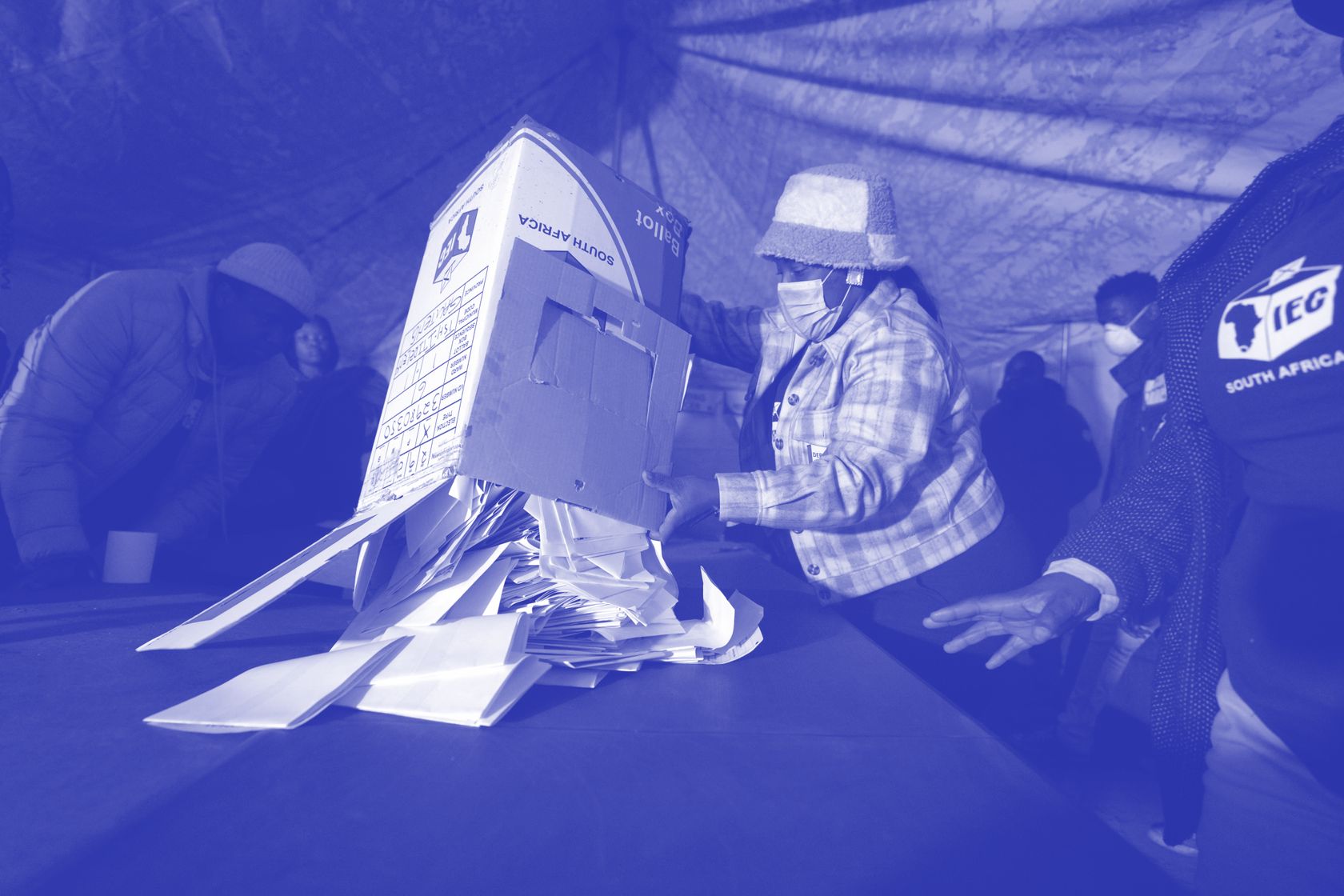
AN(s)eachange: The African National Congress (ANC) could be on course to lose the outright majority it has held for the first time since the start of South Africa’s multiparty elections 30 years ago. With 18.7% of the national vote counted, the ANC was tracking 42.9% on Thursday, worse than polls had predicted. The main opposition Democratic Alliance (DA) was doing better than expected with 25.1%, and Julius Malema’s Economic Freedom Fighters (EFF) was on 8.7%. The South African rand fell as much as 2% to trade at 18.7639 per dollar after early projections were announced on Thursday. Should the early results continue in the same direction as votes are counted, the ANC will lose its parliamentary majority for the first time since Nelson Mandela led the party at the collapse of the apartheid system in 1994. If current President Cyril Ramaphosa's ANC party fall below 50% in the final tally, he would be forced to seek coalition partners to be re-elected to form a new government. Additionally, if the ANC tally falls substantially below 45% when all the votes are counted, the party may have difficulty forming a coalition with small parties and could seek support from the EFF or Zuma’s MK. Final results are expected to be announced over the weekend. (Associated Press)(Financial Times)(Bloomberg)
2.
Tesla Tussle: Tesla has issued a sharp rebuttal of proxy adviser Glass Lewis’ advice to shareholders to vote against the company’s plans to incorporate in Texas and Elon Musk's USD46 billion ($70 billion) pay award. In a letter titled “What Glass Lewis Got Wrong About Tesla,” published Wednesday, the automaker said the proxy firm overlooked key factors, used flawed reasoning, and relied on speculation in its arguments. It urged shareholders to back Musk’s compensation and a proposal to reincorporate in Texas at the company’s 13 June annual meeting. Last weekend, Glass Lewis advised against the compensation, arguing it could dilute current shareholders' stakes and overly concentrate Musk's ownership. The firm also advised investors to vote against the proposal to reincorporate in Texas, from Delaware, and reiterated previous concerns from 2018 about the package's size and potential negative effects, questioning Musk's ability to focus due to his involvement with multiple companies. The company dismissed Glass Lewis’ concerns over the founder’s divided focus and emphasised his contribution to the company's success, with over USD735 billion of market value generated from 2018 to 2023. (Tesla)(Wall Street Journal)
3.
Oil rich pitch: Saudi Arabia is poised to decide on a USD10 billion share sale of its national oil company, Saudi Aramco, according to unnamed sources cited by Reuters. A final decision on whether to launch the sale on Sunday will be made by Crown Prince Mohammed bin Salman and could come as early as Friday AEST. The potential secondary share offering, following the record-setting 2019 IPO of the world's largest oil company, is part of a long-term plan to sell more shares to bolster the nation’s sovereign wealth fund and fund a slew of mega projects. Advisors from Citi, Goldman Sachs, and HSBC have been engaged to prepare for the sale. If the sale goes ahead on Sunday it will coincide with OPEC's upcoming meeting to determine oil production levels for the rest of the year. Saudi Arabia owns over 82% of the Saudi Arabian Oil Co, known as Aramco, with the kingdom’s Public Investment Fund owning a further 16%. The remaining portion is owned by public investors. The state-owned oil giant has remained a crucial revenue source for Saudi Arabia, paying almost USD100 billion in dividends last year. The potential sell down comes amid the kingdom’s ongoing efforts to attract foreign investment, reduce its dependency on oil revenue, and stimulate economic growth through diverse investments.(Reuters)(Financial Times)
4.
Perplexity AI boost: San Francisco-based Bessemer Venture Partners is in talks to invest in Perplexity, the developer of a search engine powered by artificial intelligence in a deal that would value the company at USD3 billion, The Information reports. The VC firm will lead a USD250 million investment that triples the valuation of the startup led by former OpenAI researcher Aravind Srinivas from earlier this year, the publication said. Perplexity’s latest funding round, its fourth since March 2023, reflects ongoing venture capital interest in generative AI startups despite high development costs. Perplexity has previously considered selling itself due to the expense of AI model training and competition with giants like Google and OpenAI, which are developing similar search products. The startup’s search product, which provides concise answers with linked citations, generates over $20 million in annual recurring revenue. Earlier this year, Amazon founder Jeff Bezos and chipmaker Nvidia participated in Perplexity AI’s USD74 million raising. (The Information)
5.
Sneesby’s Nine lives: Nine Network CEO Mike Sneesby has retained board support as details of a TV culture review continue to be exposed. An email sent to Nine Network staff by the CEO on Thursday unveils the scope of an independent review that will be conducted, after a sexual harassment crisis enveloped the company over the past two weeks. An email seen by Capital Brief explains that the independent review will be carried out by the firm Intersection, and will be limited to the company’s television news and current affairs division. Sneesby’s email states that a dedicated hotline for staff to report sexual harassment and other inappropriate behaviours against both current and former staff will be set up, and that Nine will conduct a conduct a company-wide survey, and roll out compulsory sexual harassment prevention training for staff to be completed by the end of the financial year. An investigation into the initial complaint, which was made in January, made no findings against former TV news boss Darren Wick, who left the company in March. The incident had sparked tensions on Nine's board, with some directors concerned they were shut out of the decision making process around Wick's departure. (Capital Brief)
6.
HK democracy activists crushed: A Hong Kong court found 14 pro-democracy activists guilty of subversion charges in a landmark case that has effectively dismantled the city’s political opposition. Two more were acquitted. The verdicts, part of the city's largest trial against the democratic opposition, come three years after 47 democrats were arrested. They were accused of attempting to use an unofficial 2020 primary election to paralyse the HK government by gaining legislative control. Prosecutors argued that, had the opposition won, they could have blocked budgets and public spending, forcing the city’s leader to resign. This was taken as a "vicious plot" to undermine the government. The trial and subsequent convictions have drawn international criticism. Australian Foreign Minister Penny Wong expressed "deep concern" over the verdicts, particularly regarding Australian citizen Gordon Ng. Sentencing is expected at a later date, with potential penalties ranging from three years to life in prison. The prosecution said it intended to appeal against the two acquittals. (Reuters)(Bloomberg)(Financial Times)
7.
AI warfare: Controversial US spy-tech firm Palantir has secured a contract with the US Department of Defense for work on a project called the Maven Smart System, with an estimated completion date of May 2029. Palantir has yet to comment on the Defense Department's disclosure of the the USD480 million ($723.34 million) award announced on Wednesday. Palantir, co-founded by Peter Thiel, has a current market cap of USD46.6 billion. The contract is set to extend Palantir’s ongoing relationship with the US military, making use of the firm’s AI offering. The Maven Smart System is an advanced AI and machine learning platform used to improve decision-making capabilities particularly in defence and intelligence. It incorporates data from a variety of sources including satellite imagery and video feeds to provide real-time analysis that can help military quickly and accurately identify potential targets. According to the US Army Brigade, Maven fuses data from various Intelligence Surveillance & Reconnaissance systems to identify areas of interest. (US Department of Defense press release)(Bloomberg)
8.
New silk road: Chinese President Xi Jinping has called for closer cooperation with Arab nations and reiterated Beijing’s support of UN membership for Palestine, during the 10th Ministerial Meeting of China-Arab States Cooperation Forum on Thursday. In an address, Xi explained that collaboration across a range of sectors like finance, green tech, and artificial technology should be fostered, and that “China will work with the Arab side as good partners to make our relations a model for maintaining world peace and stability.” Referring to the country’s global infrastructure project, the ‘Belt and Road Initiative’, Xi said that "Friendship between China and Chinese people and Arab countries and peoples originates from friendly exchanges along the ancient Silk Road.” With 21 Arab nations having signed cooperation agreements with Beijing as part of the Initiative, he added that "China will further enhance strategic cooperation with the Arab side on oil and gas, and integrate supply security with market security.” Xi also took the opportunity to address the Israel-Hamas war, saying that “War should not continue indefinitely, justice should not be absent forever.” Calling for a peace conference to help end the fighting, Xi emphasised China’s position that it would support UN membership for Palestine. (Bloomberg)(AFP)
