US launches retaliation strike on Iran
Plus: Economists on populism problems; OpenAI limits new model; Andrew Forrest's warning to staff.


1.
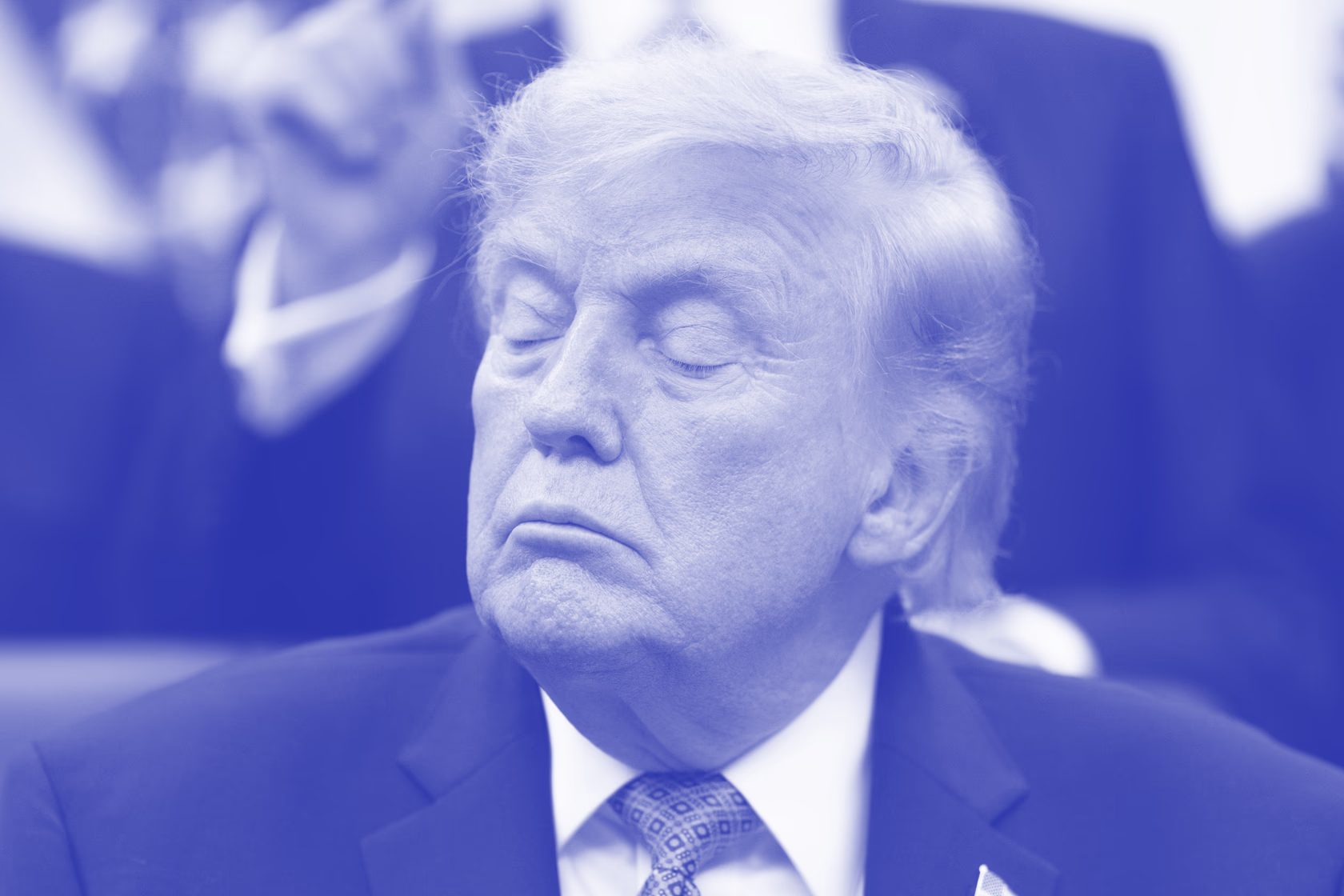
Retaliation hit: The US has launched a fresh attack on Iran as a response to the drone attack that hit a cargo ship which US President Donald Trump says violated the ceasefire agreement. A US aircraft struck Iranian missile and drone storage locations and coastal radar sites, the US Central Command announced on X. “Iran’s dangerous behavior undermined freedom of navigation as commerce increasingly flows through the vital international trade corridor,” it said. Shortly before the attack, reporters asked if the US would respond to the drone strike and Trump responded with “You’ll find out”. Following the strike, Iran’s Islamic Revolutionary Guard Corps promised a “swift and decisive” response. Prior to the attack, Iran’s deputy foreign minister Kazem Gharibabadi said on X: “Safe passage through the Strait of Hormuz, with ambiguous arrangements, parallel routes, or decision-making outside of Iran's considerations as the coastal state, cannot be guaranteed.” “Any credible framework must be based on coordination with Iran and the provisions of paragraph five of the Islamabad Memorandum of Understanding. Otherwise, the outcome will be the suspension of the designated parallel route. (X) (AP) (The Guardian) (AP) (X)
2.
Soggy chips: Wall Street ended the week lower following continued weakness in chipmakers. The S&P 500 edged 0.05% lower, the Nasdaq fell 0.24% while the Dow Jones dropped 0.09%. ON Semiconductor plunged 23.66% after announcing a deal to buy Synaptics led to a downgrade at TD Securities. In Asia, South Korean stocks were hit by another trading suspension as chipmakers plunged. Samsung Electronics and SK Hynix each fell more than 10% during the trading day while the benchmark Kospi fell as much as 9%. Traders dumped the stocks after digesting Apple’s product price hike which was a result of memory chip shortages, massive investment plans by local chipmakers and concerns that OpenAI may delay its initial public offering. Meanwhile, Brent crude fell 2.87% to around USD73 ($105.86) while Crude oil dropped 3.74% to USD69 a barrel despite a strike on a vessel in the Strait of Hormuz. Spot gold gained 1.54% to USD4,088.74 an ounce. (Reuters) (Bloomberg) (Reuters)
3.
Populism problems: Australia’s move towards populism, as indicated by the rise of Pauline Hanson, has been 20 years in the making, according to economists. And this rise has led to short-term policies that have made the cost of living crisis worse. Mainstream economists told Capital Brief the problem with populism is that seemingly common sense solutions proposed to handle complex problems always ignore the costs. AMP chief economist Shane Oliver said Hanson’s focus on curbing immigration ignored all the positives immigration brought. “Anyone who goes into an aged care facility in Australia realises that most workers there are not Anglo-Australian, they’re relatively new immigrants to Australia. Australians don’t want to do a lot of those jobs,” he said. Meanwhile, EQ Economics managing director Warren Hogan said the government’s spending measures during high inflation might be electorally popular in the short term but ultimately warned these moves only created “more problematic inflation”. Even if a populist government does win power in Australia with its promise of simple solutions, senior economist Saul Eslake is confident that persistent ignorance towards economic policymaking will lead to an inevitable collapse in support. “The inference I draw is that maybe people have to live under one of these governments before they realise how awful they are,” Eslake said. (Capital Brief)
4.
Hold your horses: OpenAI has limited the release of its new GPT-5.6 model to a small group of partners after pressure from the Trump administration to stagger the release before offering it more broadly. The ChatGPT creator said the trusted partners had been approved by the government. “We don’t believe this kind of government access process should become the long-term default. It keeps the best tools from users, developers, enterprises, cyber defenders, and global partners who need them,” OpenAI said. “We are taking this short-term step because we believe it is the strongest path to broader availability in the coming weeks, while we work with the Administration to develop the cyber Executive Order framework and a repeatable process for future model releases.” This limited release follows OpenAI rival Anthropic suspending its latest model after the US government ordered a restriction on foreign nationals inside and outside the US from using the models, citing national security concerns. “We strengthened protections for higher-risk activity, sensitive cyber requests, and repeated misuse, and spent multiple weeks finding weaknesses, pressure-testing our system, and hardening it against real-world attacks,” OpenAI said on GPT-5.6. (OpenAI) (Bloomberg)
5.
Rugby resourcing: Shares in Nine Entertainment closed 0.57% lower on Friday as the Financial Review reported the media company and Foxtel agreed to a $5 billion broadcast deal. The agreement, which has not been signed, would bring the value of NRL broadcast rights in Australia and New Zealand to about $700 million a year. The deal would give Nine exclusive coverage of the State of Origin and the NRL grand final until 2034. Meanwhile, Nine announced on Friday that Today show host Karl Stefanovic would depart the network effective immediately following Stefanovic hosting controversial British far-right figure Tommy Robinson on his independent podcast earlier this week. Both parties previously agreed he would step down at the end of the year but subsequently decided it was “no longer possible for him to continue hosting Today at the same time as his independent podcast”. Stefanovic has hosted the program for nearly 21 years. Despite complaints from some of the media on Stefanovic’s failure in asking probing journalistic questions of Robinson, the interview does not actually feature much meaningful contribution from Stefanovic. As we wrote in Edition, he spent most of the hour interview grinning, nodding and making affirmative noises. The question for Nine, and for everyone else scandalised by the Robinson interview, is whether sacking Stefanovic does anything at all about the national mood — the shift towards right-wing politics — he is trying to surf. (AFR) (Capital Brief) (Capital Brief)
6.
Class action: Fortescue founder and chair Andrew Forrest issued a warning to the global miner’s workforce on Friday after a class action was filed against the company on allegations of sexual harassment, violence and discrimination against women in the Federal Court of Australia. “Anyone who thinks this behaviour has a place at Fortescue is in the wrong company,” Forrest wrote in an internal email. “Losing your job is the beginning of the consequences, not the end.” Forrest said 50% of the board were women and made up 25% of the entire workforce, with 40% in senior leadership. “Physical harassment will not be tolerated. Sexual harassment will not be tolerated. Where conduct amounts to criminal behaviour, we will support our people and expect the law to take its course,” he said. On Thursday, a class action was filed by law firm JGA Saddler on behalf of fly-in, fly-out female workers. JGA Saddler said Fortescue was liable for “failing to protect females who worked at any of their Australian worksites (including direct employees, contractors and third-party contractors) from being exposed to sex discrimination, sexual harassment and/or a hostile workplace during the course of their employment from 1 February 2006 to 5 December 2025”. (ABC) (The Guardian) (SMH)
7.
World Cup: The Socceroos have made it through to the knock out stages of the FIFA World Cup after a 0-0 draw with Paraguay on Friday. “Just unbelievable,” Socceroos coach Tony Popovic said after the match. “Now we go to Dallas and we try to do something special… The one at the end was was the first time I really looked at the clock and said, 'blow the whistle'. But we deserved it.” Australia's next game will be at 4am AEST on 4 July at Dallas Stadium. This morning, France beat Norway 4-1 while Senegal dominated Iraq 5-0. Later today, Uruguay will play Spain while the tiny island nation of Cabo Verde will be up against Saudi Arabia. The round of 32 will start on Monday with a match between co-host of the games Canada and South Africa. Co-host Mexico is also through and will play on Wednesday while co-host USA is up against Bosnia and Herzegovina on Thursday despite a 2-3 loss against Turkey on Friday. (FIFA) (ABC)
8.
Party polling: This week’s On the Call had chief political correspondent Matthew Franklin, ideas editor James Hennessy and host Harshdeep Kaur cover the latest Capital Brief/DemosAU poll that has further indicated One Nation’s surge as support for the Coalition collapses. Matthew also delved into whether or not preference flows will work in Pauline Hanson’s favour and the global trend of insurgent right-wing parties cannibalising the centre-right. Meanwhile, Anthony Albanese has struggled to retain women voters and Matthew said he ran into a group of One Nation door knockers who were mostly older women. But, reasons for this switch remain unclear especially given the number of Albanese’s policies that are aimed at women. The conversation also turned to Labor’s capital gains tax reform adjustments which include barring SMSFs from borrowing to buy homes after striking a deal with the Greens. The SMSF industry has been up in arms but James said it might be a good thing for Labor as it brings the discussion back to whether SMSFs are driving up property prices and making it more difficult for young Australians to get into the market. (Spotify) (Apple)
